

IMF closes Morocco meetings without consensus on funding terms, conflict language 

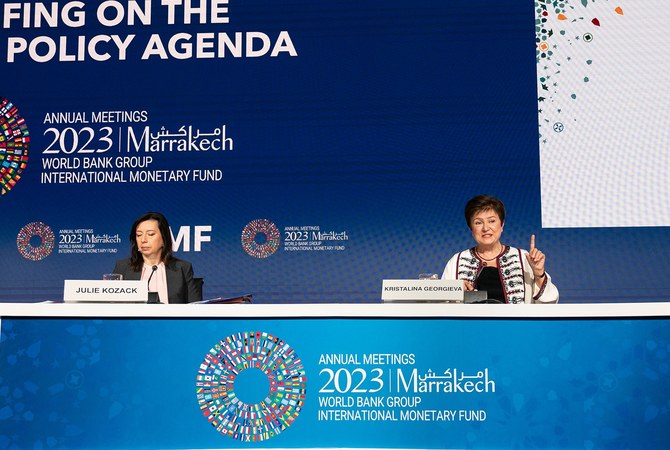
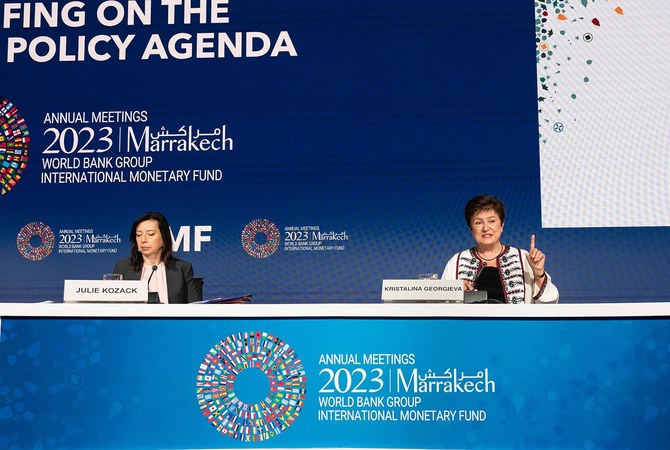
As IMF and World Bank annual meetings in Morocco closed, a statement from IMF’s steering committee chair called for new quota contributions that would “at least maintain the Fund’s current resource envelope” as $185 billion worth of bilateral borrowing arrangements expire. Photo/IMF
Short Url
Updated 15 October 2023
Follow

IMF closes Morocco meetings without consensus on funding terms, conflict language 

MARRAKECH: International Monetary Fund countries on Saturday failed to agree on a US-backed plan to boost IMF funding without giving more shares to China and other big emerging markets, but pledged a “meaningful increase” in lending resources by year-end. 

As IMF and World Bank annual meetings in Morocco closed, a statement from IMF’s steering committee chair called for new quota contributions that would “at least maintain the Fund’s current resource envelope” as $185 billion worth of bilateral borrowing arrangements expire. 

Quotas, contributed by member countries in proportion to their shareholding, make up only about 40 percent of the IMF’s roughly $1 trillion in lending firepower, and the Fund says a larger proportion of quotas would provide more lending certainty as economic shocks grow. 

CHINA PUSHBACK 

The US Treasury plan for countries to contribute new quota funds in proportion to their current shareholdings — unchanged since 2010 — had won support from G7 countries, India and a number of other emerging markets. 

China, whose economy is now three times the size it was in 2010, continued to push for more IMF shares. People’s Bank of China Governor Pan Gongsheng said in a statement to the IMFC meeting that Beijing wanted both a quota increase and a realignment of shares “to reflect members’ relative weights in the global economy, and strengthen the voice and representation of emerging markets and developing countries.” 

IMFC members agreed to add a third IMF Executive Board chair to represent African countries, a key sweetener for the US “equi-proportional quota plan. Pan said China supported this move but it was a separate issue from the shareholding formula. 

The IMFC chair’s statement left the door open to a possible adoption of the US money now-shares later plan, noting that “transitional arrangements” may be needed. It also called for the IMF’s Executive Board to propose options for changes to the shareholding formula by June 2025. 

This would accelerate the next five-year review of quotas and meet IMF Managing Director Kristalina Georgieva’s call for a deadline on adjusting its shareholding to preserve its credibility. 

A US Treasury official told reporters that despite no firm agreement, there was good progress on the quota issue, with countries talking through their positions and a deal “increasingly likely” by October. 

WAR CLOUDS 

Forging a deal to boost the IMF’s $1 trillion in lending firepower to enable it to respond to another large-scale economic crisis was one of the biggest tasks for Georgieva at the meetings in the desert tourist hub of Marrakech overshadowed somewhat. 

The IMFC’s chair, Spanish Economy Minister Nadia Calvino, said members were again unable to reach consensus on a joint communique amid disagreements over conflict language, despite many member countries condemning both Russia’s invasion of Ukraine and the killing of civilians in both Israel and Gaza. 

But the week was overshadowed by the growing conflict between Israel and Gaza, and Georgieva closed the event with an ominous warning that it was adding to global economic uncertainty. 

“I can say the shock people have felt, it came in our meetings,” Georgieva said, noting that these sentiments shifted from attacks on “innocent civilians” in Israel to "the necessity to now find ways to prevent the loss of civilian lives in Gaza.” 

“What we see, of course, is a recognition that this is yet another source of uncertainty,” she said, adding that much would depend on its scope and duration. 

The World Bank’s governing body also was unable to issue a joint communique, though it noted in a statement Development Committee Chair UAE that “most members” supported G20 leaders’ language on the war in Ukraine. 

The Development Committee formally endorsed the World Bank’s new vision “to create a world free of poverty on a livable planet,” aimed at expanding its mission to climate change, pandemics, fragile states and other global challenges. 


Saudi Arabia announces mining surprises beyond traditional belts, adding to estimated $2.4tn in mineral wealth

Updated 7 sec ago
Follow

Saudi Arabia announces mining surprises beyond traditional belts, adding to estimated $2.4tn in mineral wealth

RIYADH: Leading mining companies have announced that Saudi Arabia’s mining wealth has exceeded previous estimates of SR9 trillion ($2.4 trillion), following the results of geological and geophysical surveys of the Arabian Shield, Khalid Al-Mudaifer, vice minister of industry and mineral resources for mining affairs, told Al Eqtisadiah.

Al-Mudaifer said companies revealed significant surprises, including the discovery of mineral sites in areas not previously expected, outside the scope of the traditional mineralized belts.

He added: “Current estimates of the Kingdom’s mineral wealth point to SR9 trillion, with actual figures potentially higher, in light of the results of the Arabian Shield survey, which was completed in full for the first time at what are considered among the most precise levels globally, with investments of SR1 billion and integrated databases made available to investors.”

The estimated value of Saudi Arabia’s mineral wealth has risen by 90 percent to around SR9.375 trillion, compared with estimates announced in 2016 of SR5 trillion.

This increase reflects additional quantities from discoveries of rare earth elements and transition metals, as well as significant gains in phosphate ore and other minerals, including copper, zinc, and gold. It also includes a reassessment of fair market values.

Surprises beyond traditional belts

Al-Mudaifer said the survey results revealed important surprises, notably the discovery of mineral sites in areas not previously anticipated, outside the traditional mineralized belts of the Arabian Shield, which covers around 600,000 sq. km, as well as surrounding areas spanning about 700,000 sq. km.

New finds in the sedimentary cover

He noted that the Kingdom’s sedimentary strata contain important minerals such as phosphate and bauxite, in addition to discoveries currently under development.

He confirmed that survey work will continue periodically every three to five years, given the significant advances in data and information.

He noted that the International Mining and Resources Conference achieved significant and unprecedented global success, noting that one of its key pillars was the ministerial meeting attended by 100 countries, 70 percent of which were represented by ministers or deputy ministers — a level of representation unmatched globally, except for the previous edition, which saw participation from 89 countries.

He explained that the conference is not limited to governments, but also brings together leading global businesspeople, international trade organizations, and global institutions such as the World Bank, the UN, and UNIDO, alongside organizations concerned with the environment and the protection of local communities, to shape the future of minerals and draw up sector policies.

Mineral-consuming companies at the heart of supply chains

Al-Mudaifer revealed that the fifth edition of the International Mining Conference has expanded its platform to include mineral-consuming companies, technology firms, the automotive sector, and finance — core elements of the event.

This is particularly relevant for companies with clear demand visibility and technical specifications amid growing challenges in global supply chains.

He pointed out that direct meetings between producers, manufacturers, and consumers open the door to strategic deals in industries such as electric vehicles, batteries, aircraft, and advanced technologies.

Financing remains a global mining challenge

On the global mining strategy developed in partnership with the World Bank, Al-Mudaifer said the biggest challenge facing the sector since its inception is financing, as global mining investments require more than $4 trillion, while the combined market value of the world’s top 20 mining firms does not exceed $1 trillion.

He added that mining-related infrastructure requires financing of more than $1 trillion to $2 trillion in many countries, stressing that the World Bank, alongside institutions such as the International Finance Corp. and investment funds, represents a key tool to address this challenge, particularly for cross-border infrastructure projects.

Global competition for critical minerals

Al-Mudaifer said the world is witnessing growing competition over critical and strategic minerals such as copper, lithium, cobalt, and rare earth elements, noting that naming the conference “Future Minerals” reflects this global shift.

He added that Saudi Arabia has begun strategic investments in this area, supported by international agreements and partnerships with global companies, including MP Materials, to build a Saudi supply chain based on local resources.

He said the Jabal Sayid site ranks among the world’s top four resources for rare earth elements, noting that the project will form a cornerstone in meeting Saudi Arabia’s needs for these minerals in magnet manufacturing, EVs, and wind energy, while also supporting global supplies, including the US market.