

Griffiths: Situation in Gaza Strip ‘fast becoming untenable’

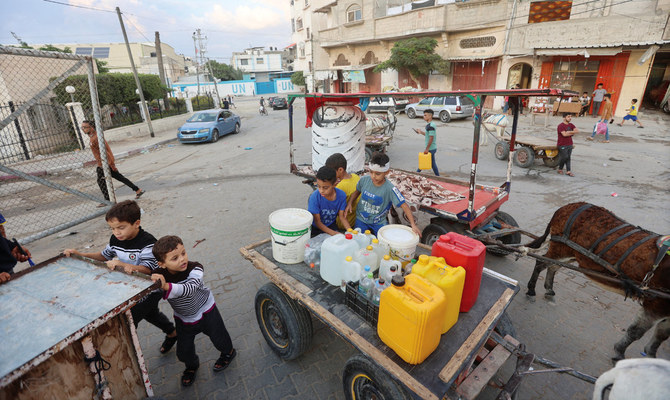
Children collect water in Khan Younis in the southern Gaza Strip on Saturday. Drinking water was in short supply amid an unrelenting bombardment. (Reuters)
Short Url
Updated 14 October 2023
Follow

Griffiths: Situation in Gaza Strip ‘fast becoming untenable’

  • The UN humanitarian office appealed on Friday for nearly $294 million to help some 1.3 million people in Gaza and the West Bank, nearly half for food aid as supplies run out

NEW YORK: The humanitarian situation in Gaza, already critical, is now “fast becoming untenable,” UN aid chief Martin Griffiths said in a statement.

There is no power, water or fuel in Gaza, and food is running dangerously low, Griffiths said, urging all countries with influence to use it to ensure respect for the rules of war, and avoid further escalation.

The actions and rhetoric by Hamas and Israel in the past few days is “extremely alarming, unacceptable,” Griffiths said.

Civilians and civilian infrastructure must protected, he said.

In Gaza, families have been bombed while inching their way south along congested, damaged roads following an evacuation order by Israel that left hundreds of thousands of people scrambling for safety but with nowhere to go, Griffiths said.

Even wars have rules, and these rules must be upheld at all times and by all sides, he said.

“Civilians must be allowed to leave for safer areas. And whether they move or stay, constant care must be taken to spare them,” Griffiths said.

He said anyone captive must be treated humanely, and all hostages must be released.

“Civilians in Israel and the Occupied Palestinian Territory are suffering from a week of utter anguish and devastation,” Griffiths said. “I fear that the worst is yet to come.”

“The past week has been a test for humanity,” he said, “and humanity is failing.”

The European Commission said it was tripling its current humanitarian assistance for Gaza to €75 million ($78.8 million) and would work with UN agencies to ensure the aid reaches those in need.

“The commission supports Israel’s right to defend itself against the Hamas terrorists, in full respect of international humanitarian law,” the EU executive said in a statement.

“We are working hard to ensure that innocent civilians in Gaza are provided support in this context.”

The EU decided earlier this week to maintain aid to Palestinians, backtracking after a commissioner said the European Commission was putting all its development aid for Palestinians, worth €691 million, under review.

The UN humanitarian office appealed on Friday for nearly $294 million to help some 1.3 million people in Gaza and the West Bank, nearly half for food aid as supplies run out.


Libya’s security authorities free more than 200 migrants from ‘secret prison’, two security sources say

Updated 6 sec ago
Follow

Libya’s security authorities free more than 200 migrants from ‘secret prison’, two security sources say

BENGHAZI: Libya’s security authorities have freed more than 200 migrants from what they described as a secret prison in the town of Kufra in the southeast of the country after they ​were held captive in inhuman conditions, two security sources from the city told Reuters on Sunday.
The security sources, speaking on condition of anonymity, said that the security authorities had found an underground prison, nearly three meters deep, which the sources said was run by a Libyan human trafficker.
One of the sources said this person had not yet been detained.
“Some of the freed migrants were ‌held captive up ‌to two years in the underground cells,” ‌this ⁠source ​said.
The ‌other source said what the operation had found was “one of the most serious crimes against humanity that has been uncovered in the region.”
“The operation resulted in a raid on a secret prison within the city, where several inhumane underground detention cells were uncovered,” one of the sources added.
The freed migrants are from sub-Saharan Africa, mainly from Somalia ⁠and Eritrea, including women and children, the sources said. Kufra lies in eastern Libya, ‌about 1,700 kilometers (1,000 miles) from the capital ‍Tripoli.
Libya has become a transit ‍route for migrants fleeing conflict and poverty to Europe via dangerous ‍routes across the desert and over the Mediterranean since the toppling of Muammar Qaddafi in a NATO-backed uprising in 2011.
The oil-based Libyan economy is also a draw for impoverished migrants seeking work, but security throughout the ​sprawling country is poor, leaving migrants vulnerable to abuses.
At least 21 bodies of migrants were found in a ⁠mass grave in eastern Libya last week, with up to 10 survivors in the group bearing signs of having been tortured before they were freed from captivity, two security sources told Reuters.
Libya’s attorney general said in a statement on Friday the authorities in the east of the country had referred a defendant to the court for trial in connection with the mass grave on charges of “committing serious violations against migrants.”
In February last year, 39 bodies of migrants were recovered from about 55 mass graves in Kufra. The town houses ‌tens of thousands of Sudanese refugees who fled the conflict that erupted in Sudan in 2023.