

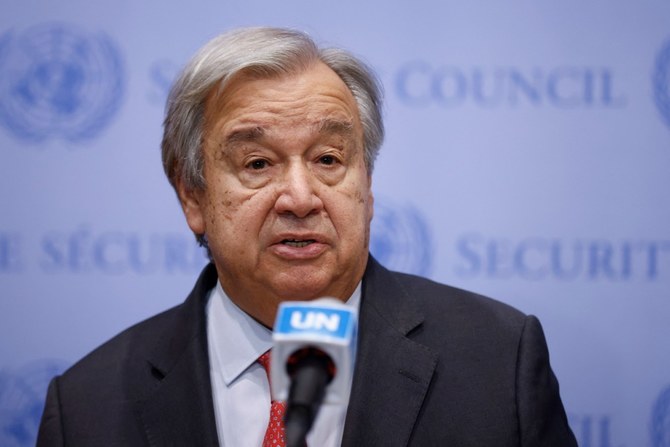

NEW YORK CITY: UN Secretary-General Antonio Guterres on Friday said that moving more than 1 million Palestinians through an overcrowded war zone that is under blockade to an area that is short of food, water and shelter would be “extremely dangerous and simply not possible.” He stopped short of calling on Israel to halt its assault on the besieged territory but said “even wars have rules.”
Humanitarian agencies have called on Israel to withdraw its ultimatum, delivered on Friday, in which it told more than 1.2 million Palestinians to relocate from northern Gaza to the south of the territory within 24 hours, denouncing it as the collective punishment of civilians, including women, children and the elderly, which is illegal under international law.
UN experts also condemned the evacuation order. Paula Gaviria Betancur, a UN special rapporteur on the human rights of internally displaced persons, said: “Forcible population transfers constitute a crime against humanity, and collective punishment is prohibited under international humanitarian law.”
Guterres called for immediate humanitarian access to all of Gaza to be granted so that food, water and fuel can reach those most in need.
“Even wars have rules,” he said ahead of a UN Security Council meeting to discuss the situation in Gaza. He urged all those involved in the conflict to respect the principles of international humanitarian and human rights law, including the requirement that “civilians must be protected and also never used as shields.”
He called for all hostages being held by Hamas to be released immediately and added: “It is imperative that all parties, and those with influence over them, do everything possible to achieve these steps.”
The closed meeting of the Security Council was called by Brazil, which holds the rotating presidency of the council this month, and the UAE. Chaired by the Brazilian minister of foreign affairs, Mauro Vieira, the meeting aimed to “address the situation in” Gaza, including the possibility of establishing a humanitarian corridor.
The World Health Organization has called for such a corridor, given that “hospitals cannot run without fuel, without electricity.”
Gaza’s power plant has run out of fuel and the UN office of humanitarian affairs has warned that “a severe shortage of drinking water is affecting more than 650,000 people.”
Before the meeting, the UK’s permanent representative to the UN, Barbara Woodward, sent her condolences to “everybody who’s been affected” by the conflict, while “unequivocally condemning Hamas (for its) acts of terrorism.” The group does not “speak for the Palestinian people,” she added, and called on her fellow council members to “do all they can to secure the release of the hostages.”
Asked whether she would call on Israel to halt its attack on Gaza, Woodward said her country “is absolutely clear that actions need to take place in line with international humanitarian law. And when my prime minister discussed the situation with (Israeli) Prime Minister (Benjamin) Netanyahu, he urged him to look for the protection of civilians in all of the follow-up actions that have taken place.”


