A ‘new front’ in Hamas war depends on Israel’s actions, says Iran

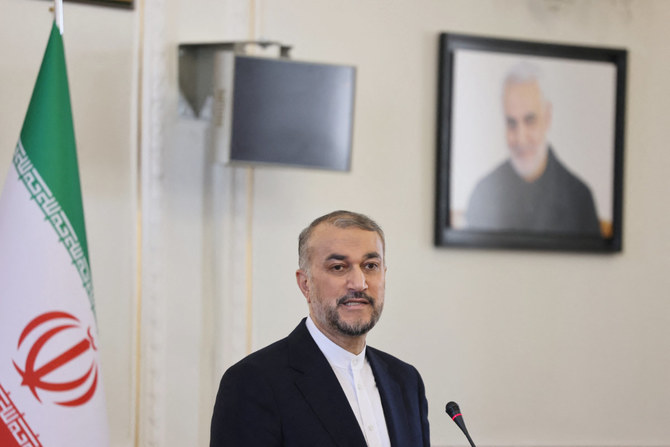
Iran's Foreign Minister Hossein Amir-Abdollahia on Thursday warned that his country’s regional allies, known as the “axis of resistance,” could respond if Israel’s Gaza offensive escalates. (AFP)
Short Url
Updated 13 October 2023
Follow

A ‘new front’ in Hamas war depends on Israel’s actions, says Iran

  • Iran's FM on Thursday said officials of some countries have asked Tehran about the possibility of a new front being opened against Israel
  • FM Hossein Amir-Abdollahian spoke before meeting with Hezbollah, Hamas and other pro-Iran groups in Beirut, Lebanon

BAGHDAD: Iran’s foreign minister, whose government supports Hamas and other Middle East militant groups, said on Thursday opening a “new front” against Israel would depend on Israel’s actions in Gaza.

Although Tehran has been a long-term backer of Hamas, Iranian officials have been adamant that the country had no involvement in the militants’ attack against its arch enemy Israel on Saturday.
Nevertheless, the United States fears the opening of a second front on Israel’s northern border with Lebanon if Hezbollah, another heavily armed Islamist group backed by Iran, were to intervene.
“Officials of some countries contact us and ask about the possibility of a new front (against Israel) being opened in the region,” said Foreign Minister Hossein Amir-Abdollahian during a meeting with Iraqi Prime Minister Mohammed Shia Al-Sudani.
“We tell them that our clear answer regarding future possibilities is that everything depends on the actions of the Zionist regime in Gaza,” he said, according to a statement from the Iranian foreign ministry.
“Even now, Israel’s crimes continue and no one in the region asks us for permission to open new fronts.”
Later on Thursday, Abdollahian arrived in the Lebanese capital Beirut, where he was received by Hezbollah and Hamas among other pro-Iran groups.
He is scheduled to meet Lebanese officials on Friday before heading to Damascus.
Speaking from Beirut’s airport, the top diplomat said that Iran’s regional allies, known as the “axis of resistance,” could respond if Israel’s Gaza offensive escalates.
“The continuation of war crimes against Palestinians and Gaza will receive a response from the rest of the axes,” he told reporters.
At least 1,200 Israelis, foreigners and dual citizens were killed by Hamas militants during its attack on Saturday.
In Gaza, health officials reported 1,417 Palestinians killed by Israel’s retaliatory barrages against the coastal enclave.
The West has been cautious about Iran since Saturday, but its leaders have warned Tehran in no uncertain terms against intervening in the war.
US President Joe Biden said on Wednesday that he had “made it clear to the Iranians: Be careful.”
After Iraq, Amir-Abdollahian will travel to Lebanon, where Hezbollah has, so far, been content to hold back from joining the war triggered by its ally Hamas.
In a call with his Syrian counterpart Bashar Assad, Iranian President Ebrahim Raisi on Wednesday appealed to “all the Islamic and Arab countries” to “reach serious convergence and cooperation on the path of stopping the crimes of the Zionist regime against the oppressed Palestinian nation.”


Lebanon president accuses Hezbollah of working to ‘collapse’ state

Updated 7 sec ago
Follow

Lebanon president accuses Hezbollah of working to ‘collapse’ state

  • Joseph Aoun: ‘Whoever launched those missiles wanted to bring about the collapse of the Lebanese state’
  • Ahmed Al-Sharaa: ‘We stand alongside Lebanese president Joseph Aoun in disarming Hezbollah’
BEIRUT, Lebanon: Lebanese President Joseph Aoun on Monday accused Hezbollah of working to “collapse” the state and expressed Beirut’s readiness for “direct negotiations” with Israel, drawing the backing of his Syrian counterpart for his goal of disarming the Iran-backed group.
Lashing out at Hezbollah over its March 2 attack against Israel, which has drawn a devastating Israeli retaliation, Aoun told European officials “Whoever launched those missiles wanted to bring about the collapse of the Lebanese state, plunging it into aggression and chaos... all for the sake of the Iranian regime’s calculations.”
To stop the war, the Lebanese president proposed a four-point initiative and called on the international community to help implement it.
The plan included “establishing a full truce” with Israel, “logistical support” for the army to disarm Hezbollah, and “direct negotiations (with Israel) under international auspices.”
Syrian President Ahmed Al-Sharaa endorsed his Lebanese counterpart on Monday saying, “We stand alongside Lebanese president Joseph Aoun in disarming Hezbollah.”
The statements came as the war between Israel and Hezbollah pushed into a second week, with Israel carrying out heavy strikes on a financial firm linked to the group.
Lebanon was drawn into the Middle East war last week when Iran-backed Hezbollah attacked Israel in response to the killing of Iranian supreme leader Ayatollah Ali Khamenei in US-Israeli strikes.
Lebanese authorities said on Monday that Israel’s attacks since March 2 have killed at least 486 people and wounded at least 1,313.
AFP has not been able to carry out a detailed breakdown of the figures.
According to the government, more than 660,000 people have registered as displaced, with 120,000 sleeping at official shelters as of Monday.

Evacuation warnings

Israel said it killed the head of Hezbollah’s Nasr unit operating in part of southern Lebanon, Abu Hussein Ragheb, on Monday.
Earlier, the Israeli military struck branches of Al-Qard Al-Hassan, a US-sanctioned financial firm, after issuing evacuation warnings, according to Lebanese state media and AFP correspondents.
The Israeli army said it was “striking Hezbollah infrastructure” in the southern suburbs.
An AFP photographer in the area witnessed a massive explosion, while an armed Hezbollah member fired warning shots into the air to encourage residents to evacuate from their homes.
The Israeli army renewed previous orders for people in the area to leave.
Al-Qard Al-Hassan is a lifeline for mainly Shia Muslim communities battling a years-long financial crisis in Lebanon that has locked people out of their bank deposits.
It says it has more than 30 branches nationwide, mainly in Hezbollah bastions such as Beirut’s southern suburbs, but also in central Beirut and other major cities.
In Lebanon’s southern city of Sidon, an area outside of Hezbollah’s traditional sphere of influence, an AFP correspondent saw ambulances and civil defense vehicles gather around a branch of Al-Qard Al-Hassan.
Israel also bombed the firm’s branches during its last war with Hezbollah in 2024, including the one in Sidon.
Israeli tank fire killed a priest in the Christian southern Lebanese town of Al-Qlayaa, according to state media and a medical source.

‘Path of allegiance’

Hezbollah on Monday celebrated the selection of Mojtaba Khamenei as Iran’s new supreme leader.
“We renew our pledge of loyalty to this blessed approach and our steadfastness on the path of allegiance,” the group said in a statement.
It also claimed responsibility for at least 10 previous attacks against Israel and its forces, including against troops advancing into Lebanese border towns, as well as a missile salvo on an air base in Haifa.
It said it targeted the Israeli Home Front Command base in Ramla, near Tel Aviv, with “advanced missiles.”
Earlier Monday, it also said it had fought Israeli troops who landed in eastern Lebanon by helicopter, the second such incident since the latest war began.
Israeli strikes on sites belonging to the Hezbollah-linked Islamic Health Committee in the Tyre and Jwaya areas in south Lebanon killed two paramedics and wounded six, the health ministry said, accusing Israel of “systematic targeting of rescue teams.”
Despite the bombing in Beirut, Lebanon’s parliament met on Monday and postponed legislative elections by two years due to the conflict.
The polls had been scheduled to take place in May.