Saudi fintech sector gets boost as 5 MoUs inked at Financial Academy Forum

These agreements aimed to facilitate advanced research, executive courses, and collaborative efforts to support entrepreneurs through guidance and digital training in open finance. SPA
Short Url
Updated 12 October 2023
Follow

Saudi fintech sector gets boost as 5 MoUs inked at Financial Academy Forum

RIYADH: Aimed at delivering essential training programs to the financial sector, the second edition of the Financial Academy Forum, held in Riyadh on Wednesday, witnessed the signing of five memorandums of understanding.  

These agreements aimed to facilitate advanced research, executive courses, and collaborative efforts to support entrepreneurs through guidance and digital training in open finance. 

Speaking at the forum, Mana bin Mohammad Al-Khamsan, the CEO of the Financial Academy, highlighted the institute’s commitment to delivering a unique training experience tailored to the needs of the fintech sector through these MOUs.  

By partnering with industry leaders, he added that the academy aims to elevate professional excellence within the broader financial sector. 

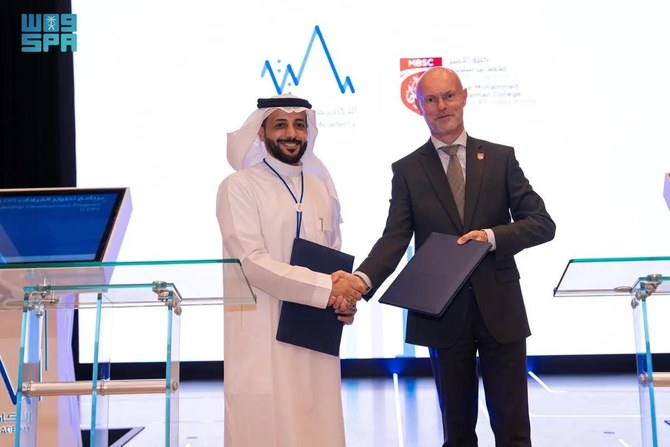
The signatory parties included agreements with the Saudi Governance Center and Prince Mohammed Bin Salman College of Business and Entrepreneurship. Additionally, the ZISHI Group for Financial Learning & Professional Development and Ozone API, an open finance company, were also part of the signatory group. 

Saudi Arabia’s 2030 goals, as outlined in the National Fintech Strategy, target creating 525 companies, 18,000 jobs, and a SR13.3 billion ($3.55 billion) direct gross domestic product contribution.  

To pave the way for these objectives, the Saudi Central Bank’s annual fintech report has established benchmark milestones for 2025. This includes 230 operational tech companies in the Kingdom’s financial service sector and SR2.6 billion in venture capital investments. 

In 2023, the fintech sector experienced significant growth, doubling its number of players to 200 firms compared to the 89 present in 2022, according to Ayman Al-Sayari, the governor of the Saudi Central Bank, as reported last month. 


BYD Americas CEO hails Middle East as ‘homeland for innovation’

Updated 21 January 2026
Follow

BYD Americas CEO hails Middle East as ‘homeland for innovation’

  • In an interview on the sidelines of Davos, Stella Li highlighted the region’s openness to new technologies and opportunities for growth

DAVOS: BYD Americas CEO Stella Li described the Middle East as a “homeland for innovation” during an interview with Arab News on the sidelines of the World Economic Forum.

The executive of the Chinese electric vehicle giant highlighted the region’s openness to new technologies and opportunities for growth.

“The people (are) very open. And then from the government, from everybody there, they are open to enjoy the technology,” she said.

BYD has accelerated its expansion of battery electric vehicles and plug-in hybrids across the Middle East and North Africa region, with a strong focus on Gulf Cooperation Council countries like the UAE and Saudi Arabia.

GCC EV markets, led by the UAE and Saudi Arabia, rank among the world’s fastest-growing. Saudi Arabia’s Public Investment Fund has been aggressively investing in the EV sector, backing Lucid Motors, launching its brand Ceer, and supporting charging infrastructure development.

However, EVs still account for just over 1 percent of total car sales, as high costs, limited charging infrastructure, and extreme weather remain challenges.

In summer 2025, BYD announced it was aiming to triple its Saudi footprint following Tesla’s entry, targeting 5,000 EV sales and 10 showrooms by late 2026.

“We commit a lot of investment there (in the region),” Li noted, adding that the company is building a robust dealer network and introducing cutting-edge technology.

Discussing growth plans, she envisioned Saudi Arabia and the wider Middle East as a potential “dreamland” for innovation — what she described as a regional “Silicon Valley.” 

Talking about the EV ambitions of the Saudi government, she said: “If they set up (a) target, they will make (it) happen. Then they need a technology company like us to support their … 2030 Vision.”