Pakistan cabinet greenlights much-anticipated 5G spectrum auction

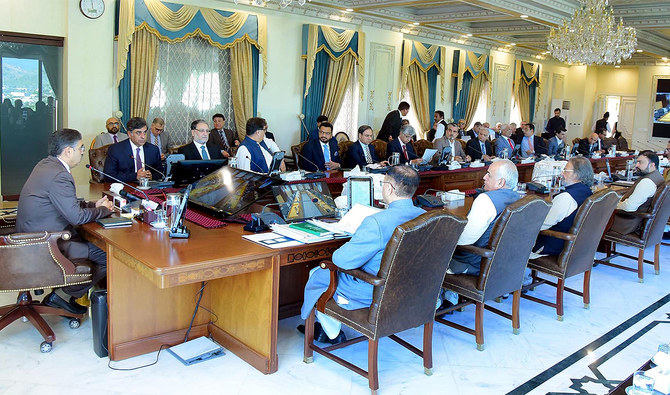
Pakistan's caretaker Prime Minister Anwaar-ul-Haq Kakar (left) chairs a cabinet meeting in Islamabad, Pakistan, on October 11, 2023. (PID/File)
Short Url
Updated 12 October 2023
Follow

Pakistan cabinet greenlights much-anticipated 5G spectrum auction

  • Pakistan establishes advisory committee led by finance minister to oversee auction 
  • IT minister says 5G spectrum can ‘revolutionize’ Pakistan’s telecommunications landscape

ISLAMABAD: Pakistan’s federal cabinet has given the green signal for the much-anticipated auction of 5G spectrum services in the country, a report in the state-run Associated Press of Pakistan (APP) said this week. 

Caretaker IT Minister Dr. Umar Saif told Arab News in September that Pakistan would carry out a 5G auction to bring fresh investment into the country in the coming months. The use of 5G entails faster video streaming and Internet downloads for mobile users. 

Pakistan last completed the auction for 3G and the more advanced 4G network— the first of its kind in the country— in April 2014. 

“Caretaker Federal Minister for Information Technology and Telecommunication Dr. Umar Saif Wednesday said that the Federal Cabinet has given the green signal for the auction of the much-anticipated 5G spectrum,” APP said. 

Saif said a Spectrum Auction Advisory Committee, led by Pakistan’s finance minister, had been established to oversee the impending spectrum auction. The report quoted Saif as saying that the committee includes members from Pakistan’s IT, telecommunication, industries and production ministries. 

“The eagerly awaited 5G spectrum is set to make 300 Megahertz of spectrum available, with the potential to revolutionize Pakistan’s telecommunications landscape,” the report quoted Saif as saying. 

The IT minister said a consultant would “soon” be appointed through the Pakistan Telecommunication Authority (PTA) to ensure an efficient spectrum auction process.

 Pakistan has 194 million cellphone users in the country, according to official figures. By 2023, the mobile industry’s economic contribution in Pakistan is estimated to reach $24 billion, global non-profit organization GSMA estimated in 2021. 


China backs Pakistan in fight against militancy after deadly Balochistan attacks

Updated 03 February 2026
Follow

China backs Pakistan in fight against militancy after deadly Balochistan attacks

  • China is a major ally and investor in Pakistan and has pledged over $65 billion in major infrastructure projects, including in Balochistan
  • Chinese Foreign Ministry spokesperson Lin Jian says ‘we mourn for lives lost, and our hearts go out to injured and those who lost loved ones’

ISLAMABAD: China condemns the recent attacks that killed more than 200 people in Pakistan’s southwestern Balochistan province, a Chinese foreign ministry spokesperson said on Tuesday, reaffirming Beijing’s support for Pakistan in its fight against militancy.

The Baloch Liberation Army (BLA) group launched coordinated attacks in several cities across Balochistan on Saturday, killing 33 civilians and 17 security personnel. Officials said 117 militants were killed in skirmishes and follow-up operations.

Balochistan, which borders Iran and Afghanistan, is the site of a decades-long insurgency waged by Baloch separatist groups who often attack security forces, foreigners and non-local Pakistanis and kidnap government officials.

China is a major ally and investor in Pakistan and has pledged over $65 billion in investment in road, infrastructure and development projects under the China-Pakistan Economic Corridor (CPEC).

“China strongly condemns the [Balochistan] attacks... We mourn for the lives lost, and our hearts go out to the injured and those who lost their loved ones,” Chinese Foreign Ministry spokesperson Lin Jian said at a press briefing on Tuesday.

“China firmly opposes any form of terrorism and will as always firmly support Pakistan in combating terrorism, maintaining solidarity and social stability, and protecting the safety of the people.”

Chinese nationals working in Pakistan have often been targeted by militants, particularly in the southwestern Balochistan province, where China is developing a deep seaport that is touted as the crown jewel of CPEC.

Interior Minister Mohsin Naqvi said last week the attacks, claimed by the separatist Baloch Liberation Army (BLA), were planned from India. New Delhi rejected the allegation as “baseless,” saying Islamabad was attempting to deflect attention from its internal challenges.

Balochistan is home to vast reserves of minerals and hydrocarbons. Separatist militant groups such as the BLA blame Islamabad for exploiting Balochistan’s natural resources and denying locals a share in them. The military and civilian government reject these allegations and say they are investing in the province’s development.