After four years in exile, Pakistan’s ex-PM Nawaz Sharif begins journey home via Saudi Arabia

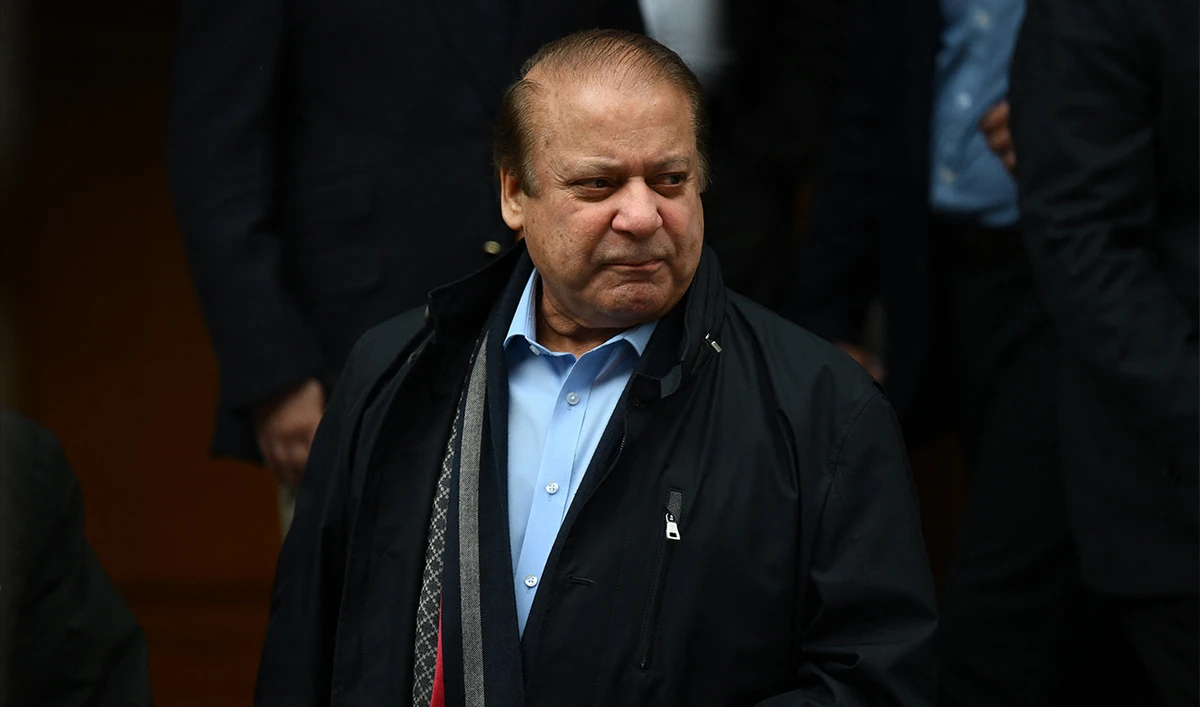
Pakistan's former Prime Minister Nawaz Sharif, brother of Pakistan's current Prime Minister Shehbaz Sharif, leaves from a property in west London on May 11, 2022. (AFP/File)
Short Url
Updated 12 October 2023
Follow

After four years in exile, Pakistan’s ex-PM Nawaz Sharif begins journey home via Saudi Arabia

  • Sharif left Pakistan in 2019 in an air ambulance to seek medical treatment in London, has since lived there in self-imposed exile
  • Sharif’s third term as PM ran from 2013 to 2017 when he was removed by the court amid revelations over his personal wealth

ISLAMABAD: Former prime minister and head of the Pakistan Muslim League-Nawaz (PML-N) party, Nawaz Sharif, left London for Pakistan via Saudi Arabia and Dubai, making the journey back home after four years of self-imposed exile.

The three-time former PM left Pakistan in November 2019 in an air ambulance to seek medical treatment in London, a month after he was released on bail from a seven-year prison sentence for corruption.

Sharif’s third term as prime minister ran from 2013 to 2017, when he was removed by the Supreme Court amid revelations over his personal wealth and subsequently convicted of corruption. Sharif has consistently denied the accusations, claiming they were politically motivated and blaming the country’s generals for directing the judges to bring him down. The military denies interfering in politics.

Sharif was only allowed to leave for medical treatment on Nov 19, 2019, after agreeing to a series of conditions preventing him seeking exile. Under the court’s terms, Sharif had to return in four weeks if his doctors found him fit, and he was required to submit medical reports notarized by Pakistan’s embassy in London. Sharif has since lived in London in self-imposed exile.

“The PML-N supremo will … stay in the kingdom [Saudi Arabia] for a week during which he will hold important meetings. He will arrive in Dubai on October 17,” Geo News reported. “The flight carrying Nawaz to Pakistan will have the name “Umeed-e-Pakistan” (Pakistan’s Hope), which can carry approximately 150 passengers.”

He is scheduled to leave Dubai for Pakistan on October 21.

PML-N senior leader Ishaq Dar said there was “no chance” of Sharif being arrested on his return to Pakistan, adding that he would obtain transit and protective bails.

“Nawaz Sharif will follow the standard legal procedures,” Dar, a former finance minister, told reporters.

Sharif has been a central figure in Pakistan’s turbulent politics for three decades, repeatedly clashing with the powerful military.

In 1999, Sharif was overthrown by a military coup that brought army chief General Pervez Musharraf to power. Sharif subsequently went into exile in Saudi Arabia, before returning to Pakistan in 2007 as Musharraf’s grip on power began to slip.

Pakistan seeks operationalization of World Bank’s $20 billion framework to advance reform priorities

Updated 5 sec ago
Follow

Pakistan seeks operationalization of World Bank’s $20 billion framework to advance reform priorities

  • Pakistan’s finance chief meets World Bank Country Director Bolormaa Amgaabazar in the capital
  • The Bank’s 10-year Country Partnership Agreement for Pakistan was approved in January last year

ISLAMABAD: Pakistan’s Finance Minister Muhammad Aurangzeb on Wednesday called for the operationalization of the World Bank Country Partnership Framework (CPF) to advance the government’s key reform priorities during a meeting with the Bank’s country director, according to a statement.

The Bank’s Board of Directors approved a 10-year CPF deal with Pakistan, indicating $20 billion in financing for Pakistan under the framework. The amount will include public and private financing from the World Bank Group, with roughly half expected to come from private-sector operations led by the International Finance Corporation (IFC).

“The Finance Minister emphasized the importance of effective operationalization of the CPF, particularly in priority areas such as population management and climate change,” the finance ministry said in a statement after Aurangzeb’s meeting with the Bank’s Country Director Bolormaa Amgaabazar.

“He underscored the need for strong coordination between federal and provincial governments to ensure coherence in policy design and implementation.”

Discussions focused on population, human capital development, climate resilience, agricultural reform and energy sector sustainability, it added.

The ministry said both sides exchanged views on enhancing institutional coordination, improving transparency in project design and strengthening monitoring mechanisms to deliver intended outcomes. It highlighted that the World Bank expressed readiness to continue supporting agricultural transformation efforts in collaboration with the IFC.

“Both sides agreed to continue technical-level engagements to explore feasible solutions in line with Pakistan’s reform agenda and fiscal framework,” the finance ministry added.

Climate resilience and population control are major concerns for policymakers in Pakistan, a country whose population exceeds 241 million, making it the world’s sixth-most populous country. Limited infrastructure, health care, and educational opportunities place added strain on public services, contributing to unemployment and poverty.

The South Asian nation is also among the countries most affected by climate change. Unusually heavy monsoon rains in 2022 killed more than 1,700 people and caused over $30 billion in damages. Torrential rains and floods since late June last year have claimed more than 1,000 lives, as authorities continue surveys to assess the full extent of the destruction.