

From Marawi to Syria, Filipino nurse answers call of duty in conflict zones

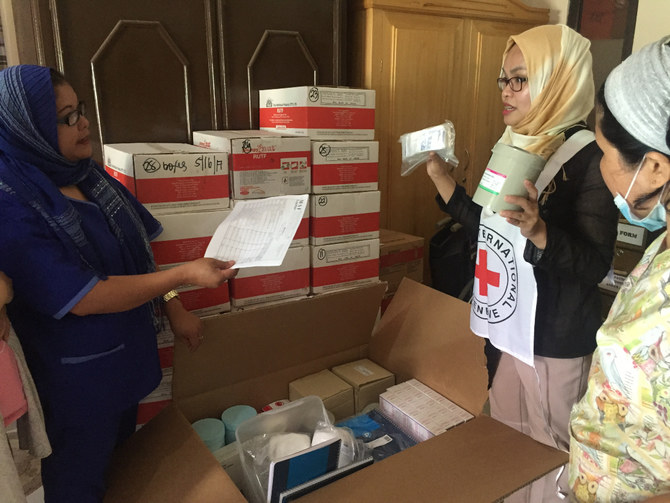
Princess Joy Maulana, right, is seen on duty with the International Committee of the Red Cross during the Marawi crisis in the southern Philippines in 2017. (Supplied)
Short Url
Updated 12 October 2023
Follow

From Marawi to Syria, Filipino nurse answers call of duty in conflict zones

  • Princess Joy Maulana’s first deployment was to Marawi in 2017
  • She is one of 100 Filipinos involved in ICRC relief work globally

MANILA: In 2020, before coronavirus vaccines were released and travel came to a standstill, Princess Joy Maulana set out on a solitary journey from the Philippines to the Middle East to serve the most vulnerable communities in Syria.

At that time, restrictions and lockdowns were becoming a new normal as the world struggled to contain the impending COVID-19 pandemic. Maulana was sent on a mission to help where the global health crisis was compounded by a different kind of outbreak — of armed violence.

She traveled through the UAE and Lebanon until she reached northeast Syria, where for the next 15 months she would serve as health field officer of the International Committee of the Red Cross, managing primary health care in a place where protracted conflict since 2011 has led to the collapse of basic services.

The main area of duty was a refugee camp in the middle of the desert, where weather conditions were something the Filipina nurse had never experienced before. But Maulana had to keep going — motivated not only by her duty, but also the resilience of those whom she was serving.

“It can be scorching hot during summer or bitingly cold during winter. But I just kept thinking about what the residents of the camp must endure all the time, as some of them still live there,” she told Arab News.

“I wish the world would know the amazing natural hospitality and generosity of Syria’s people, even in the face of adversity. Even under extremely difficult living conditions, Syrians would warmly welcome us into their homes and their tents, and they would offer sweets, qahwa, or tea, even when we have nothing to offer them in terms of assistance.”

Maulana, a Cotabato native who is affectionately known as PJae, joined the ICRC in 2016, after working for years as a pediatric emergency nurse. She is one of 100 Filipinos working for the organization in different parts of the world.

Her first deployment was to Marawi in the southern Philippines, which in 2017 was taken over by groups affiliated with Daesh. After five months of fighting, hundreds of deaths and widespread destruction, the Philippine army reclaimed the city.

Facilitating the evacuation of Marawi residents, listening to their stories, being helpless in the face of individual tragedies somehow made her ready for what she would later continue to face in her line of work, although PJae says that “no one can ever prepare you (for this).”

Even the most crucial assistance that she and other relief workers provide in conflict zones seems less significant to her compared with the scale of tragedies they are addressing: the direct effects of violence on people’s lives.

“Marawi taught me that the painful effects of conflict on the affected people and communities are never acute but last long, or even a lifetime,” she said, recalling “the wounded and sick having no access to hospitals because these hospitals were damaged or inaccessible, families separated from loved ones, not knowing whether they are alive or dead.”

Another major difficulty that PJae has been facing in conflict zones — first in Marawi, then Syria, and most recently South Sudan — is making people understand that relief aid is impartial.

“During times of conflict, people take sides, fighting for one side or the other, no matter the cost. So, when the ICRC tries to access a conflict-affected community that may be perceived as sympathetic to one side of the conflict, in order to provide them with assistance, we may face security risks, which poses a huge challenge to our ability to help those in need,” she said.

“There are also affected communities with no part in the hostilities suffering from lack of access to basic services because nobody could reach them because of the perception of belonging to one side of the conflict.”

PJae is now preparing for her next deployment. In December, she will join ICRC operations in Myanmar.

The assignment means she will again be away from her family and 10-year-old son in the Philippines. But she knows they support her and that they are well and safe — a basic thing that is not a reality for many of the people she has helped.

“I am always profoundly struck by the many things we often take for granted — even as simple as the hug we get from our loved ones. In many conflict-affected communities, the everyday uncertainty of even ever seeing a missing loved one or family is there,” PJae said.

“Luckily, my family understands and supports my job, including my son. He seems happy that I am out there trying to help people in need.”


Troops guard Bangladesh depots as fuel crunch hits Asia

Updated 2 sec ago
Follow

Troops guard Bangladesh depots as fuel crunch hits Asia

  • The oil price spike caused by the war in the Middle East has sparked unrest in Bangladesh and exasperation at petrol pumps around Asia
DHAKA: The oil price spike caused by the war in the Middle East has sparked unrest in Bangladesh and exasperation at petrol pumps around Asia, where many economies are heavily dependent on fossil fuel imports.
Even as governments move to limit the impact on fuel prices, lines have formed at petrol stations in countries including Vietnam, Pakistan and the Philippines, although the situation remains stable elsewhere.
In Bangladesh — which imports 95 percent of its oil and gas needs — the military has been deployed at major oil depots, as police patrol in and around filling stations.
“We haven’t received supply from the depot, but the bike riders weren’t convinced and vandalized the station,” said petrol station worker Ashrafuzzaman Dulal told AFP, describing violence on Sunday.
On Tuesday his station Shahjahan Traders, one of the oldest in the capital Dhaka, had hung a banner apologizing because its stock had run out.
The South Asian nation of 170 million people has started fuel rationing, sent students home and scrapped celebratory light displays over the energy crunch.
One man was killed on Saturday night in the southern Bangladeshi district of Jhenaidah after an altercation over refueling with staff.
Following the 25-year-old’s death, angry crowds torched three buses and vandalized a filling station, police said.
- ‘So, so angry’ -
On Tuesday, queues stretched for 1.5 kilometers (nearly one mile) through Dhaka’s city center.
“My boss left the car here and took a rickshaw to reach his destination,” Kamrul Hasan, who was waiting in a vehicle almost at the end of the queue, told AFP.
Filling station worker Akhtar Hossain said he had not stopped for hours.
“Even during the Gulf War, we didn’t experience this sort of rush,” Hossain told AFP.
Oil prices fell Tuesday after US President Donald Trump said the US-Israel war on Iran could end “very soon.”
The previous day, the price of benchmark crude had rocketed past $100 a barrel — its highest level since Russia’s invasion of Ukraine in 2022.
The market instability came as Iran targeted the crude-rich Gulf with missile and drone barrages.
Maritime traffic in the Strait of Hormuz — a key Gulf waterway through which a fifth of global crude passes — has also all but halted since the war broke out.
Thousands of motorbike riders queued for fuel Tuesday in Vietnam, where prices for unleaded gasoline have surged more than 20 percent.
Vietnam has so far avoided mass shortages, with the government scraping duties on many imported petroleum products.
A 57-year-old who gave his name as Tuan told AFP at a Hanoi petrol station that he was “so, so angry.”
“I have been waiting in line for almost one hour. Then my turn came, and they said their system is down,” he said as dozens of drivers waited but others gave up.
- Myanmar price spike -
Vehicles also lined up in scorching heat at Philippine petrol stations this week, as officials warned against hoarding fuel, with similar scenes unfolding in Pakistan and Sri Lanka.
Enrico Guda, a gas station attendant in Metro Manila, said the station had double its usual daily workload as people rushed to fuel up before prices jumped.
In Myanmar, which imports 90 percent of its fuel oil and has long suffered from a fragile energy supply chain owing to the civil war consuming the country, traffic curbs are in place.
From Saturday, half of private vehicles have been ordered off the roads each day to preserve oil stocks.
“Some drivers depend on their vehicles for work and survival... the new system has made it harder for them to run their businesses,” said Hla Htay, 56, a car rental business owner.
In the Myanmar frontier town of Tachileik, an AFP reporter saw signs cross-border supplies from Thailand had been cut — with some petrol stations shut last week after an up-to threefold price spike the day before.
In several other Asian countries, from Japan to Indonesia, as well as China, India and Afghanistan, panic appears not yet to have hit, apart from a few sporadic queues for petrol.
“I used to fill up regularly once a week, but now I try to fill up whenever I find a cheaper gas station,” South Korean businessman Lee In-tae, 42, told AFP in Seoul.