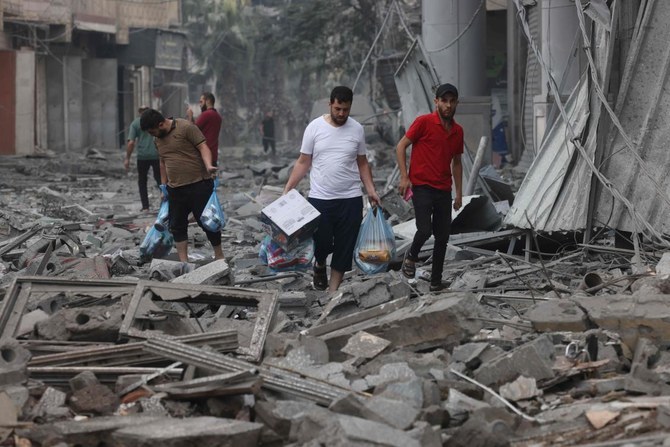

GAZA CITY, Gaza Strip: Collapsed buildings, mangled infrastructure, streets turned into fields of rubble.
Scenes of violence and destruction in the long-blockaded Gaza Strip have filled the world’s airwaves throughout four wars and countless rounds of hostilities between Israel and Hamas militants. But this conflict, Palestinians say, is different.
On Tuesday, following a night of intense bombardment, residents were struggling to grasp the sheer scale of damage inflicted on Gaza City’s upscale Rimal neighborhood, with its shopping malls, restaurants, residential buildings and offices belonging to aid groups and international media far from the territory’s hard-hit border towns and impoverished refugee camps.
Israel has hit Rimal, also home to Hamas government ministries, in the 2021 war, but never like this.
Israeli bombs blew out walls and ripped off roofs of upper-class apartment towers. They toppled trees that had lined the sidewalks. They uprooted streets that had teemed with businessmen hustling to work and vendors hawking roasted nuts. They leveled mosques and university buildings and wrecked high-rise offices of companies and organizations like Gaza’s main telecommunications company and Bar Association.
Among those broad boulevards full of beauty salons, falafel shops and pizzerias beat the heart of Gaza City. For many, the magnitude of the devastation there, affecting the territory’s middle and upper classes, had symbolic significance.
“Israel has destroyed the center of everything,” said Palestinian businessman Ali Al-Hiyak from his home near Rimal. “That is the space of our public life, our community.”
“They are breaking us,” he added.
After Gaza’s Hamas rulers mounted the deadliest attack on Israel in decades, killing over 1,000 people and taking dozens hostage in a multi-pronged offensive, Israel unleashed what Gaza residents described as the most intense bombing campaign in recent memory, with hundreds of airstrikes Monday night.
“These sounds are different,” 30-year-old Saman Ashour in Gaza City texted as she lay awake in a neighborhood north of Rimal, listening to the roar of explosions. “It’s the sound of revenge.”
Residents said the Israeli military struck some buildings without first firing warning missiles as a precaution. The civilian death toll has been rapidly rising. Overall, Gaza health officials have reported the airstrikes have killed over 800 people and wounded thousands more.
Israel has also cut off Gaza’s water supplies and electricity, worsening the territory’s already abysmal humanitarian conditions.
The Israeli military’s Arabic spokesperson, Avichay Adraee, said that Israel was trying to “evacuate civilian populations from areas where Hamas has a military presence” before unleashing “powerful destruction.”
That tactic is evident from staggering drone footage that shows vast swaths of central Gaza City reduced to nothing but dirt craters and ruins from demolished buildings.
But most Palestinian civilians did not evacuate. There are no bomb shelters. Israel and Egypt tightly control the enclave’s borders and have not let anyone out. UN shelters are rapidly filling up.
After the militant group’s unprecedented attack on Israeli civilians and soldiers, which stunned and terrorized a country long seen as invincible, analysts said it was clear the group bet all of its chips no matter the consequences. Israel was now waging a war not to repel
Hamas, like in past rounds, but to destroy it.
“The strategic prospect is to annihilate, destroy and demolish the military capacity of Hamas,” said Kobi Michael, a senior fellow at the Institute for National Security Studies, an Israeli think tank. “Hamas brought this on the heads of the Gazans.”
“If Israel is not aggressive enough,” he added, “that will only drag us to another front and to another conflict.”
But Palestinians in Gaza see the Israeli military’s wrath as collective punishment.
“We’re talking about damage to hospitals that can’t even run without fuel, the total demolition of homes and infrastructure,” said Iyad Bozum, spokesman for Gaza’s Interior Ministry. “At the end of this there will be nothing left to even reconstruct. It will be impossible to live here.”
The strikes on Rimal early Tuesday killed ordinary residents like shopkeepers and local journalists and destroyed dozens of homes.
Issa Abu Salim, 60, was seething as he stood amid the debris of his home, his clothes filthy with the dust of the destruction.
“Our money is gone. My identity cards are lost. The entire house, all four floors, is lost,” he said. “The most beautiful area, they destroyed it.”