Pakistan calls Israel-Palestine dispute ‘war between oppressor and oppressed’ amid continuing Gaza airstrikes

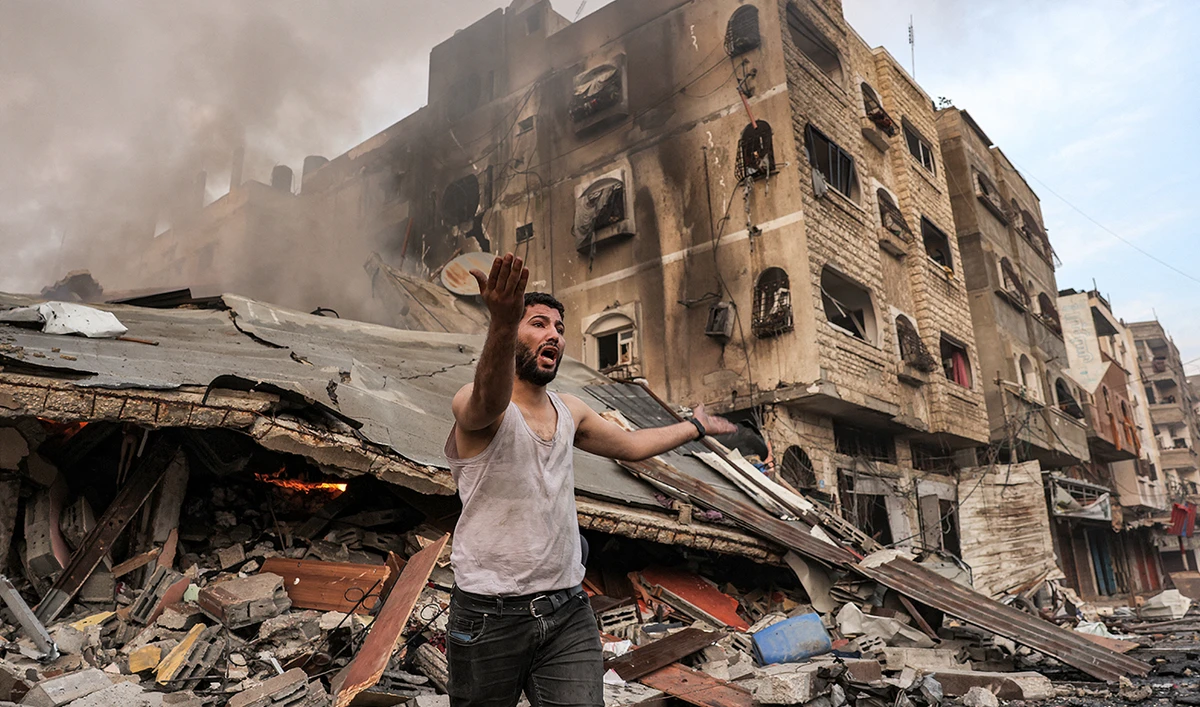
A man reacts outside a burning collapsed building following Israeli bombardment in Gaza City on October 11, 2023. At least 30 people have been killed and hundreds wounded as Israel pounded the Gaza Strip with hundreds of air strikes overnight, a Hamas government official said on October 11. (AFP)
Short Url
Updated 11 October 2023
Follow

Pakistan calls Israel-Palestine dispute ‘war between oppressor and oppressed’ amid continuing Gaza airstrikes

  • PM Kakar says the Palestine issue has played a pivotal role in pushing Muslim populations toward religious extremism
  • He maintains Pakistan’s Palestine policy has long been in place, says nothing has changed which warrants a change in it

ISLAMABAD: Caretaker Prime Minister Anwaar-ul-Haq Kakar on Tuesday characterized the ongoing violence in West Asia as “the war between the oppressor and the oppressed,” as Israel continued to besiege the Gaza Strip and its warplanes pounded residential neighborhoods in response to a recent Hamas attack.
The Palestinian group initiated a surprise attack against Israel over the weekend, describing it as retribution for the deteriorating conditions of its people under Israeli occupation. The ensuing violence has so far claimed at least 1,900 lives on both sides and exacerbated an already dire humanitarian crisis for Palestinians.
“We have a stance: Israel is known and understood to be an occupying state which is what we also believe,” the prime minister told a YouTube channel during an interview. “And we consider the people of Palestine as persecuted. This is the war between the oppressor and the oppressed. More than Israel and Palestine, this [conflict] is between two nations that have remained caught in a specific state.”

Kakar said that Jews were persecuted during the Second World War when Germany was ruled by Hitler, adding as soon as they came out of that situation and established a Zionist state, they started persecuting the Palestinians.
“The biggest party to this dispute are Palestinians themselves,” he continued. “We believe as a state and society that the first right to decide their political future lies with Palestinians.”
However, he mentioned the proposal recommending a two-state solution to the dispute while lamenting that Israel was in a “state of denial” about it.
The prime minister blamed Israel’s intransigence for complicating the situation in the Middle East and compounding the problems of Palestinians.
He also noted that such geopolitical complications were instrumental in pushing young Muslims toward extremism.
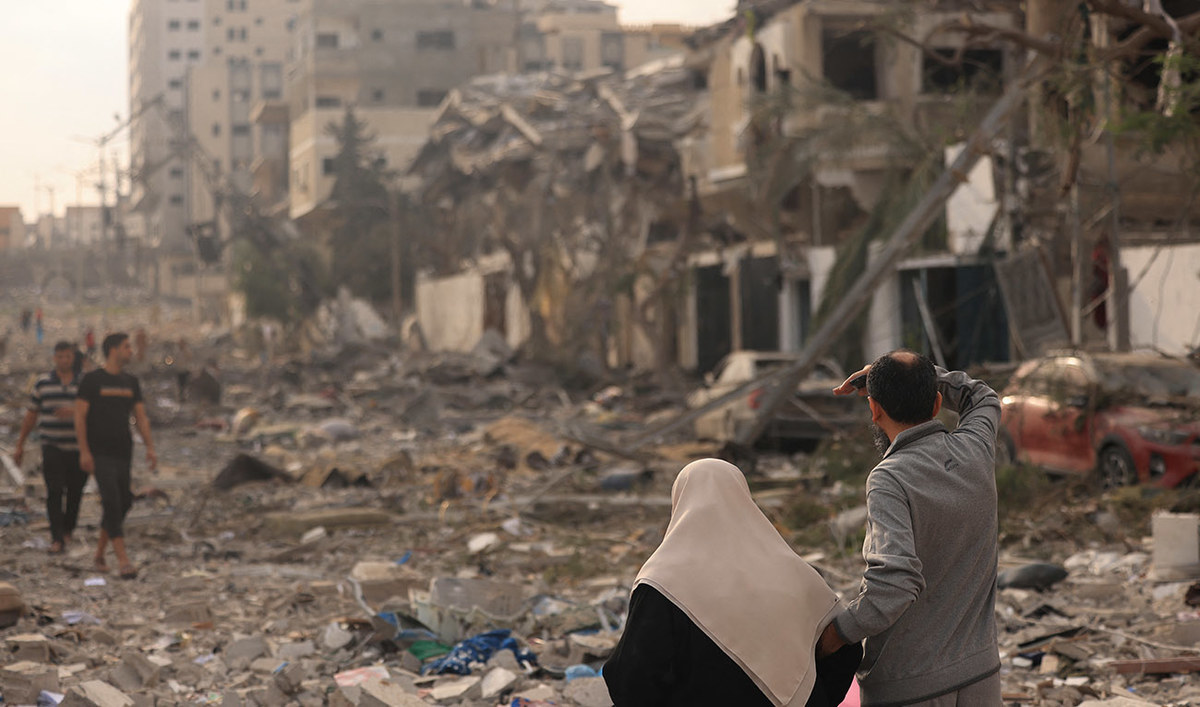


Palestinians inspect the massive destruction from Israeli airstrikes in Gaza City's al-Rimal district, on October 10, 2023. (AFP)

“There are two problems – one in Palestine and the other in Kashmir – which have deeply contributed to the radicalization of our population,” he said. “Wherever religion has been used in politics as a tool, these two issues have been joined together quite deeply.”
Kakar said if the world wanted civilizations to coexist peacefully, it will have to realize that the solution to these two problems will be pivotal.
He also categorically denied that Pakistan was trying to shift its Palestine policy, saying that nothing had changed over the years to warrant such a change.
Pakistan’s stance on Palestine had been in place for long, he continued, and the caretaker administration had also been pursuing the same policy.


UAE president to visit Pakistan on Dec. 26 to strengthen trade, investment cooperation

Updated 4 sec ago
Follow

UAE president to visit Pakistan on Dec. 26 to strengthen trade, investment cooperation

  • Sheikh Mohamed bin Zayed Al Nahyan will visit Pakistan with high-level delegation of ministers, officials, says FO
  • UAE president to meet PM Shehbaz Sharif to review bilateral ties, discuss matters of regional and global interest

ISLAMABAD: UAE President Sheikh Mohamed bin Zayed Al Nahyan will visit Pakistan on Dec. 26 to review ties between the two nations, exchange views on regional matters and strengthen collaboration with Islamabad in trade, investment, energy and development sectors, the Pakistani foreign office said on Wednesday. 

Al Nayhan, who will undertake his first official visit to Pakistan as the UAE’s president later this week, will arrive with a high-level delegation comprising ministers and senior officials, the foreign office said in a statement. 

“The visit of High Highness reflects the depth of bilateral relations between the two countries and shared commitment of both sides to further enhancing collaboration in key areas, including trade, investment, energy, development and regional stability,” the statement said. 

The UAE president will review the entire spectrum of bilateral ties in a meeting with Prime Minister Shehbaz Sharif and exchange views on regional and international issues of mutual interest. 

“The visit will provide an important opportunity to further strengthen the longstanding brotherly relations between Pakistan and the United Arab Emirates,” the foreign office noted. 

The announcement from the foreign office takes place a day after Prime Minister Shehbaz Sharif met UAE Ambassador Salem Mohammed Salem Al Bawab Al Zaabi in Islamabad. The prime minister urged both countries to enhance cooperation in trade and investment. 

Pakistan considers the UAE among its closest economic and regional allies, since the Gulf nation is Islamabad’s third-largest trading partner after China and the US. 

Policymakers in Pakistan consider the UAE an optimal export destination due to its geographical proximity, which minimizes transportation and freight costs while facilitating commercial transactions.

Both nations have signed agreements worth billions of dollars recently as Pakistan eyes greater trade and economic ties with Gulf states. 

In January 2024, Pakistan and the UAE signed multiple agreements worth more than $3 billion for cooperation in railways, economic zones and infrastructure sectors.

The UAE is also a major source of foreign investment in Pakistan, which has been valued at over $10 billion in the last 20 years, according to the UAE’s foreign ministry.