

Over 200 Afghan journalists in Pakistan face deportation amid crackdown on illegal immigrants

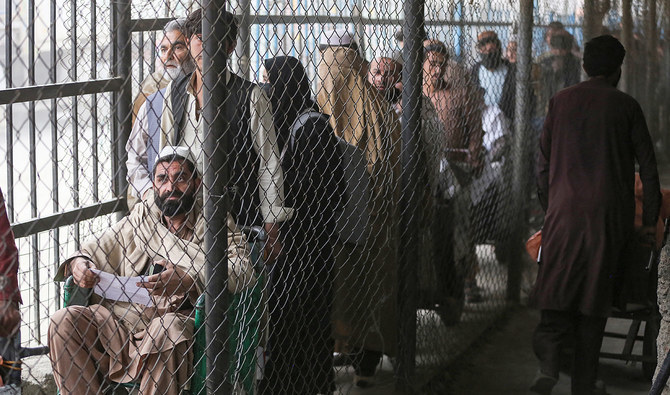
Afghan people wait behind a fenced corridor before crossing into Pakistan at the zero point Torkham border crossing between Afghanistan and Pakistan, in Nangarhar province on February 25, 2023. (AFP/File)
Short Url
Updated 10 October 2023
Follow

Over 200 Afghan journalists in Pakistan face deportation amid crackdown on illegal immigrants

  • Afghan journalists urge Pakistani authorities to extend legal stay in the country until they are resettled to other countries
  • Pakistani federation of journalists says lives of Afghan journalists deported would be under threat in Afghanistan

ISLAMABAD: With over 200 Afghan journalists and their families facing deportation from Pakistan, a federation of Afghan journalists on Tuesday urged the Pakistani government to reconsider its decision to expel them from the country.

According to data by the Pakistan-Afghan International Forum of Journalists, at least 650 media workers fled to Pakistan fearing persecution at the hands of the Taliban after the group took over Kabul in August 2021. About 400 journalists have made it to different countries, including the US, Germany and France, but the rest have been stuck as their travel documents have expired.

Pakistan's caretaker interior minister announced last Tuesday the government would deport illegal immigrants in the country from Nov. 1. While Pakistan says the operation would not be restricted to people of any particular nationality, the move is likely to impact Afghan nationals in Pakistan the most.

“The majority of Afghan journalists entered Pakistan legally but Pakistani authorities are not extending our visas now,” Hashmat Vejdani, spokesperson of the Federation of Afghan Journalists in Exile, told Arab News on Tuesday.

“Those who entered Pakistan illegally to escape Taliban persecution have also applied for visas but the government was not entertaining their applications.”

At least 600,000 Afghans fled to neighboring Pakistan after the withdrawal of foreign forces from Afghanistan in August 2021, according to the United Nations refugee agency.

Even before then, Pakistan hosted some 1.5 million registered refugees, one of the largest such populations in the world, according to the United Nations refugee agency. Over a million others are estimated to live in Pakistan unregistered.

Afghan journalists in Pakistan are anxiously waiting for visas from countries that previously employed them and have often complained that Pakistani police detain or threaten to arrest them for bribes, a charge police officials deny.

For over 200 Afghan journalists in Pakistan, the clock is ticking as their travel documents are expiring.

"Cases of the majority of Afghan journalists staying in Pakistan are under process for resettlement in European countries, therefore Pakistani government should reconsider its decision,” Vejdani said.

He voiced fears that Afghan journalists deported to Afghanistan would either be jailed or killed by the Taliban.

“The media in Afghanistan is in total control of the Taliban," he said. "We have worked for Western news organizations during the war so the Taliban consider us their staunch enemies."

Vejdani said Afghan journalists are ready to cooperate with the Pakistani government and called upon authorities to extend their visas till their resettlement applications are not finalized.

He said Afghan journalists and their families in Pakistan were registered with the Society for Human Rights and Prisoners’ Aid (SHARP), a Pakistani NGO that is an implementing partner of the UNHCR.

“Our deportation would clearly mean throwing us to the Taliban for murder," Vejdani said. "Pakistan should heed our requests for a safe and legal stay here."

Pakistan’s interior ministry did not respond to calls and messages seeking their version for this story.

Separately, the International Federation of Journalists (IFJ) on Tuesday urged Pakistan's government to reconsider its decision and called on media stakeholders, civil society organizations, and international governments to increase their support for Afghan journalists in exile.

“At least 200 Afghan journalists are currently refugees in Pakistan, forced to flee the Taliban’s crackdown on press freedom, including draconian restrictions on women journalists, shuttering of media houses, and rampant censorship,” the IFJ said in a statement.

In August, the IFJ and Pakistan Federal Union of Journalists (PFUJ) established two solidarity centers in Islamabad to aid Afghan journalists that provided emergency housing, legal and psychological support. One of the two centers is exclusively for women journalists.

“We have the data of 256 Afghan journalists in Pakistan, and we have been in touch with the government to chalk out a way for their stay in the country,” PFUJ President Afzal Butt told Arab News.

“We know the lives of these journalists would be in danger if deported to Afghanistan, therefore we have been trying our best for their legal stay in Pakistan until their resettlement to third countries,” Butt added.


Tens of thousands flee northwest Pakistan over fears of military operation

Updated 28 January 2026
Follow

Tens of thousands flee northwest Pakistan over fears of military operation

  • More than 70,000 people, mostly women and children, have fled remote Tirah region bordering Afghanistan 
  • Government says no military operation underway or planned in Tirah, a town in Khyber Pakhtunkhwa province

BARA, Pakistan: More than 70,000 people, mostly women and children, have fled a remote region in northwestern Pakistan bordering Afghanistan over uncertainty of a military operation against the Pakistani Taliban, residents and officials said Tuesday.

Pakistan’s Defense Minister Khawaja Mohammad Asif has denied the claim by residents and provincial authorities. He said no military operation was underway or planned in Tirah, a town in Khyber Pakhtunkhwa province.

Speaking at a news conference in Islamabad, he said harsh weather, rather than military action, was driving the migration. His comments came weeks after residents started fleeing Tirah over fears of a possible army operation.

The exodus began a month after mosque loudspeakers urged residents to leave Tirah by Jan. 23 to avoid potential fighting. Last August, Pakistan launched a military operation against Pakistani Taliban in the Bajau r district in the northwest, displacing hundreds of thousands of people.

Shafi Jan, a spokesman for the provincial government in Khyber Pakhtunkhwa, posted on X that he held the federal government responsible for the ordeal of the displaced people, saying authorities in Islamabad were retracting their earlier position about the military operation.

Khyber Pakhtunkhwa Chief Minister Suhail Afridi, whose party is led by imprisoned former Prime Minister Imran Khan, has criticized the military and said his government will not allow troops to launch a full-scale operation in Tirah.

The military says it will continue intelligence-based operations against Pakistani Taliban, who are known as Tehrik-e-Taliban Pakistan, or TTP. Though a separate group, it has been emboldened since the Afghan

Taliban returned to power in 2021. Authorities say many TTP leaders and fighters have found sanctuary in Afghanistan and that hundreds of them have crossed into Tirah, often using residents as human shields when militant hideouts are raided.

Caught in the middle are the residents of Tirah, who continued arriving in Bara.

So far, local authorities have registered roughly 10,000 families — about 70,000 people — from Tirah, which has a population of around 150,000, said Talha Rafiq Alam, a local government administrator overseeing the relief effort. He said the registration deadline, originally set for Jan. 23, has been extended to Feb. 5.

He said the displaced would be able to return once the law-and-order situation improves.

Among those arriving in Bara and nearby towns was 35-year-old Zar Badshah, who said he left with his wife and four children after the authorities ordered an evacuation. He said mortar shells had exploded in villages in recent weeks, killing a woman and wounding four children in his village. “Community elders told us to leave. They instructed us to evacuate to safer places,” he said.

At a government school in Bara, hundreds of displaced lined up outside registration centers, waiting to be enrolled to receive government assistance. Many complained the process was slow.

Narendra Singh, 27, said members of the minority Sikh community also fled Tirah after food shortages worsened, exacerbated by heavy snowfall and uncertain security.

“There was a severe shortage of food items in Tirah, and that forced us to leave,” he said.

Tirah gained national attention in September, after an explosion at a compound allegedly used to store bomb-making materials killed at least 24 people. Authorities said most of the dead were militants linked to the TTP, though local leaders disputed that account, saying civilians, including women and children, were among the dead.