Jordan, UNICEF discuss water scarcity

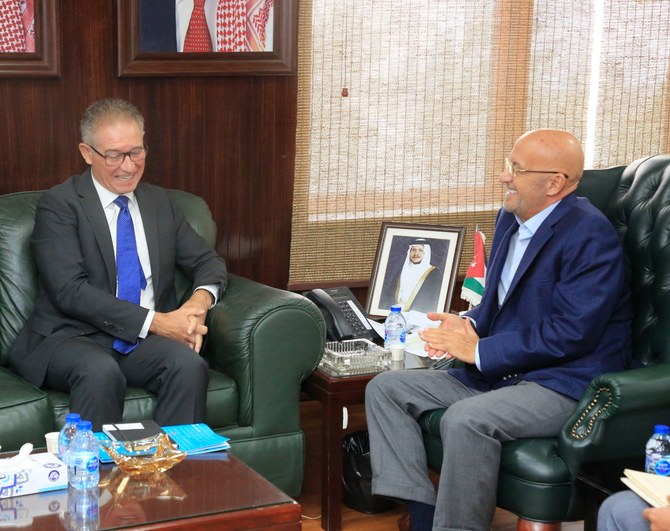
Jordan’s Minister of Water and Irrigation Raed Abu Soud and UNICEF Representative to Jordan Philippe Duamelle
Short Url
Updated 09 October 2023
Follow

Jordan, UNICEF discuss water scarcity

  • Abu Soud highlights depletion of water resources due to unpredictable rainfall patterns caused by climate change

LONDON: Jordan’s Minister of Water and Irrigation Raed Abu Soud met United Nations Children’s Fund Representative to Jordan Philippe Duamelle on Monday to discuss water sector challenges in light of the large numbers of refugees in the country, Jordan News Agency reported on Monday.

Abu Soud expressed concern over the depletion of water resources, particularly because of unpredictable rainfall patterns caused by climate change. This has resulted in a significant shortage of water for both citizens and host communities.

The minister added that the scarcity is placing a heavy burden on the water sector. He called for the fast-tracking of funding to implement projects that can meet the water demands of all regions.

Duamelle said that UNICEF is committed to assisting Jordan’s water sector, following the priorities set by the ministry. He urged the international community to fulfill its responsibilities by increasing aid to the water sector, especially given that UNICEF is grappling with funding reductions.

The representative lauded Jordan’s robust partnership with UNICEF, which aims to enhance access to water and sanitation services for disadvantaged communities and refugees.

The partnership also seeks to bolster the resilience of water systems against climate change. Duamelle praised Jordan’s continued efforts in hosting a large number of Syrian refugees.


The art of war: fears for masterpieces on loan to Louvre Abu Dhabi

Updated 13 March 2026
Follow

The art of war: fears for masterpieces on loan to Louvre Abu Dhabi

  • UAE paid more than €1 billion to borrow priceless works, but experts in France want them back

PARIS: The Middle East war has raised fears for the safety of priceless masterpieces on loan from France to the Louvre Abu Dhabi, the museum’s only foreign branch.
The Abu Dhabi museum, which opened in 2017, has so far escaped damage from nearly 1,800 Iranian drone and missile strikes launched since the conflict erupted on Feb. 28.
However, concerns are mounting in France. “The works must be removed,” said Didier Selles, who helped broker the original agreement between France and the UAE.
French journal La Tribune de l’Art echoed that alarm. “The Louvre’s works in Abu Dhabi must be secured!” it said.
France’s culture ministry said French authorities were “in close and regular contact with the authorities of the UAE to ensure the protection of the works loaned by France.”
Under the agreement with the UAE, France agreed to provide expertise, lend works of art and organize exhibitions, in return for €1 billion, including €400 million for licensing the use of the Louvre name. The deal was extended in 2021 to 2047 for an additional €165 million.
Works on loan include paintings by Rembrandt and Chardin, Classical statues of Isis, Roman sarcophagi and Islamic masterpieces: such as the Pyxis of Al-Mughira.

A Louvre Abu Dhabi source said the museum was designed to protect collections from both security threats and natural disasters.