

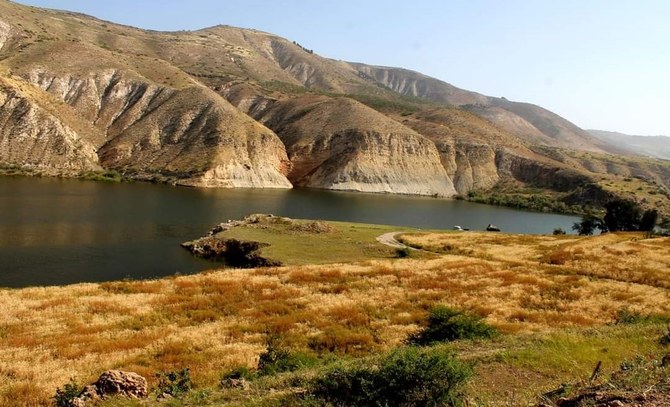
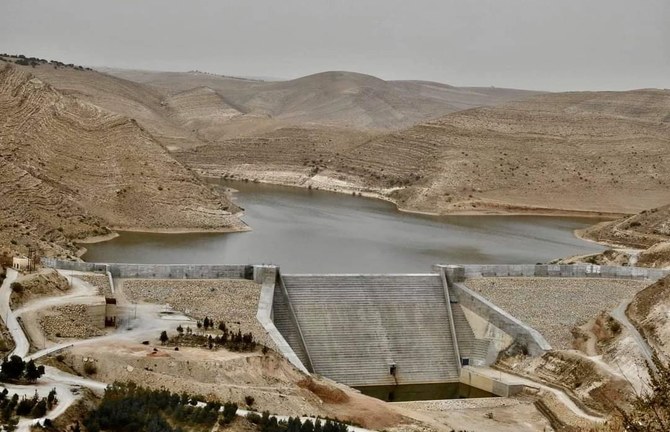


AMMAN: After a long and hot summer, Jordan’s water reserves have hit record lows, with major dams being less than 15 percent full, officials said, warning of a looming water crisis amid a delayed onset of the wet season.
Omar Salameh, spokesperson for the Water Ministry, told Arab News that “water reserves at all Jordan’s dams have dropped to critical levels of less than 15 percent.”
Acknowledging that a drop in water storage is normal at the end of summer, Salameh added: “But this is unprecedented. Never in the history of Jordan has such a percentage been recorded.”
The official attributed the cause of the limited water supply to this year’s “long dry season, the rising temperature and the accompanying high water consumption for household usage and irrigation.”
He added that the volume of water currently stored at the kingdom’s 14 major dams is “only 43 million cubic meters of their total capacity of 336.4 million cubic meters.”
Salameh warned that “we will definitely face a water crisis in case of a delay in the onset of the rainy season (which begins in November to May).”
Water from Syria
Jordan recently confirmed that its request for 30 million cubic meters of water from Syria was rejected as Amman looks to secure water for agriculture in the fertile northern region.
Water Minister Mohammad Najjar said in late July that Syria had rejected Jordan’s request under the deal signed between the two countries, attributing the reason to the northern neighbor also facing a water crisis and to the political situation in Syria’s southern regions bordering the kingdom.
Najjar said at the time that the ministry’s available solution to the growing demand on irrigation water was to rehabilitate the underground water reservoirs in northern Jordan.
Jordan and Syria signed the Yarmouk Water Agreement in 1987 to institutionalize water cooperation. Under the deal, signed in Damascus, the two sides agreed to build the Al-Wehda Dam on the borders between the two countries to also generate electricity.
Under the deal, Syria receives 75 percent of the electricity generated from the dam while Jordan has “all the sovereignty over its water storage.”
Jordan has always accused the Syrians of building water reservoirs and large agricultural projects on the sides of the Yarmouk River, thus allowing only small quantities of water to flow to the Wehda Dam.
“The Syrians are honoring the agreement but they also face a water crisis like all the region,” Salameh said.
National conveyor project
Classified as the world’s second most water-scarce country, Jordan announced the launch of the Aqaba-Amman Water Desalination and Conveyance National Project (AAWDC) in February 2020.
An unnamed government source has been quoted in Jordan’s news agency, Petra, as saying that the kingdom will host an international donor conference in Amman at the end of the year to secure funds for the project, described as “the largest water generation scheme to be implemented in the history of the kingdom.”
Jordan’s Water Authority has recently said that the mega-project will “ensure the country’s water stability until 2040.”
The Water Ministry announced that the AAWDC will generate 130 million cubic meters of water each year and will be implemented on a build-operate-transfer basis.
In October last year, Jordan announced it had purchased an additional 50 million cubic meters of water from Israel outside the framework of the 1994 peace agreement and what it stipulates in regard to water quantities.


