

Silent art protest by animal rights activists demands liberation of captive bear at Karachi Zoo

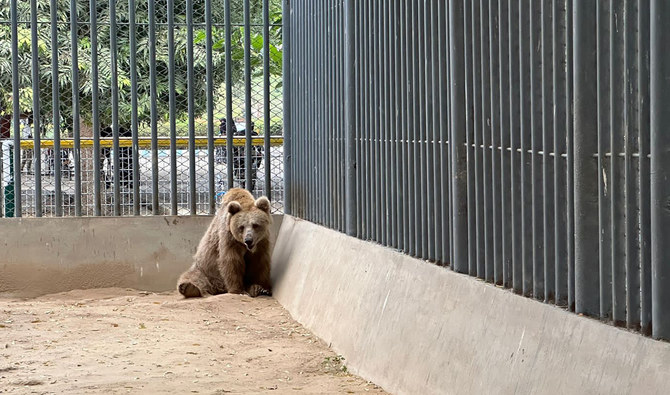
The photo taken on October 7, 2023, shows Rano, a brown bear at a zoo in Karachi, Pakistan. (Photo courtesy: Pakistan Animal Welfare Society)
Short Url
Updated 08 October 2023
Follow

Silent art protest by animal rights activists demands liberation of captive bear at Karachi Zoo

  • The protest was arranged by Pakistan Animal Welfare Society to highlight the plight of Rano, a lone brown bear
  • Rano was brought to the Karachi Zoo in 2017 along with an Asiatic black bear who has not been seen since 2020

KARACHI: In a poignant demonstration of compassion and solidarity, Pakistan Animal Welfare Society (PAWS) on Saturday organized a silent art protest at Gandhi Garden, widely known as the Karachi Zoo, to commemorate World Animal Day, with calls to liberate Rano, a brown bear enduring captivity within the facility.
Rano was brought to Karachi Zoo in 2017 along with an Asiatic black bear who has not been seen since 2020. They were both placed inside a Victorian Era pit that earlier housed Emma, a black bear, who died in 2013.
After Rano was seen alone in the pit, her plight caught the attention of citizens who filed a petition in the Sindh High Court, prompting the zoo to shift the bear to the current cage after the court order.
“We the friends Rano held a silent protest in which students from the Karachi University brought in their artwork to highlight the plight of the lone brown bear,” PAWS co-founder Mehra Omar told Arab News, adding the zoo authorities did not allow the protest until an intervention made by the mayor, Murtaza Wahab.


The Mayor of Karachi, Murtaza Wahab (second left) sits with the members of Pakistan Animal Welfare Society as they hold a silent art protest at Gandhi Garden, widely known as the Karachi Zoo, to commemorate World Animal Day in Karachi, Pakistan on October 7, 2023. (Photo courtesy: Pakistan Animal Welfare Society)

The fundamental reason for holding the protest, she added, was to raise awareness about Rano’s distressed life in captivity and to underscore the urgency of relocating her to proper bear sanctuary.
“Rano does not belong in Karachi Zoo,” she said. “She is a Himalayan brown bear, a wildlife species native to Pakistan. Most likely snatched from the wild as a cub, she has spent her entire life in cruel captivity. She cannot bear it any longer. The only way to right all the wrongs done to her is to let her spend the rest of her life in a sanctuary.”


A protestor holds up her painting of Rano, a brown bear at a zoo in Karachi during a silent art protest to commemorate World Animal Day in Karachi, Pakistan on October 7, 2023. (Photo courtesy: Pakistan Animal Welfare Society)

Omar said the national wildlife rehabilitation center run by the Islamabad Wildlife Management Board would be the ideal home for Rano.
The other option, she added, was the bear sanctuary in Balkasar in Punjab under the Ministry of Climate Change.
“She is frustrated in this completely inadequate cage that was built for her in 2020,” she said. “Whoever designed it had absolutely no idea about the needs of a wild bear.”
Omar said since the bear belonged to a cold climate, it should not be “held hostage in Karachi.”


A painting of Rano, a brown bear at a zoo in Karachi, made during a silent art protest to commemorate World Animal Day in Karachi, Pakistan on October 7, 2023. (Photo courtesy: Pakistan Animal Welfare Society)


She maintained the good thing about the protest was that the Karachi mayor had also visited the camp and assured if the bear turned out to be of Himalayan origin, it would be relocated to Balkasar.


Pakistan vaccinates over 43 million children as last polio drive of 2025 enters 6th day

Updated 8 sec ago
Follow

Pakistan vaccinates over 43 million children as last polio drive of 2025 enters 6th day

  • Campaign running simultaneously in Pakistan and Afghanistan, last two polio-endemic countries
  • Health authorities urge parents and communities to fully cooperate with anti-polio vaccinators

ISLAMABAD: Pakistan has vaccinated more than 43.8 million children in five days of its last nationwide polio campaign of 2025, health authorities said on Saturday, as the drive entered its sixth day amid renewed efforts to curb the virus.

The campaign, running from Dec. 15 to 21, targets children under the age of five and is being conducted simultaneously in Pakistan and Afghanistan, according to Pakistan’s National Emergency Operations Center (NEOC) which oversees eradication efforts.

Pakistan and neighboring Afghanistan are the only two countries where wild poliovirus transmission has never been interrupted, keeping global eradication efforts at risk. The virus, which can cause irreversible paralysis, has no cure and can only be prevented through repeated oral vaccination.

“The last nationwide polio campaign of 2025 continues in full swing on the sixth day,” the NEOC said in a statement. “Over 43.8 million children have been vaccinated in five days so far.”

Provincial data released by the National EOC showed that around 22.7 million children had been vaccinated in Punjab province, more than 10.2 million in Sindh, approximately 6.9 million in Khyber Pakhtunkhwa and about 2.5 million in Balochistan. In Islamabad, over 450,000 children received polio drops, while more than 274,000 were vaccinated in Gilgit-Baltistan and over 714,000 in Azad Jammu and Kashmir.

“The polio campaign is being conducted simultaneously in Pakistan and Afghanistan,” the NEOC said. “More than 400,000 polio workers are going door to door across the country to administer vaccines.”

Pakistan has logged 30 polio cases so far in 2025, underscoring the fragility of progress against the virus. The country recorded 74 cases in 2024, a sharp rise from six cases in 2023, reflecting setbacks caused by vaccine hesitancy, misinformation and access challenges in high-risk areas.

Health officials say insecurity remains a major obstacle. Polio workers and their security escorts have repeatedly been targeted in militant attacks, particularly in parts of northwestern Khyber Pakhtunkhwa and southwestern Balochistan, complicating efforts to reach every child. Natural disasters, including flooding, have further disrupted vaccination campaigns in recent years.

“Parents and communities are urged to fully cooperate with polio workers,” the NEOC said, stressing that every child under the age of five must be given polio drops.

Pakistan has dramatically reduced polio prevalence since the 1990s, when annual cases exceeded 20,000. Health authorities, however, warn that without sustained access to children in underserved and conflict-affected areas, eradication will remain out of reach.