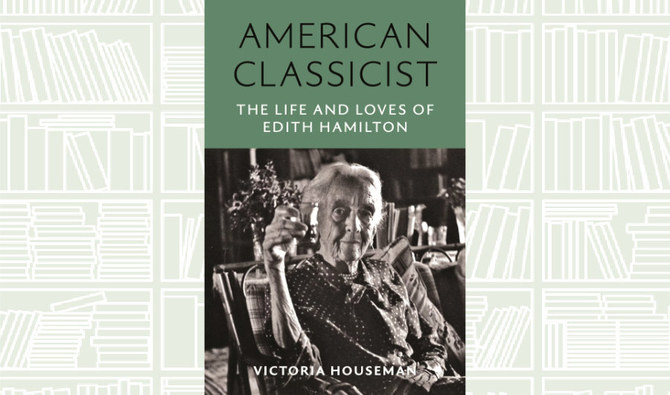
What We Are Reading Today: American Classicist by Victoria Houseman

Short Url
Updated 08 October 2023
Follow

What We Are Reading Today: American Classicist by Victoria Houseman

Edith Hamilton (1867–1963) didn’t publish her first book until she was 62. But over the next three decades, this former headmistress would become the 20th century’s most famous interpreter of the classical world. Today, Hamilton’s Mythology (1942) remains the standard version of ancient tales and sells tens of thousands of copies a year. During the Cold War, her influence even extended to politics, as she argued that postwar America could learn from the fate of Athens after its victory in the Persian Wars. 

In “American Classicist,” Victoria Houseman tells the fascinating life story of a remarkable classicist whose ideas were shaped by — and aspired to shape — her times. 

Hamilton studied Latin and Greek from an early age, earned a BA and MA at Bryn Mawr College, and ran a girls’ prep school for 26 years. After retiring, she turned to writing. Hamilton traveled around the world, formed friendships with Gertrude Stein and Ezra Pound, and was made an honorary citizen of Athens.


What We Are Reading Today: Elites and Democracy by Hugo Drotchon

Updated 08 January 2026
Follow

What We Are Reading Today: Elites and Democracy by Hugo Drotchon

A central paradox of democracies is that they are always ruled by elites. What can democracy mean in this context? Today, it is often said that a populist revolt against elites is driving democratic politics throughout the West.

But in “Elites and Democracy,” Hugo Drochon argues that democracy is more accurately and usefully understood as a perpetual struggle among competing elites—between rising elites and ruling elites.

Real political change comes from the interaction between social movements and elite political institutions such as parties. But, although true democracy—the rule of the people—may never be achieved, striving toward it can bring about worthwhile democratic results.

Moving away from conceptions of democracy, “Elites and Democracy” develops a dynamic theory of democracy.

At the turn of the 20th century, Gaetano Mosca, Vilfredo Pareto, and Robert Michels put forward “elite” theories of democracy and gave us terms such as the “ruling class” and “elites” itself.