

Saudi FM rejects targeting of civilians in Gaza violence

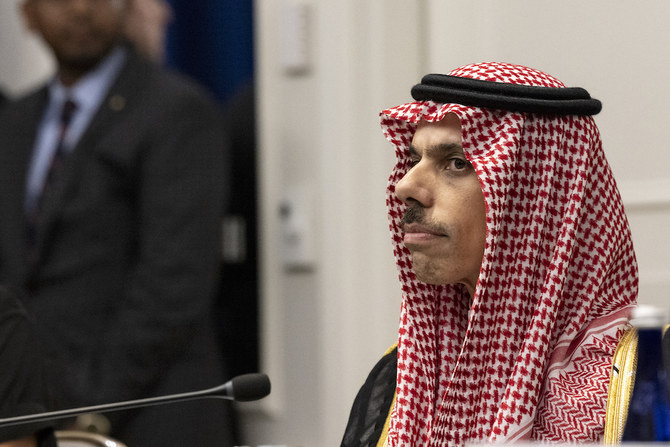
Saudi Arabia’s Foreign Minister Prince Faisal bin Farhan stressed the need to stop the escalation and for all parties to respect international humanitarian law. (AFP)
Short Url
Updated 09 October 2023
Follow

Saudi FM rejects targeting of civilians in Gaza violence

  • Prince Faisal’s diplomatic efforts advocated for peace during calls with his counterparts in the US, EU, Qatar, Jordan and Egypt
  • Saudi foreign minister emphasized the need for a joint action plan during the calls

RIYADH: Saudi Arabia’s Foreign Minister Prince Faisal bin Farhan on Saturday said that the Kingdom rejected the targeting of unarmed civilians “in any way,” according to a foreign ministry statement.
His comments came during separate phone calls with US Secretary of State Antony Blinken and EU Foreign Policy Chief Josep Borrell to discuss violence in Gaza, which broke out on Saturday morning.
The Palestinian Hamas group launched the biggest attack on Israel in years and the assault followed months of surging violence in the Israeli-Palestinian conflict, with fatalities in the occupied West Bank hitting a scale not seen in years.
The early morning Hamas offensive by air, land and sea was met by Israeli air strikes on the blockaded coastal enclave, in the bloodiest escalation with the Palestinians since May 2021.
Prince Faisal stressed the need to stop the escalation and for all parties to respect international humanitarian law.
He also called for “concerted efforts to calm the situation and avoid further violence,” the ministry said.
The Saudi minister also held separate calls with his Qatari counterpart Mohammed bin Abdulrahman bin Jassim, and his Egyptian and Jordanian counterparts, where he emphasised the need for a joint action plan.

Prior to these calls, Prince Faisal issued a statement urging an immediate cessation of hostilities and calling upon the international community to initiate a peace initiative aimed at achieving a sustainable two-state resolution.

Prince Faisal asserted last month that “there is no solution to the Israeli-Palestinian conflict other than the two state solution”, and that while “people have started losing hope in the two-state solution, our efforts aim to bring it back to the forefront.”

Meanwhile, Blinken urged the Palestinian Authority to restore calm and stability in the West Bank in a call with Palestinian President Mahmoud Abbas, the US State Department said in a statement.
Blinken “reiterated the United States’ unequivocal condemnation of the terrorist attacks by Hamas against Israel, and called on all leadership in the region to condemn them,” a State Department spokesperson said.
“The Secretary urged the Palestinian Authority to continue and enhance steps to restore calm and stability in the West Bank,” the spokesperson said.
Abbas told Blinken that “injustice” toward Palestinians is driving the conflict with Israel to an “explosion,” Palestinian news agency WAFA said.
He also said the ongoing escalation is down to the “practices of the colonialists and the Israeli occupation forces, and the aggression against Islamic and Christian sanctities,” according to WAFA.
US President Joe Biden made clear in a call with Israeli Prime Minister Benjamin Netanyahu that “we stand ready to offer all appropriate means of support,” according to the White House. He also called Jordan’s King Abdullah II.
Egyptian President Abdel Fattah El-Sisi warned “against the danger of the situation deteriorating and sliding into more violence.”
In a call with French President Emmanuel Macron, he urged international cooperation on stopping the conflict from getting worse.
Cairo has historically been a key mediator in conflicts between the two sides.
Foreign Minister Sameh Shoukry spoke to his Jordanian, UAE, Turkish, Russian, German, French, Russian and Spanish counterparts, and to Borrell, where he stressed the “importance of stopping the escalation and all sides’ exercising restraint.”
A foreign ministry statement said Shoukry sought to rally “international actors” to “intervene immediately.”
In a call with Jordanian Foreign Minister Ayman Safadi, both ministers “expressed their deep concern about the progressive and dangerous deterioration of events.”
In a separate statement, Safadi warned of the “volatility” of the situation, “particularly in light of what cities and areas of the West Bank are witnessing of Israeli attacks and violations against the Palestinian people.”
Shoukry called UAE Foreign Minister Sheikh Abdullah Bin Zayed to discuss “the gravity of the current situation and the need to make every effort to prevent the security situation from getting out of control.”
Turkish Foreign Minister Hakan Fidan held calls with his regional counterparts to discuss the fighting between Israel and the Palestinians, a foreign ministry source said, as Ankara said it stood ready to help de-escalate the situation.
The source said Fidan discussed the conflict with his Saudi, Qatari, Iranian, Palestinian and Egyptian counterparts, but did not provide any further details. The source later said Fidan had also discussed the situation with Blinken in a call.


Is sourdough Saudi Arabia’s latest craft food?

Updated 07 February 2026
Follow

Is sourdough Saudi Arabia’s latest craft food?

  • Saudi home bakers point to a practice that was once routine, not artisanal
  • Naturally fermented bread reflects a broader shift toward process-driven, premium food culture

ALKHOBAR: Sourdough has started to shift from a niche interest into a mainstream feature of home kitchens, cafes and specialty bakeries across the Kingdom.

The rise of sourdough is part of a wider shift in Saudi Arabia’s food landscape, where artisanal production and slower preparation methods are gaining traction.

Specialty coffee seems to have set the early template for this transition, normalizing premium pricing, craftsmanship and an interest in process.

The rise of sourdough is part of a wider shift in Saudi Arabia’s food landscape, where artisanal production and slower preparation methods are gaining traction. (Supplied/creativecommons)

Bread is now undergoing a similar shift, with fermentation replacing extraction and roasting as the central point of differentiation.

In both cases, the appeal is rooted in the product’s perceived authenticity, reduced additives, and a clearer link between raw ingredients and final consumption.

Home bakers in Riyadh, Jeddah and the Eastern Province have adapted natural yeast cultures to the Saudi environment, adjusting feeding schedules, hydration ratios, and fermentation times to accommodate higher temperatures and lower humidity in the summer months.

HIGHLIGHTS

• Home bakers in Riyadh, Jeddah and the Eastern Province have adapted natural yeast cultures to the Saudi environment.

• They adjust feeding schedules, hydration ratios, and fermentation times to accommodate higher temperatures and lower humidity in the summer months.

Cafes and specialty bakeries have responded by adding sourdough loaves, baguettes and focaccia to their menus, often positioned as premium alternatives to conventional commercial bread.

For younger home bakers, the appeal lies in the craft and the learning curve rather than nostalgia. “It feels more real and more intentional,” home baker Sarah Al-Almaei told Arab News. She began experimenting with natural yeast at home after watching starter tutorials online.

The technical aspect — hydration percentages, fermentation control and starter maintenance — has become content in its own right, with TikTok and Instagram compressing trial-and-error learning into short videos and recipe cards.

But the practice of maintaining a natural yeast culture is not new in Saudi Arabia. Long before sourdough became a global trend, Saudi households kept what was commonly referred to as the “mother dough,” a natural yeast starter fed and used daily.

“We used to maintain it every day and bake with it,” said Hessa Al-Otaibi, 56, a Saudi home baker with more than four decades’ experience. “People today call it sourdough. For us, it was simply bread.”

Her comment highlights a cultural continuity that has remained largely unrecognized, partly because the practice was not framed as artisanal or health-oriented, but as a routine household function.

The modern sourdough trend differs in its market positioning. While the older model was practical and domestic, the current model is commercial, aesthetic and often health-coded. Bakeries justify higher pricing through longer fermentation times, higher ingredient costs and smaller batch production.

Consumers justify their purchases through digestibility, perceived health benefits, flavor and product integrity.

“Once you get used to it, it’s hard to go back,” said Amina Al-Zahrani, a regular buyer of sourdough from specialty bakeries in Alkhobar.

Digestibility and texture are often cited as reasons for substitution, especially among buyers who report discomfort from standard commercial bread.

Another consumer, Majda Al-Ansari, says sourdough has become part of her weekly routine, noting that availability and quality have improved significantly in the past year.

The social media component has played an outsized role in accelerating adoption. Home bakers document starter feeding cycles, cold proofing and first bakes, turning a once-private domestic process into visible public content.

This has also created micro-markets of home-based sellers, where individual bakers offer loaves to local buyers, often fulfilling orders through direct messaging.

What remains to be seen is how far the trend will scale. If specialty bakeries continue to expand and consumers maintain willingness to pay premium prices, sourdough could establish a long-term place in Saudi food culture.

If not, it may revert to a smaller niche of committed home bakers and specialty cafes. For now, however, sourdough occupies an unusual position: both a newly fashionable trend and a quiet continuation of an older Saudi baking practice.