

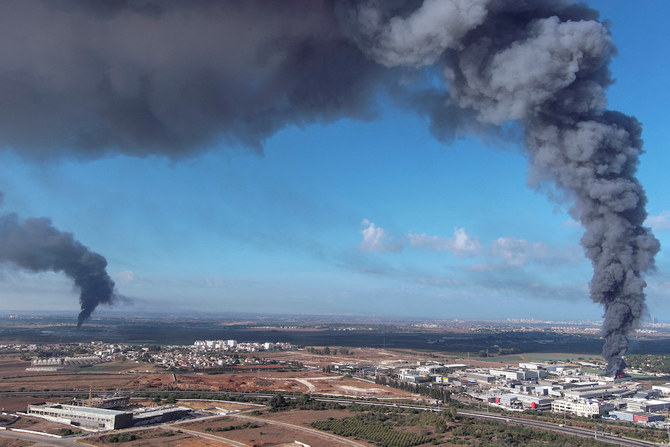

RIYADH: Saudi Arabia has called for an “immediate halt to the escalation of conflict between Palestinians and Israel” after Hamas militants carried out an unprecedented attack on daybreak Saturday.
Saudi Arabia’s foreign affairs ministry said in a statement that it “is closely following developments in the unprecedented situation between a number of Palestinian factions and the Israeli occupation forces, which has resulted in a high level of violence taking place on a number of fronts there.”
“We recall our repeated warnings of the dangers of the situation exploding as a result of the continued occupation,” the statement said. It also called on the international community to activate a credible peace process that would lead to a two-state solution.
Foreign minister Prince Faisal bin Farhan spoke with US Secretary of State Antony Blinken to discuss the escalation of the violence in Gaza, the foreign ministry said.
#بيان | تتابع المملكة العربية السعودية عن كثب تطورات الأوضاع غير المسبوقة بين عددٍ من الفصائل الفلسطينية وقوات الاحتلال الاسرائيلي، مما نتج عنها ارتفاع مستوى العنف الدائر في عددٍ من الجبهات هناك. pic.twitter.com/NhlkexyhEQ
— وزارة الخارجية (@KSAMOFA) October 7, 2023
Secretary-General of the Gulf Cooperation Council Jassem Albudaiwi called for an immediate cease-fire between the two sides to protect innocent civilians.
He “held the Israeli occupation forces responsible for the current situation resulting from the continuous and flagrant Israeli attacks against the Palestinian people and holy sites,” the GCC said in a statement.
Albudaiwi added that the ongoing Israeli attacks represent a blatant violation of international conventions and laws, hindering the peace process for resolving the Palestinian issue.
The UAE foreign affairs ministry, in a statement on social media, also called for an ‘end to the escalation between the Israelis and the Palestinians.’
The UAE has called for exercising the utmost restraint and an immediate ceasefire in order to avoid serious repercussions, and “urged the international community to immediately reactivate the international Quartet to revive the path process of Arab-Israeli peace, and increase all efforts to achieve a just and comprehensive peace, and prevent the region from experiencing further violence, tension, and instability.”
Kuwait expressed its “grave concern” over the developments, blaming Israel for what it called its “blatant attacks.”
The foreign ministry in a statement called on the international community to “stop the provocative practices by the occupation” and the “policy of expanding settlements.”
Oman also called on both parties to “exercise utmost levels of restraint, stressing the importance of protecting civilians.”
“Oman is following with concern the ongoing escalation between the Palestinian and Israeli sides as a result of continued illegal Israeli occupation of the Palestinian territories, constant Israeli aggressions, which portend serious repercussions,” Oman’s state media said.
#Oman is following with concern the ongoing escalation between the Palestinian and Israeli sides as a result of continued illegal Israeli occupation of the Palestinian territories, constant Israeli aggressions, which portend serious repercussions.
— Oman News Agency (@ONA_eng) October 7, 2023
Egypt urged the Palestinians and Israel to “exercise restraint” and warned of the “dire danger of ongoing escalation.”
Egypt also called on the international community to “urge Israel to stop the attacks and provocative actions against the Palestinian people and to adhere to the principles of international humanitarian law with regard to the responsibilities of an occupying state.”
Military operations undertaken by the Palestinian people on Saturday are a natural result of decades of “systemic oppression” by the “Zionist Occupation authority,” a statement by the Iraqi government’s official spokesperson said.
The statement also warned of a continued escalation in the Palestinian territories, which it said could affect the stability of the region.
The Palestinian people have the right to defend themselves against the “terror of settlers and occupation troops,” the official news agency WAFA quoted President Mahmoud Abbas as saying.
Jordanian Foreign Minister Ayman Safadi warned of the “volatility” of the situation, “particularly in light of what cities and areas of the West Bank are witnessing of Israeli attacks and violations against the Palestinian people.”
Turkish President Recep Tayyip Erdogan meanwhile has called “on Israelis, Palestinians to act with restraint, refrain from aggressive acts that will exacerbate situation.”
“We invite all parties to act reasonably and to stay away from impulsive steps that raise tensions,” Erdogan said.
Qatar’s foreign ministry issued a statement saying that Israel alone was responsible for the ongoing escalation of violence with the Palestinian people.
It said Qatar calls on both sides to exercise utmost restraint and calls on the international community to prevent Israel from using these events as an excuse to launch a disproportionate war against Palestinian civilians in Gaza.
Bahrain called for self-restraint in the Gaza Strip, saying that continued fighting had negative consequences on the region’s peace and stability.
It stressed “the need for de-escalation among all parties to preserve the lives of people” in a statement from the foreign ministry.
“The continuation of violence will impede efforts aiming at achieving a just and lasting peace in the Middle East,” it said, adding that it called upon the international community to help end the armed conflict and to protect civilians.
Morocco expressed “its deep concern at the deterioration of the situation and the outbreak of military action in the Gaza Strip, and condemns attacks against civilians wherever they may be,” a foreign ministry statement said.
“The kingdom calls for an immediate halt to the escalation between the two sides, protection of civilians, and self-control,” it added.
Arab League chief Ahmed Aboul Gheit urged “an immediate halt to military operations in Gaza” and “the cycle of armed confrontation between the two sides.”
He said: “Israel’s continued implementation of violent and extremist policies is a time bomb depriving the region of any serious opportunity for stability in the foreseeable future.”
The Jeddah-based Organization for Islamic Cooperation — that the attack was “a result of the continued occupation and deprivation of the Palestinian people of their legitimate rights.”
The Muslim World League and the Arab Parliament echoed similar statements.
A White House National Security Council spokesperson said the US “unequivocally condemns” attacks by the Palestinian group Hamas against Israeli civilians and firmly stands with the government and people of Israel, CNN reported on Saturday.
Citing a statement from the spokesperson, CNN reported that White House National Security Adviser Jake Sullivan had spoken with his Israeli counterpart, Tzachi Hanegbi, and would remain in close contact.
US President Joe Biden on Saturday warned “against any other party hostile to Israel seeking advantage in this situation” after Palestinian militant group Hamas launched a large-scale surprise attack.
Biden said in his statement that he had spoken to Israeli Prime Minister Benjamin Netanyahu, and underlined that the United States stood “ready to offer all appropriate means of support.”
“I made clear to Prime Minister Netanyahu that we stand ready to offer all appropriate means of support to the Government and people of Israel,” Biden said in a statement issued after their call.
“Israel has a right to defend itself and its people. The United States warns against any other party hostile to Israel seeking advantage in this situation,” Biden added.
Russia has also urged for ‘restraint’ after the attacks on Israel.
“We are now in contact with everyone. With the Israelis, Palestinians, Arabs,” Deputy Foreign Minister Mikhail Bogdanov told Russian private news agency Interfax, adding: “Of course, we always call for restraint.”
EU chief Ursula von der Leyen said that she ‘unequivocally’ condemned the ‘terrorist attack by Hamas on Israel’, adding that it was ‘terrorism in its most contemptible form’.
“This horrific violence must stop immediately. Terrorism and violence solve nothing. The EU expresses its solidarity with Israel in these difficult moments,” EU foreign policy chief Josep Borrell meanwhile said.
Dutch prime minister Mark Rutte meanwhile said: “Appalling images from Israel. Terror organization Hamas is waging an unprecedented attack on Israel... This violence must stop; Israel has every right to defend itself.”
“The UK unequivocally condemns the horrific attacks by Hamas on Israeli civilians. The UK will always support Israel’s right to defend itself,” Britain’s Foreign Secretary James Cleverly said in a post on social media.
The UK unequivocally condemns the horrific attacks by Hamas on Israeli civilians.
The UK will always support Israel’s right to defend itself.
— James Cleverly (@JamesCleverly) October 7, 2023
Italy meanwhile said it backed “Israel’s right to defend itself” against the “brutal attack” underway after hundreds of rockets were fired on its territory from Gaza.
The Italian government said it “condemns in the strongest terms the terror and the violence underway against innocent civilians”, adding: “We back the right of Israel to defend itself”.
Spain’s acting Foreign Minister Jose Manuel Albares on social media platform X on Saturday condemned attacks from Gaza against Israel.
Condenamos enérgicamente los gravísimos ataques terroristas desde Gaza contra Israel.
Sobrecogidos por esta violencia indiscriminada. Toda nuestra solidaridad con las víctimas.
España está firmemente comprometida con la paz, la seguridad y la estabilidad en la región.
— José Manuel Albares (@jmalbares) October 7, 2023
“We strongly condemn the very serious terrorist attacks from Gaza against Israel.
“Overwhelmed by this indiscriminate violence. All our solidarity (is) with the victims.”
German top envoy Annalena Baerbock said that Germany “firmly condemns the terrorist attacks from Gaza against Israel” and it “has our full solidarity” and “the right, guaranteed by international law, to defend itself against terrorism.”
The French foreign ministry also condemned “in the strongest possible terms the ongoing terrorist attacks against Israel and its population” after the firing of hundreds of rockets into Israel from the Gaza Strip.
France “expresses its full solidarity with Israel and the victims of these attacks. It reaffirms its absolute rejection of terrorism and its commitment to Israel’s security”, the ministry added.
French President Emmanuel Macron has also strongly condemned attacks in a post on social media.
Je condamne fermement les attaques terroristes qui frappent actuellement Israël. J’exprime ma pleine solidarité avec les victimes, leurs familles et leurs proches.
— Emmanuel Macron (@EmmanuelMacron) October 7, 2023
Roberta Metsola, the president of the European Parliament meanwhile said: We condemn the attacks launched by Hamas on Israel.”
I condemn the indiscriminate rocket fire by Hamas terrorists against Israeli civilians. I am in contact with Israeli officials, and fully support Israel's right to defend itself from such terrorist acts.
— Chargé d’Affaires a.i. Stephanie Hallett (@USAmbIsrael) October 7, 2023
Stephanie Hallett, the US Chargé d’Affaires to Israel said on social media: “I condemn the indiscriminate rocket fire by Hamas terrorists against Israeli civilians. I am in contact with Israeli officials, and fully support Israel’s right to defend itself from such terrorist acts.
“Sickened by the images coming out of southern Israel of dead and wounded civilians at the hands of terrorists from Gaza. The United States stands with Israel.”
Ukraine’s foreign ministry also condemned what it described as “ongoing terrorist attacks” on Israel.
“Ukraine strongly condemns the ongoing terrorist attacks against Israel, including rocket attacks against the civilian population in Jerusalem and Tel Aviv,” the ministry said on the social media platform X.
(With Agencies)


