

Saudi FM rejects targeting of civilians in Gaza violence

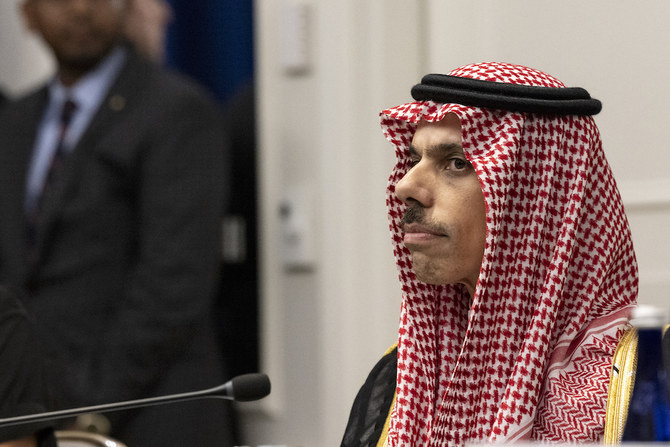
Saudi Arabia’s Foreign Minister Prince Faisal bin Farhan stressed the need to stop the escalation and for all parties to respect international humanitarian law. (AFP)
Short Url
Updated 09 October 2023
Follow

Saudi FM rejects targeting of civilians in Gaza violence

  • Prince Faisal’s diplomatic efforts advocated for peace during calls with his counterparts in the US, EU, Qatar, Jordan and Egypt
  • Saudi foreign minister emphasized the need for a joint action plan during the calls

RIYADH: Saudi Arabia’s Foreign Minister Prince Faisal bin Farhan on Saturday said that the Kingdom rejected the targeting of unarmed civilians “in any way,” according to a foreign ministry statement.
His comments came during separate phone calls with US Secretary of State Antony Blinken and EU Foreign Policy Chief Josep Borrell to discuss violence in Gaza, which broke out on Saturday morning.
The Palestinian Hamas group launched the biggest attack on Israel in years and the assault followed months of surging violence in the Israeli-Palestinian conflict, with fatalities in the occupied West Bank hitting a scale not seen in years.
The early morning Hamas offensive by air, land and sea was met by Israeli air strikes on the blockaded coastal enclave, in the bloodiest escalation with the Palestinians since May 2021.
Prince Faisal stressed the need to stop the escalation and for all parties to respect international humanitarian law.
He also called for “concerted efforts to calm the situation and avoid further violence,” the ministry said.
The Saudi minister also held separate calls with his Qatari counterpart Mohammed bin Abdulrahman bin Jassim, and his Egyptian and Jordanian counterparts, where he emphasised the need for a joint action plan.

Prior to these calls, Prince Faisal issued a statement urging an immediate cessation of hostilities and calling upon the international community to initiate a peace initiative aimed at achieving a sustainable two-state resolution.

Prince Faisal asserted last month that “there is no solution to the Israeli-Palestinian conflict other than the two state solution”, and that while “people have started losing hope in the two-state solution, our efforts aim to bring it back to the forefront.”

Meanwhile, Blinken urged the Palestinian Authority to restore calm and stability in the West Bank in a call with Palestinian President Mahmoud Abbas, the US State Department said in a statement.
Blinken “reiterated the United States’ unequivocal condemnation of the terrorist attacks by Hamas against Israel, and called on all leadership in the region to condemn them,” a State Department spokesperson said.
“The Secretary urged the Palestinian Authority to continue and enhance steps to restore calm and stability in the West Bank,” the spokesperson said.
Abbas told Blinken that “injustice” toward Palestinians is driving the conflict with Israel to an “explosion,” Palestinian news agency WAFA said.
He also said the ongoing escalation is down to the “practices of the colonialists and the Israeli occupation forces, and the aggression against Islamic and Christian sanctities,” according to WAFA.
US President Joe Biden made clear in a call with Israeli Prime Minister Benjamin Netanyahu that “we stand ready to offer all appropriate means of support,” according to the White House. He also called Jordan’s King Abdullah II.
Egyptian President Abdel Fattah El-Sisi warned “against the danger of the situation deteriorating and sliding into more violence.”
In a call with French President Emmanuel Macron, he urged international cooperation on stopping the conflict from getting worse.
Cairo has historically been a key mediator in conflicts between the two sides.
Foreign Minister Sameh Shoukry spoke to his Jordanian, UAE, Turkish, Russian, German, French, Russian and Spanish counterparts, and to Borrell, where he stressed the “importance of stopping the escalation and all sides’ exercising restraint.”
A foreign ministry statement said Shoukry sought to rally “international actors” to “intervene immediately.”
In a call with Jordanian Foreign Minister Ayman Safadi, both ministers “expressed their deep concern about the progressive and dangerous deterioration of events.”
In a separate statement, Safadi warned of the “volatility” of the situation, “particularly in light of what cities and areas of the West Bank are witnessing of Israeli attacks and violations against the Palestinian people.”
Shoukry called UAE Foreign Minister Sheikh Abdullah Bin Zayed to discuss “the gravity of the current situation and the need to make every effort to prevent the security situation from getting out of control.”
Turkish Foreign Minister Hakan Fidan held calls with his regional counterparts to discuss the fighting between Israel and the Palestinians, a foreign ministry source said, as Ankara said it stood ready to help de-escalate the situation.
The source said Fidan discussed the conflict with his Saudi, Qatari, Iranian, Palestinian and Egyptian counterparts, but did not provide any further details. The source later said Fidan had also discussed the situation with Blinken in a call.


National program identifies 165 native plants for afforestation efforts in Asir

Updated 29 December 2025
Follow

National program identifies 165 native plants for afforestation efforts in Asir

  • The survey is part of broader plans focused on restoring degraded land, using native vegetation 

JEDDAH: Saudi Arabia’s National Afforestation Program has identified more than 165 species of native plants suitable for afforestation in the Asir region, highlighting the ecological diversity of one of the Kingdom’s most environmentally varied areas, the Saudi Press Agency reported.

The findings form part of broader national efforts to expand vegetation cover, address land degradation, and support sustainability goals linked to the Saudi Green Initiative and Vision 2030.

According to the program, the identified species are distributed across a wide range of natural environments in Asir, including mountainous terrain, highlands, slopes, valleys, plains, rocky landscapes, and coastal areas stretching from the Red Sea to Tihama.

The species belong to numerous plant families, including Fabaceae, Anacardiaceae, Burseraceae, Capparaceae, Ebenaceae, Euphorbiaceae, Malvaceae, Myrtaceae, Oleaceae, and Primulaceae, among others.

Plants suitable for afforestation range from large and small trees to perennial and annual shrubs, herbs, succulents, bulbs, and climbing plants. 

Among the most notable species identified are the grey mangrove, mastic tree, mooring or ben tree, juniper, sycamore fig, wild olive, henna, wild jasmine, hawthorn, and arak.

The Saudi Arabian Botanical Society described the announcement as an important step in protecting plant diversity and strengthening the ecosystem conservation in the Kingdom. 

Munirah bin Hamad Al-Hazani, founder and president of the society, said that prioritizing native species is central to sustainable afforestation.

“Focusing on the cultivation of native plants adapted to diverse environments forms the cornerstone of sustainable afforestation projects, as it plays a pivotal role in enhancing vegetation cover, combating land degradation, and conserving natural and financial resources,” she told Arab News.

Al-Hazani added that long-term success depends on cooperation between government bodies and the nonprofit sector, alongside community involvement and environmental awareness programs.

The National Afforestation Program has increasingly emphasized community participation, working with government agencies, private companies, and nonprofit organizations to support planting initiatives and environmental education. Its approach includes promoting volunteerism and discouraging harmful environmental practices, while focusing on the use of native plants adapted to local conditions.

Parallel efforts are underway in other regions of the Kingdom to support vegetation restoration through research and infrastructure development. In Jouf, often referred to as the Kingdom’s food basket, the King Salman bin Abdulaziz Royal Reserve Development Authority has established a Central Nursery and a Wild Seeds Research and Production Station to address the growing demand for reliable sources of native seeds and seedlings.

The project was launched in 2023 under the directive of Prince Abdulaziz bin Saud bin Naif, the minister of interior and chairman of the authority’s board of directors. 

Since then, the facilities has become a key component of vegetation restoration efforts within the reserve.

The authority has focused on building operational capacity by recruiting and training specialists to manage cultivation and research activities. The research and production station includes 14 mother-seed production fields containing over 400,000 trees and shrubs. 

Planting began in late 2024, with more than 30 native plant species represented, selected for their role in the reserve’s natural ecosystem. 

The facility also includes two seed storage units with a combined capacity of 3,000 kilograms. Seeds are collected annually from multiple sites within the reserve and used for seedling production habitat rehabilitation.

The Central Nursery spans 6,000 square meters and includes 30 greenhouses spanning 1,500 square meters, as well as two shade houses used during summer months. A plant hardening facility, designed to prepare seedlings for natural environmental conditions, covers 10,000 square meters and is divided into seven sections. The nursery’s annual production capacity reaches 1.5 million seedlings, representing more than 15 native plant species. 

Together, these initiatives underscore the growing role of native plant research and propagation in Saudi Arabia’s afforestation strategy, particularly as the Kingdom works to balance environmental restoration with long-term sustainability goals.