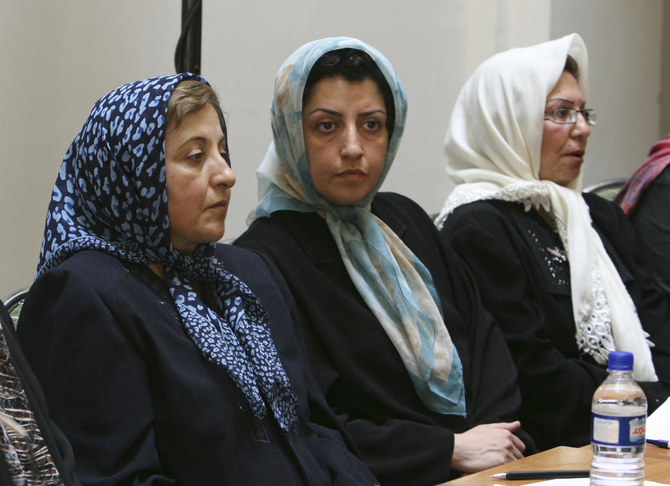
OSLO: Imprisoned activist Narges Mohammadi won the Nobel Peace Prize Friday for fighting the oppression of women in Iran.
“This prize is first and foremost a recognition of the very important work of a whole movement in Iran with with its undisputed leader, Nargis Mohammadi,” said Berit Reiss-Andersen, the chair of the Norwegian Nobel Committee who announced the prize in Oslo. “The impact of the prize is not for the Nobel committee to decide upon. We hope that it is an encouragement to continue the work in whichever form this movement finds to be fitting.”
Authorities arrested Mohammadi in November after she attended a memorial for a victim of violent 2019 protests. Reiss-Andersen said Mohammadi has been imprisoned 13 times and convicted five times. In total, she has been sentenced to 31 years in prison.
She is the 19th woman to win the Nobel Peace Prize and the second Iranian woman, after human rights activist Shirin Ebadi won the award in 2003.
Mohammadi was behind bars for the recent nationwide protests over the death of 22-year-old Mahsa Amini, who died after she she was detained by the country’s morality police. That sparked one of the most-intense challenges ever to Iran’s theocracy since its 1979 Islamic Revolution. More than 500 people were killed in a heavy security crackdown while over 22,000 others were arrested.
However, Mohammadi contributed an opinion piece for The New York Times from behind bars.
“What the government may not understand is that the more of us they lock up, the stronger we become,” she wrote.
There was no immediate reaction from Iranian state television and other state-controlled media. Some semiofficial news agencies acknowledged Mohammadi’s win in online messages, citing foreign press reports.
Before being jailed, Mohammadi was vice president of the banned Defenders of Human Rights Center in Iran. She has been close to Ebadi, who founded the center.
In 2018, Mohammadi, an engineer, was awarded the 2018 Andrei Sakharov Prize.
The Nobel Prizes carry a cash award of 11 million Swedish kronor (about $1 million). Winners also receive an 18-carat gold medal and diploma at the award ceremonies in December.
The winner of the prestigious Nobel Peace Prize is chosen by a panel of experts in Norway from a list of just over 350 nominations.
Last year’s prize was won by human rights activists from Ukraine, Belarus and Russia, in what was seen as a strong rebuke to Russian President Vladimir Putin and his Belarusian counterpart and ally.
Other previous winners include Nelson Mandela, Barack Obama, Mikhail Gorbachev, Aung San Suu Kyi and the United Nations.
Unlike the other Nobel prizes that are selected and announced in Stockholm, founder Alfred Nobel decreed that the peace prize be decided and awarded in Oslo by the five-member Norwegian Nobel Committee. The independent panel is appointed by the Norwegian parliament.
The peace prize is the fifth of this year’s prizes to be announced. A day earlier, the Nobel committee awarded Norwegian writer Jon Fosse the prize for literature. On Wednesday, the chemistry prize went to US scientists Moungi Bawendi, Louis Brus and Alexei Ekimov.
The physics prize went Tuesday to French-Swedish physicist Anne L’Huillier, French scientist Pierre Agostini and Hungarian-born Ferenc Krausz. Hungarian-American Katalin Karikó and American Drew Weissman won the Nobel Prize in medicine on Monday.
Nobels season ends next week with the announcement of the winner of the economics prize, formally known as the Bank of Sweden Prize in Economic Sciences in Memory of Alfred Nobel.


![]()

Narges Mohammadi wins the Nobel Peace Prize for fighting the oppression of women in Iran
Short Url
https://arab.news/cdxwc
Narges Mohammadi wins the Nobel Peace Prize for fighting the oppression of women in Iran
- Authorities arrested Mohammadi in November after she attended a memorial for a victim of violent 2019 protests
- Mohammadi contributed an opinion piece for The New York Times from behind bars
Latest updates


© 2026 SAUDI RESEARCH & PUBLISHING COMPANY, All Rights Reserved And subject to Terms of Use Agreement.