

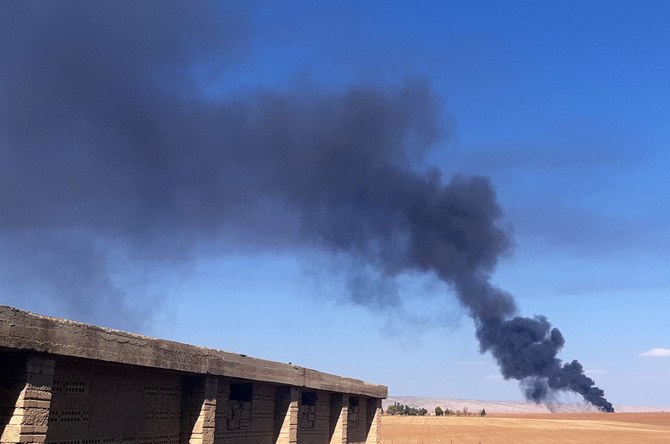
Eight killed in Turkish air strikes on Kurdish-held zone in Syria

Short Url
Updated 05 October 2023
Follow

Eight killed in Turkish air strikes on Kurdish-held zone in Syria

  • Turkiye has also launched strikes on positions of the Kurdistan Workers’ Party (PKK) in northern Iraq since Sunday
  • Between 2016 and 2019, Turkiye carried out three major operations in northern Syria against Kurdish forces

BEIRUT: At least eight people have been killed in Turkish drone strikes on Thursday on the Kurdish-held zone of northeast Syria, a war monitor and a local security source said, following Ankara’s threats against Kurdish military facilities in Syria and Iraq.
Two were killed in a strike on a car near a military facility and another six were killed in a later strike on a military post near the town of Amuda, the security source told Reuters.
Turkiye said Wednesday that all Kurdish militant facilities in Syria and Iraq are valid targets after it concluded that two attackers who detonated a bomb in front of government buildings in Ankara last weekend had come from Syria.
The Syrian Democratic Forces, the US-backed force dominated by the Kurdish YPG and which spearheaded a years-long campaign against the Daesh group, has denied the bombers came through territory it controls.
SDF head, Mazloum Abdi, said on Wednesday in a post on the social media platform X that Turkiye was looking for “pretexts” to carry on attacking SDF-held areas.
Aladdin Al-Ali, an aid worker running a camp for displaced people in northeast Syria, said relief organizations “suspended their work and left” following a strike near the camp.
Ankara has frequently carried out air strikes in northern Iraq against the outlawed PKK militia, which is designated as a terrorist organization by Turkiye, the European Union, and the United States.
It has also carried out several cross-border incursions into Syria targeting the YPG, which it views as a terrorist group affiliated with the PKK.

Ground Operations

A ground operation into Syria is one option Turkiye could consider, a defense ministry official said on Thursday after Ankara found that two attackers who had set off a bomb near government buildings at the weekend had come from Syria.
“Our only goal is to eliminate the terrorist organizations that pose a threat to Turkiye. A ground operation is one of the options to eliminate this threat, but it is not the only option for us,” the official said.


Israel orders Gaza families to move in first forced evacuation since ceasefire

Updated 58 min 21 sec ago
Follow

Israel orders Gaza families to move in first forced evacuation since ceasefire

  • Residents of Bani Suhaila, east of Khan Younis, said the leaflets were dropped on Monday on families living in tent encampments in the Al-Reqeb neighborhood

CAIRO: Israeli forces have ordered dozens of Palestinian families in the southern Gaza Strip to leave their homes in the first forced evacuation since October’s ceasefire, as residents and Hamas said on Tuesday the military was ​expanding the area under its control.
Residents of Bani Suhaila, east of Khan Younis, said the leaflets were dropped on Monday on families living in tent encampments in the Al-Reqeb neighborhood.
“Urgent message. The area is under IDF control. You must evacuate immediately,” said the leaflets, written in Arabic, Hebrew, and English, which the army dropped over the Al-Reqeb neighborhood in the town of Bani Suhaila.
In the two-year war before the US brokered ceasefire was signed in October, Israel dropped leaflets over areas that were subsequently raided or bombarded, forcing some families to move several times.
Residents and a source from the Hamas militant group said this was the first time they had been ‌dropped since then. ‌The Israeli military did not immediately respond to a request for comment.

SIDES FAR ‌APART ⁠ON ​NEXT PHASES
The ‌ceasefire has not progressed beyond its first phase, under which major fighting has stopped, Israel withdrew from less than half of Gaza, and Hamas released hostages in return for Palestinian detainees and prisoners.
Virtually the entire population of more than 2 million people are confined to around a third of Gaza’s territory, mostly in makeshift tents and damaged buildings, where life has resumed under control of an administration led by Hamas.
Israel and Hamas have accused each other of major breaches of the ceasefire and remain far apart on the more difficult steps planned for the next phase.
Mahmoud, a resident from the ⁠Bani Suhaila area, who asked not to give his family name, said the evacuation orders impacted at least 70 families, living in tents and homes, ‌some of which were partially damaged, in the area.
“We have fled ‍the area and relocated westward. It is maybe the ‍fourth or fifth time the occupation expanded the yellow line since last month,” he told Reuters by phone ‍from Khan Younis, referring to the line behind which Israel has withdrawn.
“Each time they move it around 120 to 150 meters (yards) inside the Palestinian-controlled territory, swallowing more land,” the father-of-three said.

HAMAS CITES STATE OF HUMANITARIAN DISRUPTION
Ismail Al-Thawabta, director of the Hamas-run Gaza government media office, said the Israeli military had expanded the area under its control in eastern Khan Younis five times since ​the ceasefire, forcing the displacement of at least 9,000 people.
“On Monday, 19 January 2026, the Israeli occupation forces dropped warning leaflets demanding the forced evacuation of the Bani Suhaila area in eastern ⁠Khan Younis Governorate, in a measure that falls within a policy of intimidation and pressure on civilians,” Thawabta told Reuters.
He said the new evacuation orders affected approximately 3,000 people.
“The move created a state of humanitarian disruption, increased pressure on the already limited shelter areas, and further deepened the internal displacement crisis in the governorate,” Thawabta added.
Israel’s military has previously said it has opened fire after identifying what it called “terrorists” crossing the yellow line and approaching its troops, posing an immediate threat to them.
It has continued to conduct air strikes and targeted operations across Gaza. The Israeli military has said it views “with utmost severity” any attempts by militant groups in Gaza to attack Israel.
Under future phases of the ceasefire that have yet to be hammered out, US President Donald Trump’s plan envisages Hamas disarming, Israel pulling out further, and an internationally backed administration rebuilding Gaza.
More than 460 Palestinians and three Israeli soldiers have been reported killed since the ceasefire took ‌effect.
Israel launched its operations in Gaza in the wake of an attack by Hamas-led fighters in October 2023 which killed 1,200 people, according to Israeli tallies. Israel’s assault has killed 71,000 people, according to health authorities in the enclave.