



GILGIT: A group of young programmers developed an online consumer app three years ago to serve the local community members in Pakistan’s northern Gilgit-Baltistan (GB) region, more famous for its stunning landscapes than technological prowess.
Yet, the app garnered surprising attention and business from major urban centers across Pakistan after a successful test run in Karachi last year in January, challenging the norm of tech start-ups typically emerging from big cities. Gilgit App, having expanded its reach in recent months, now finds more of its business originating outside its native region than within it.
Originally a part of uConnect Technologies, a local firm offering software solutions since 2016, the app emerged from a pre-marketing strategy on Facebook where it assisted locals in buying and selling vehicles.
Its debut not only shook the local market but also made ripples in cities far removed from GB, a beautiful but resource-limited area not commonly associated with Pakistan’s burgeoning tech sector.
“We started a service on Facebook under the name of Gilgit App where we used to technologically assist people with the buying and selling of bikes and other vehicles,” Ejaz Karim, one of the founders and CEO of Gilgit App, told Arab News in a recent conversation.
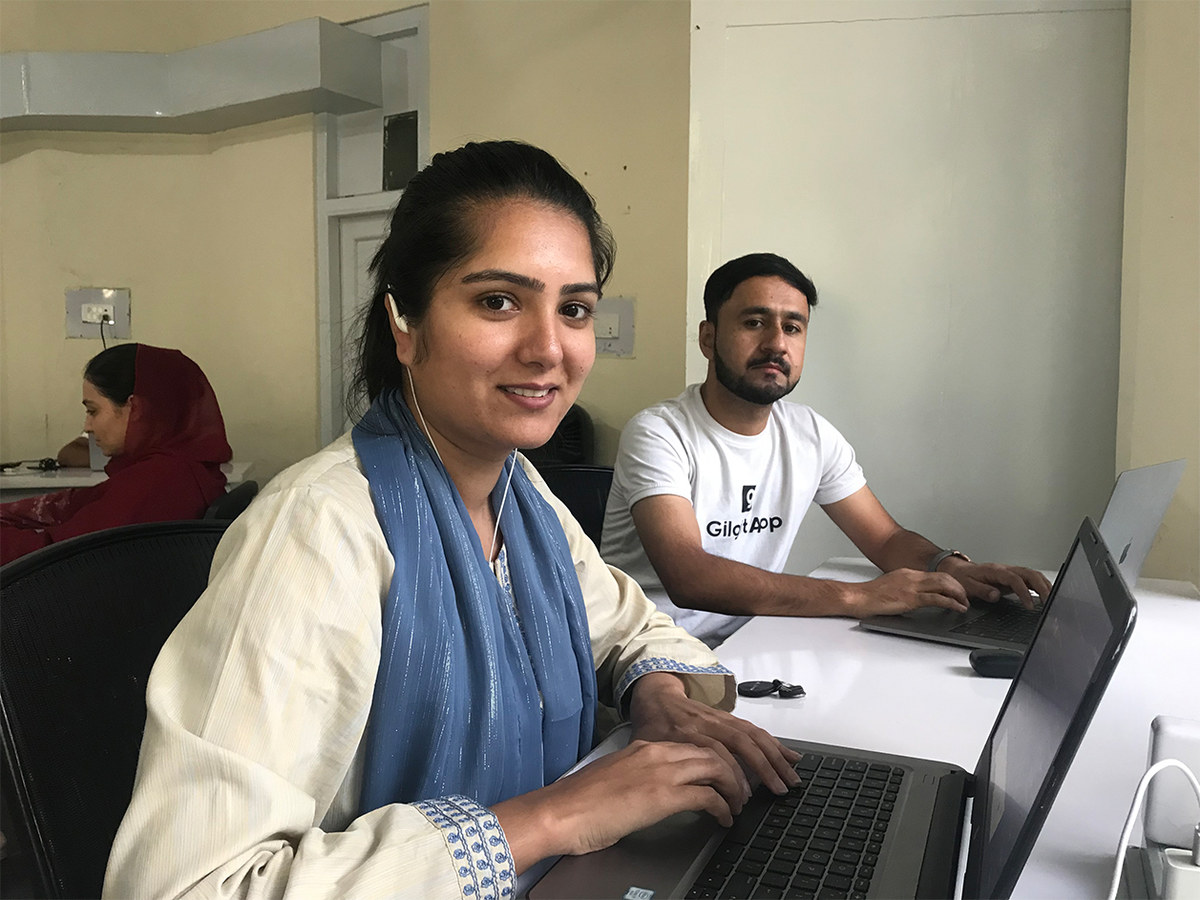
Team of Gilgit App poses for a photograph in Pakistan’s northern Gilgit-Baltistan (GB) region on September 9, 2022. (Photo courtesy: Gilgit App)
He informed the digital service was trending among the top app soon after its launch, adding that it was downloaded between 10,000 and 20,000 times within a brief span of 24 hours.
With an easy-to-use interface, the users of the online tool can buy and sell products, including cars, motorbikes, cellphones, laptops, home appliances, furniture, fashion products, property and pets, to meet their basic consumer needs.
“This app was initially designed and launched for the people of Gilgit,” Karim said. “But then our test run in Karachi got us a positive response. That’s when we released it in Lahore, Karachi, Rawalpindi and across Pakistan.”
“It now has more users in other cities compared to Gilgit,” he added.
Asked how his app was different from other mainstream platforms like OLX, he said that most online marketplace programs were “sellers-centric,” adding that his application also provided a comfortable experience to buyers since there were safety features in the app that protected them from fraudsters.
The Gilgit App CEO described frequent power breakdowns in his native region as one of the biggest problems faced by his company.
“This is especially true for the winter season when there is little to no electricity,” he said.
Additionally, he flagged the paucity of technical prowess around him as yet another issue while also mentioning the challenge of Internet connectivity.
“Nowadays, the Internet [issue] has almost resolved after the offices started to get fiber optics,” he said. “But many of our users [in GB] complain about the connectivity at their end. When the app runs slowly, the pace of downloading reduces as well.”
Discussing the expansion plans, Karim said the app was performing quite well, though his company wanted to strengthen itself further in the local market before making a move to the Middle East.
Shazia, who only goes by a single name, told Arab News she was the frontend developer.
“At Gilgit App, as a female, we get a favorable work environment to learn and hone our skills,” she said. “Our team leads deal with us respectfully and provide timely assistance to enhance our programming abilities.”
With the online consumer tool beginning to gain traction in local market, many of its users have started recommending it to others.
“I have been using Gilgit App for a year now, and my experience has been excellent,” Adnan Ali, whose job requires him to buy and sell sophisticated gadgets, told Arab News. “I’ve sold more than 10 products in the last year using this platform. Recently, I even sold a drone worth Rs120k.”
Ali called the app “user-friendly,” saying whenever he encountered an issue, the support team responded promptly and effectively.
“I highly recommend this app to anyone who’s looking to sell their products,” he continued. “I find it very reliable for finding the required items as well.”
Karamat Ali, another user, told Arab News he had been using the app for nearly three years.
“It has many good features to sell products,” he said. “But I would recommend the company to introduce inbox chatting and activate comments under photographs and images.”


