

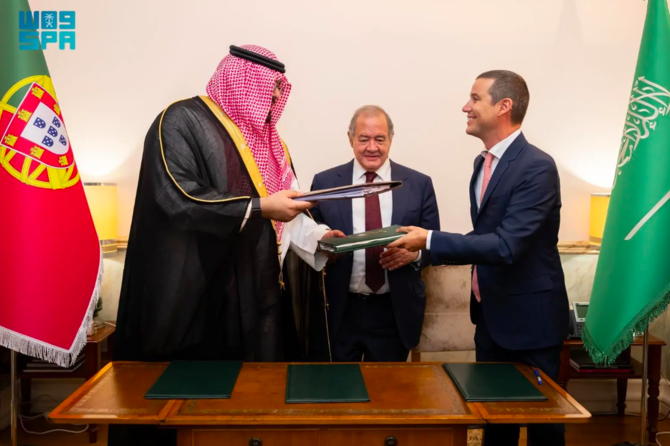

RIYADH: Air transport services between Saudi Arabia and Portugal are on course to flourish thanks to a new agreement between the Kingdom’s General Authority of Civil Aviation and the European country’s Ministry of Infrastructure.
Signed on the sidelines of the Saudi-Portuguese Joint Committee, the deal aims to establish air services that ensure the highest levels of safety and security, enhance trade exchange, and support economic growth between the two countries, the Saudi Press Agency reported.
The agreement is one of a range of contracts signed during the visit of Saudi Minister of Economy and Planning Faisal Al-Ibrahim to Lisbon. These deals aim to strengthen economic relations and promote increased collaboration between Riyadh and Lisbon.
“From 2021 to 2022, Saudi exports to Portugal surged by 50 percent, and imports from Portugal increased by almost 40 percent, culminating in a trade volume of $1 billion, underscoring the potential for enhanced collaboration between the two nations,” Al-Ibrahim said during his opening remarks at the Saudi-Portuguese Investment Forum.
He affirmed that confronting unprecedented global challenges, particularly climate change, sustainability, and post-pandemic economic recovery, calls for top-notch solutions where collaborative efforts between the public and private sectors in the Kingdom and Portugal can play an important role.

Saudi Minister of Economy and Planning Faisal Al-Ibrahim speaks at an investment forum held in Lisbon to explore investment opportunities in both countries. SPA
During his visit, on behalf of the chairman of the Saudi Food and Drug Authority board of directors, Al-Ibrahim also signed a memorandum of understanding with the Portuguese National Authority of Medicines and Health Products to propel the initiative.
The MoU aims to enhance cooperation and facilitate the trade of information and expertise between the two regulatory bodies in handling medicines, medical devices, and supplies.
The agreement will also tackle cosmetic products and related fields, including laboratories and inspection.
Under the terms of the MoU, both parties will unite to exchange experiences and information and facilitate technical visits.
They will also work on establishing on-the-job training related to laboratory tests for biological practices and the evaluation of bioequivalence studies.
The programs will also include conducting trials and assessing the safety and effectiveness of medical devices and supplies for licensing, marketing, and post-marketing control.
The Saudi minister held a meeting with the European country’s Minister of Agriculture and Food Maria do Ceu Antunes and discussed ways to boost economic ties.
He also met with his Portuguese counterpart Antonio Costa Silva to consider strategies to strengthen economic and investment cooperation between their respective countries.
The Saudi delegation includes representatives of different ministries and top officials of various government agencies.
In September, on the sidelines of the 2023 SDG Summit in New York, Al-Ibrahim met with Germany’s State Secretary for Economic, Finance, and European Affairs Jorg Kukies to discuss ways to strengthen economic, trade, and investment relations, as reported by SPA.
At the time, SPA said Al-Ibrahim also met with Swedish Minister for International Development Cooperation and Foreign Trade Johan Forssell to explore bilateral economic and investment relations between the two countries.
The meetings focused on the potential for increased international cooperation to accelerate the implementation of their SDGs, along with discussions established on mutual interests.
Prior to that, in June, economic relations between Riyadh and Paris received a significant boost when 24 agreements were signed at the French-Saudi Investment Forum.
The agreements were formalized by companies from both the Kingdom and France in a wide range of sectors, including energy, defense, and telecommunication, a statement released at the time revealed.
In May, a high-level delegation from Saudi Arabia’s Shoura Council visited the UK for the first time in years to share the Kingdom’s latest development and investment plans, enhance relations, and exchange expertise.
“Our visit aims to highlight the huge changes taking place in the Kingdom as part of Vision 2030, and the opportunities they bring, and also to underscore the importance and the significance of the umbrella strategic agreement between Saudi Arabia and the United Kingdom, with all the various areas that it intends to build,” Ghazi Binzagr, a member of the Shoura Council, told Arab News.


