Pakistan imposes 10 percent fee on Afghan transit trade items

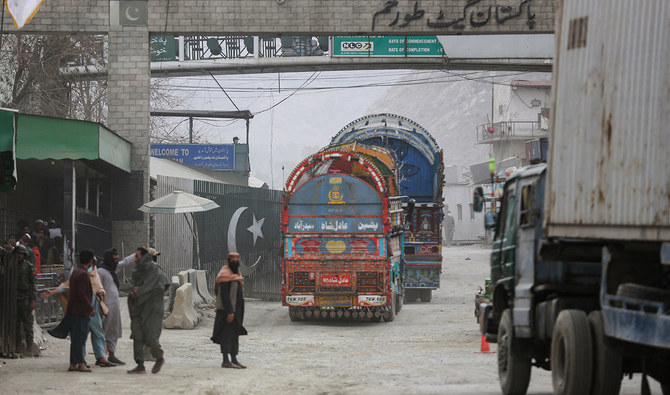
Goods carrier trucks cross into Pakistan at the zero point Torkham border crossing between Afghanistan and Pakistan, in Nangarhar province on February 25, 2023. (AFP/File)
Short Url
Updated 04 October 2023
Follow

Pakistan imposes 10 percent fee on Afghan transit trade items

  • The decision comes amid an intense crackdown against smugglers and hoarders to bolster the weakening economy
  • Officials say the move will prevent items destined for Afghanistan to be brought into Pakistani markets by traders

PESHAWAR: Pakistan announced on Tuesday to impose a 10 percent processing fee on several items imported from Afghanistan under a transit trade agreement in a step that has been viewed as an attempt to stop illegal entry of goods into the country from the neighboring state.
The government launched an intense crackdown against smugglers and black marketers last month to bolster the country’s weakening economy and bring down the prices of essential items in the market.
The counter smuggling operation prevented the flight of foreign currencies from Pakistan, leading to the stabilization of its value somewhat subsiding the inflationary pressure in the economy.
“In exercise of the powers conferred by section 18D of the Customs Act, 1969 (IV of 1969), the Federal Government is pleased to impose processing fee at the rate of 10 percent ad valorem on the following Afghan transit Commercial goods imported into Afghanistan in transit via Pakistan,” said a customs department notification while listing down the items.
These included confectionaries and chocolates, footwear, mechanical and electrical machinery, blankets and home textiles, and garments.
Pakistan’s Dawn newspaper reported customs officials “suspect that certain goods, though destined for Afghanistan, are clandestinely rerouted back into Pakistan, prompting this latest measure.”
However, the official notification said goods declarations filed prior to the decision on Tuesday would be exempt from the processing fee.
Pakistan has also announced to crack down on illegal immigrants, mostly Afghans, residing in the country, asking them to leave before the end of the month.


Pakistan, global crypto exchange discuss modernizing digital payments, creating job prospects 

Updated 05 December 2025
Follow

Pakistan, global crypto exchange discuss modernizing digital payments, creating job prospects 

  • Pakistani officials, Binance team discuss coordination between Islamabad, local banks and global exchanges
  • Pakistan has attempted to tap into growing crypto market to curb illicit transactions, improve oversight

ISLAMABAD: Pakistan’s finance officials and the team of a global cryptocurrency exchange on Friday held discussions aimed at modernizing the country’s digital payments system and building local talent pipelines to meet rising demand for blockchain and Web3 skills, the finance ministry said.

The development took place during a high-level meeting between Finance Minister Muhammad Aurangzeb, Pakistan Virtual Assets Regulatory Authority (PVARA) Chairman Bilal bin Saqib, domestic bank presidents and a Binance team led by Global CEO Richard Teng. The meeting was held to advance work on Pakistan’s National Digital Asset Framework, a regulatory setup to govern Pakistan’s digital assets.

Pakistan has been moving to regulate its fast-growing crypto and digital assets market by bringing virtual asset service providers (VASPs) under a formal licensing regime. Officials say the push is aimed at curbing illicit transactions, improving oversight, and encouraging innovation in blockchain-based financial services.

“Participants reviewed opportunities to modernize Pakistan’s digital payments landscape, noting that blockchain-based systems could significantly reduce costs from the country’s $38 billion annual remittance flows,” the finance ministry said in a statement. 

“Discussions also emphasized building local talent pipelines to meet rising global demand for blockchain and Web3 skills, creating high-value employment prospects for Pakistani youth.”

Blockchain is a type of digital database that is shared, transparent and tamper-resistant. Instead of being stored on one computer, the data is kept on a distributed network of computers, making it very hard to alter or hack.

Web3 refers to the next generation of the Internet built using blockchain, focusing on giving users more control over their data, identity and digital assets rather than big tech companies controlling it.

Participants of the meeting also discussed sovereign debt tokenization, which is the process of converting a country’s debt such as government bonds, into digital tokens on a blockchain, the ministry said. 

Aurangzeb called for close coordination between the government, domestic banks and global exchanges to modernize Pakistan’s payment landscape.

Participants of the meeting also discussed considering a “time-bound amnesty” to encourage users to move assets onto regulated platforms, stressing the need for stronger verifications and a risk-mitigation system.

Pakistan has attempted in recent months to tap into the country’s growing crypto market, crack down on money laundering and terror financing, and promote responsible innovation — a move analysts say could bring an estimated $25 billion in virtual assets into the tax net.

In September, Islamabad invited international crypto exchanges and other VASPs to apply for licenses to operate in the country, a step aimed at formalizing and regulating its fast-growing digital market.