Pakistani cybersecurity expert leads King Saud University in winning US AI-based biometrics patent

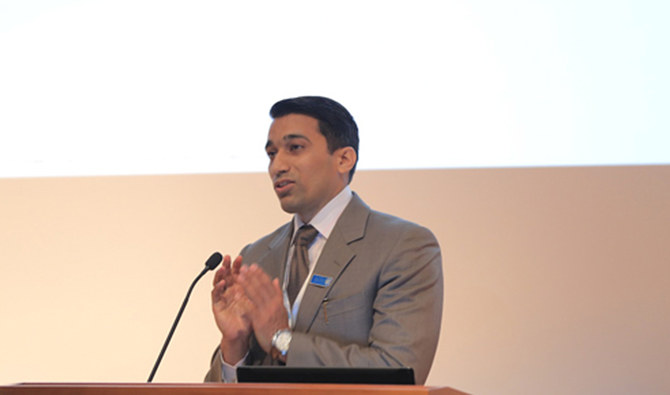
An undated file photo of Prof. Muhammad Khurram Khan. (Photo courtesy: www.professorkhurram.com/website)
Short Url
Updated 04 October 2023
Follow

Pakistani cybersecurity expert leads King Saud University in winning US AI-based biometrics patent

  • The university says it such research projects can help transform the kingdom into a knowledge-based economy
  • Muhammad Khurram Khan, who led the research team, has set up a cybersecurity think tank in the United States

KARACHI: King Saud University has won a patent from the United States by developing a biometrics-based iris recognition system after carrying out a project led by an accomplished Pakistani expert who is also the founded of an independent and non-partisan cybersecurity think-tank in Washington.
According to a post shared on the university’s website, the new system uses artificial intelligence and employs deep learning-based methods for extracting discriminant features from biometric traits obtained from eyeball images.
Muhammad Khurram Khan, who carried out and supervised the research, is a distinguished professor of cybersecurity from the Center of Excellence in Information Assurance and the founding CEO of the US think tank, Global Foundation for Cyber Studies and Research.
“The invention provides an innovative method based on multi-algorithm, multi-biometric, and multi-instance approaches to a single biometric source that enhances security and performance of the identification process at significant level,” the Saudi university announced.
“The invented technology has widespread applications, which are not only limited to areas such as immigration and border control, health care, banking and finance, consumer electronics, smart mobility, and military and defense, etc.,” it added.
The university website also proclaimed that Khan and his research team held a number of US patents in cybersecurity and had also published numerous high-impact research papers in flagship journals.
It also highlighted its own commitment to such research and development projects to transform the kingdom into a knowledge-based economy under Vision 2030.


Pakistan reviews austerity measures amid Middle East crisis, urges strict nationwide implementation

Updated 11 March 2026
Follow

Pakistan reviews austerity measures amid Middle East crisis, urges strict nationwide implementation

  • Deputy Prime Minister Ishaq Dar chairs review meeting of austerity steps
  • Officials briefed on salary cuts, school closures, four‑day week, petrol conservation

ISLAMABAD: Pakistan’s government on Wednesday assessed progress on a sweeping set of austerity measures introduced to mitigate the country’s economic strain from sharply rising global oil prices and supply disruptions linked to the ongoing war in the Middle East.

Prime Minister Shehbaz Sharif this week announced a series of austerity steps, including a four‑day work week for government offices, requiring 50  percent of staff to work from home, cutting fuel allowances for official vehicles by half, grounding up to 60  percent of the government fleet and closing all schools for two weeks to conserve fuel amid the global oil crisis.

The measures were unveiled in response to global oil market volatility triggered by the conflict involving the United States, Israel and Iran, which has disrupted supply routes such as the Strait of Hormuz and pushed crude prices sharply higher, straining Pakistan’s heavily import‑dependent energy sector.

“The meeting stressed the importance of strict and transparent adherence to the austerity measures, promoting fiscal responsibility and prudent use of public resources,” Deputy Prime Minister and Foreign Minister Senator Mohammad Ishaq Dar said in a statement.

He was chairing a meeting of the Committee for Monitoring and Implementation of Conservation and Additional Austerity Measures, constituted under the directions of the PM, bringing together federal and provincial officials to review execution of the broad cost‑cutting plan. 

Dar emphasized the government’s commitment to enforcing the PM’s austerity steps nationwide. The committee’s review also covered reductions in departmental expenditure, deductions from salaries of senior officials earning over Rs. 300,000 ($1,120), and coordination with provincial administrations to ensure uniform implementation of the plan.

Participants at the meeting reiterated that all ministries and divisions must continue strict monitoring and reporting, with transparent oversight mechanisms, as Pakistan navigates the economic pressures from the prolonged Middle East crisis and its fallout on global energy and trade markets.