Pakistan’s cotton production bounces back after last year’s losses, records 71 percent growth

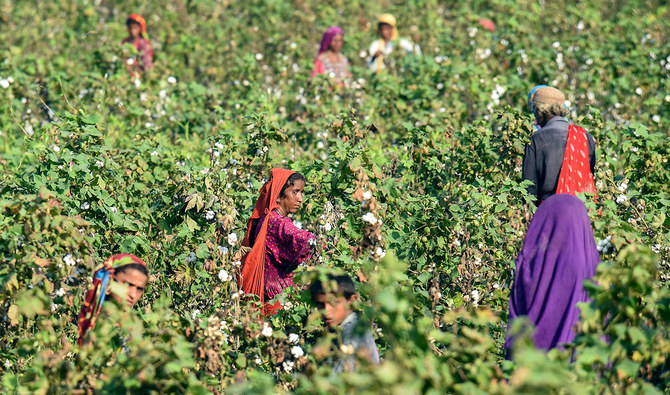
In this picture taken on September 1, 2022 labourers pick cotton in a field at Sammu Khan Bhanbro village in Sukkur, Sindh province. (AFP/File)
Short Url
Updated 04 October 2023
Follow

Pakistan’s cotton production bounces back after last year’s losses, records 71 percent growth

  • The country witnessed a massive decline of 34 percent in cotton production last year due to the floods
  • The government calls this year’s production level ‘momentous,’ expects a bumper crop of 12 million bales

ISLAMABAD: Pakistan’s cotton producers have made a remarkable comeback after suffering massive losses due to last year’s monsoon floods, with the commerce ministry announcing a 71 percent year-on-year growth in the ongoing year by issuing a brief statement on Tuesday.
Cotton is the main raw material of Pakistan’s textile sector which contributes about 60 percent to the overall exports of the country.
Torrential rains during monsoon last year triggered flash flood, destroying people’s houses and farmlands across much of the country.
The situation caused a huge setback to cotton production sector that experienced a 34 percent year-on-year decline, according to the official figures.
However, the ministry said in its statement that the “astounding 71 percent year-on-year growth” had “not only surpassed the previous year’s figures but also exceeded expectations.”
“Cotton arrivals crossing the 5 million bales mark on October 1, 2023, is a momentous achievement for Pakistan,” Dr. Gohar Ejaz, the interim commerce minister, said while commenting on the development. “Last year, our total crop was 5 million bales, and this year, we are anticipating a bumper crop of 12 million bales.”
“This remarkable growth showcases the dedication and hard work of our farmers and the resilience of our cotton industry,” he added.
The minister also promised to support and promote the cotton sector of the country, saying it had always played an “indispensable role” in Pakistan’s economic development and global competitiveness.
According to the textile industry stakeholders, the country’s cotton production has been shrinking in recent years.
“The cotton output in Pakistan is declining mainly due to the climate change-related issues and reduction in the cultivation area,” Chaudhry Waheed Arshad, a top official of Pakistan Cotton Ginners Association, told Arab News earlier this year in January.


Pakistan Air Force conducts ‘Exercise Golden Eagle’ to test combat readiness, agility

Updated 10 February 2026
Follow

Pakistan Air Force conducts ‘Exercise Golden Eagle’ to test combat readiness, agility

  • The exercise follows an intense, four-day Pakistan-India military conflict in May 2025
  • It focused on AI-enabled operations integrating disruptive technologies, military says

ISLAMABAD: The Pakistan Air Force (PAF) has conducted “Exercise Golden Eagle” that successfully validated its combat readiness and operational agility through synchronized employment of the PAF’s complete combat potential, the Pakistani military said on Tuesday.

It comes months after Pakistan’s four-day military conflict with India in May, with Islamabad claiming victory in the standoff after the PAF claimed to have shot down at least six Indian fighter aircraft, including the French-made Rafale. New Delhi acknowledged some losses but did not specify a number.

The exercise was conducted on a Two-Force construct, focusing on AI-enabled, net-centric operations while integrating indigenous niche, disruptive and smart technologies in line with evolving regional security dynamics, according to the Inter-Services Public Relations (ISPR), the Pakistani military’s media wing.

Operating within a robust Integrated Air Defense System, friendly forces shaped the battlespace through seamless fusion of kinetic operations with cyber, space and electro-magnetic spectrum operations.

“The kinetic phase featured First-Shoot, First-Kill swing-role combat aircraft equipped with long-range BVR air-to-air missiles, extended-range stand-off weapons and precision strike capabilities, supported by Airborne Early Warning & Control platforms and Air-to-Air Refuelers,” the ISPR said in a statement.

“A key highlight of the exercise was Manned–Unmanned Teaming, with deep-reach killer drones and loitering munitions operating in a highly contested, congested and degraded environment, validating PAF’s capability to conduct high-tempo operations in modern warfare.”

In recent months, many countries have stepped up defense engagement with Pakistan, while delegations from multiple nations have proposed learning from the PAF’s multi-domain air warfare capabilities that officials say were successfully employed during the May conflict.

“The successful conduct of Exercise Golden Eagle reaffirms Pakistan Air Force’s unwavering commitment to maintaining a high state of operational preparedness, leveraging indigenous innovation and effectively countering emerging and future security challenges,” the ISPR added.