

Onus on Pakistan batters to paper over bowling cracks

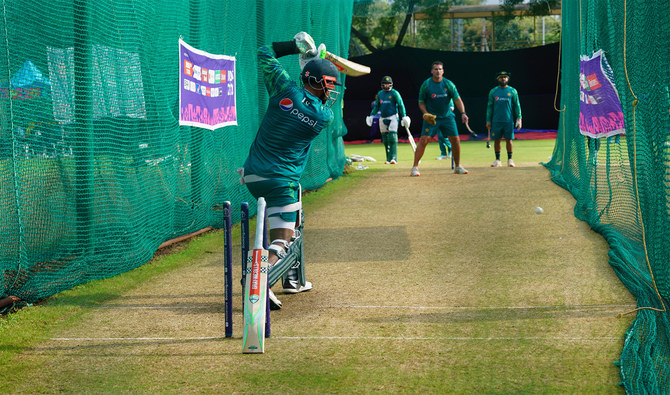
Pakistani skipper Babar Azam plays a shot during a practice session ahead of the Pakistan cricket team's second warm-up match against Australia in India's Hyderabad Cricket Stadium on October 01, 2023. (Photo courtesy: Pakistan Cricket Board)
Short Url
Updated 02 October 2023
Follow

Onus on Pakistan batters to paper over bowling cracks

  • India’s batting friendly pitches expected to pose challenges for Pakistani bowlers
  • Defeats by India, Sri Lanka dented Pakistan’s confidence ahead of the World Cup

NEW DELHI: Bowling has traditionally been Pakistan’s strong suit but since that is unlikely to be the case in India, the onus will be on their batters, skipper Babar Azam in particular, to drive their bid for a second 50-overs World Cup title.

Pakistan were the number one ODI side a month ago and Babar’s team looked favorites as they began their campaign in the recent Asia Cup.

Defeats by arch-rivals India and Sri Lanka in the tournament not only knocked them off the perch, however, but also left them with new concerns.

Pace spearhead Naseem Shah injured his bowling shoulder against India and was ruled him of the World Cup disrupting his potent new-ball partnership with Shaheen Afridi.

Hasan Ali was drafted in but Pakistan would not rely to a large extent on Afridi to get those early breakthroughs.

Pakistan spinners, including vice-captain Shadab Khan, also struggled for wickets in the tournament but Babar believes in the players who put the side top of the rankings.

“We know we have lapsed in fielding and in our wicket-taking abilities in the middle overs but we are going to work on it and hopefully will not be repeating them,” Babar said before leaving for India.

The 28-year-old was not amused when asked if the 1992 winners would be happy with a top-four finish in India.

“The top-four is a small goal for us. We want to come out as winners,” said Babar.

Although this is not the first time Pakistan would enter a World Cup looking slightly unsettled, they will have their work cut out in India.

That is partly because Pakistan face a unique problem in India, for geopolitical reasons.

Thanks to a soured political relationship between the Asian neighbors, bilateral cricket remains suspended between India and Pakistan, who meet only in multi-team events.

Pakistan last toured India for the T20 World Cup in 2016 and their players do not feature in the Indian Premier League either.

It leaves them with little knowledge of the conditions they would encounter in the next six weeks but Babar is unperturbed.

“Although we have not played in India before, we are not under any pressure,” he said.

“We have done our research and we have heard the conditions are quite similar except maybe in Chennai where spinners get a lot of help.”

Pakistan begin their campaign against the Netherlands on Oct. 6 and face India in a soldout Oct. 14 game in Ahmedabad.


Pakistan blocks ‘thousands’ of passports in crackdown on overseas begging in Gulf countries

Updated 5 sec ago
Follow

Pakistan blocks ‘thousands’ of passports in crackdown on overseas begging in Gulf countries

  • Authorities impose five- to 10-year passport restrictions on deported offenders, report sharp decline in cases
  • Government links enforcement drive to broader push for skilled labor exports and record remittance inflows

ISLAMABAD: Pakistan has blocked “several thousand passports” and imposed long-term travel restrictions on citizens involved in begging abroad, the country’s overseas minister said on Wednesday, reporting a sharp decline in such cases following enforcement reforms.

Last August, the government announced a sweeping crackdown on what it described as a “beggar mafia” accused of exploiting visas to solicit money in Saudi Arabia and other Middle Eastern states. The practice had drawn complaints from Riyadh, prompting Islamabad to direct the Federal Investigation Agency (FIA) to curb the trend.

Federal Minister for Overseas Pakistanis Chaudhry Salik Hussain said authorities were targeting individuals who misuse Umrah and other visit visas to beg overseas, particularly in Gulf countries.

“We are not sending the beggars abroad,” he said at the Pakistan Governance Forum 2026 in the federal capital. “It is not written on the face of the beggar that he is a beggar. They go through the normal process of getting a visa for Umrah and then start this work on the side.”

Hussain said passports of deported individuals involved in begging or criminal activity were being blocked to prevent repeat travel.

“For that we can only do that if someone is involved in this work and he is caught and when he is deported, then at least we block his passport, which is happening,” he said. “Believe me, there has been a drastic drop in this.”

“There is no visa for begging. They go on a normal visa. Every document is 100 percent correct,” he added.

According to Hussain, the FIA is imposing passport restrictions of five to 10 years on offenders, preventing them from obtaining new travel documents.

He added that “several thousand passports” had so far been blocked.

Pakistan, which relies heavily on remittances from its overseas workforce, is also seeking to improve the quality of labor exports following meetings with labor ministers in Qatar, Bahrain, Saudi Arabia and the United Arab Emirates.

“We want our workforce to go there. The quantity is increasing but the quality element is very important,” he said, adding that the government plans to make soft skills training compulsory for Pakistanis going abroad “from the labor class to the undergraduates” so they better understand local norms and regulations.

The minister said exporting skilled labor helps ease unemployment pressures driven by Pakistan’s growing youth population while boosting remittances, which recently hit an all-time high.

“I think this is one of the reasons because our youth bulge is very high in Pakistan and local industries are not enough to cater to that. So we should at least find good jobs in foreign countries and send them there,” he said, adding that overseas workers “not only get employed but also send valuable remittances back home.”

Hussain said broader reforms were also under way to digitize overseas employment processes and reduce corruption.

“We are moving toward maximum digitization,” he said. “Problems and issues arise where humans interact with humans. We are moving toward digitization very quickly.”