

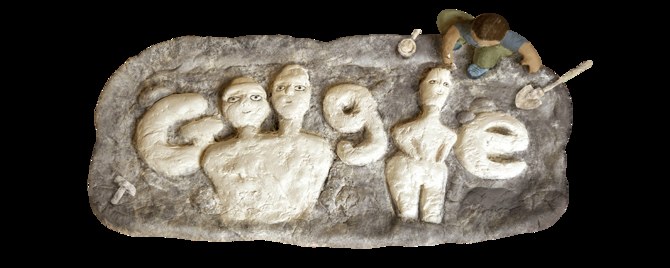
Google pays homage to Jordan’s Ain Ghazal statues in latest Doodle

Google’s handcrafted Doodles are intended to commemorate holidays, events, achievements, and notable historical figures.
Short Url
Updated 20 November 2023
Follow

Google pays homage to Jordan’s Ain Ghazal statues in latest Doodle

DUBAI: Google on Saturday paid homage to the prehistoric Ain Ghazal statues first unearth in Jordan in the latest addition to its homepage.

Google’s handcrafted Doodles are intended to commemorate holidays, events, achievements, and notable historical figures.

Two caches of the statues — roughly 9,000 years old and considered one of the earliest large-scale representations of the human form — were unearthed, the first on this day in 1983, at the Neolithic site of Ain Ghazal, near Amman. The second group of sculptures were discovered in 1985.

The Ain Ghazal figures depict men, women, and children with intricate human features such as almond-shaped eyes, prominent noses, and realistic legs, toes and toenails. Experts still have no concrete answers why these sculptures were created by unknown craftsmen, although it is known that after the statues served their purpose, their prehistoric creators strategically buried the sculptures, aligning them east to west.

Neolithic peoples gave these statues definitive use-lives; they were created, fulfilled a purpose, presumably in some sort of religious or cultic ceremony, and then were destroyed and buried, one study noted.

Both caches of statues where brought to the US to undergo radiocarbon dating: the first was found to be older at 80 years before or after 6750 BC while the second cache’s statues’ creation seemed to lie within 80 years of 6710 BC.

The statues have gained global interest and can be viewed today at galleries such as the Jordan Museum, Jordan Archaeological Museum, British Museum and Louvre Abu Dhabi, where people can go to ponder the mysteries of the past, Google explained in its description of the Doodle.


Foreign press group welcomes Israel court deadline on Gaza access

Updated 36 sec ago
Follow

Foreign press group welcomes Israel court deadline on Gaza access

  • Supreme Court set deadline for responding to petition to Jan. 4
  • Since the start of the Gaza war in October 2023, Israeli authorities have prevented foreign journalists from independently entering the Strip
JERUSALEM: The Foreign Press Association in Jerusalem on Sunday welcomed the Israeli Supreme Court’s decision to set January 4 as the deadline for Israel to respond to its petition seeking media access to Gaza.
Since the start of the Gaza war in October 2023, sparked by Palestinian militant group Hamas’s attack on Israel, Israeli authorities have prevented foreign journalists from independently entering the devastated territory.
Israel has instead allowed, on a case-by-case basis, a handful of reporters to accompany its troops into the blockaded Palestinian territory.
The Foreign Press Association (FPA), which represents hundreds of foreign journalists in Israel and the Palestinian territories, filed a petition to the supreme court last year, seeking immediate access for international journalists to the Gaza Strip.
On October 23, the court held a first hearing on the case, and decided to give Israeli authorities one month to develop a plan for granting access.
Since then the court has given several extensions to the Israeli authorities to come up with their plan, but on Saturday it set January 4 as a final deadline.
“If the respondents (Israeli authorities) do not inform us of their position by that date, a decision on the request for a conditional order will be made on the basis of the material in the case file,” the court said.
The FPA welcomed the court’s latest directive.
“After two years of the state’s delay tactics, we are pleased that the court’s patience has finally run out,” the association said in a statement.
“We renew our call for the state of Israel to immediately grant journalists free and unfettered access to the Gaza Strip.
“And should the government continue to obstruct press freedoms, we hope that the supreme court will recognize and uphold those freedoms,” it added.
An AFP journalist sits on the board of the FPA.