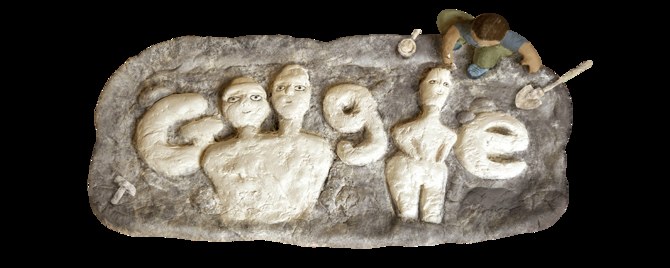
Google pays homage to Jordan’s Ain Ghazal statues in latest Doodle

Google’s handcrafted Doodles are intended to commemorate holidays, events, achievements, and notable historical figures.
Short Url
Updated 20 November 2023
Follow

Google pays homage to Jordan’s Ain Ghazal statues in latest Doodle

DUBAI: Google on Saturday paid homage to the prehistoric Ain Ghazal statues first unearth in Jordan in the latest addition to its homepage.

Google’s handcrafted Doodles are intended to commemorate holidays, events, achievements, and notable historical figures.

Two caches of the statues — roughly 9,000 years old and considered one of the earliest large-scale representations of the human form — were unearthed, the first on this day in 1983, at the Neolithic site of Ain Ghazal, near Amman. The second group of sculptures were discovered in 1985.

The Ain Ghazal figures depict men, women, and children with intricate human features such as almond-shaped eyes, prominent noses, and realistic legs, toes and toenails. Experts still have no concrete answers why these sculptures were created by unknown craftsmen, although it is known that after the statues served their purpose, their prehistoric creators strategically buried the sculptures, aligning them east to west.

Neolithic peoples gave these statues definitive use-lives; they were created, fulfilled a purpose, presumably in some sort of religious or cultic ceremony, and then were destroyed and buried, one study noted.

Both caches of statues where brought to the US to undergo radiocarbon dating: the first was found to be older at 80 years before or after 6750 BC while the second cache’s statues’ creation seemed to lie within 80 years of 6710 BC.

The statues have gained global interest and can be viewed today at galleries such as the Jordan Museum, Jordan Archaeological Museum, British Museum and Louvre Abu Dhabi, where people can go to ponder the mysteries of the past, Google explained in its description of the Doodle.


Eurovision Sport, Camb.ai to provide live subtitling for Paralympic Winter Games

Updated 06 March 2026
Follow

Eurovision Sport, Camb.ai to provide live subtitling for Paralympic Winter Games

  • Partnership aims to increase accessibility for all audiences
  • Milano Cortina Games run from Friday to March 15

LONDON: Eurovision Sport, the European Broadcasting Union’s free-to-air streaming platform, will provide live and on-demand subtitling for coverage of the Milano Cortina 2026 Paralympic Winter Games in partnership with AI language company Camb.ai

The service will run across all competition days, allowing viewers to stream all six Paralympic Winter Games sports on Eurovision Sport with real-time subtitles. The Games open on Friday and run through March 15.

Camb.ai will supply contextual speech-to-text transcription for both live and catch-up coverage, which the organizers said would support accessibility without altering the editorial integrity of broadcasts.

Eurovision Sport Managing Director Alan Fagan said the aim was to make the Games available to “the widest possible audience,” by scaling up digital accessibility across every event on the platform.

The initiative forms part of the EBU’s most extensive digital coverage of a Paralympic Winter Games to date and complements member broadcasters’ linear output.

It also reflects a wider industry push to make live sport easier to follow for viewers watching without sound, people with hearing impairments and audiences consuming content on demand.

Camb.ai’s Chief Technology Officer Akshat Prakash said the company was proud to deepen its partnership with Eurovision Sport, describing the platform as a leader in applying new technology to sports coverage.

The two organizations began working together in 2024, when they delivered what they described as Europe’s first AI-powered real-time translated sports commentary during European Athletics events.