

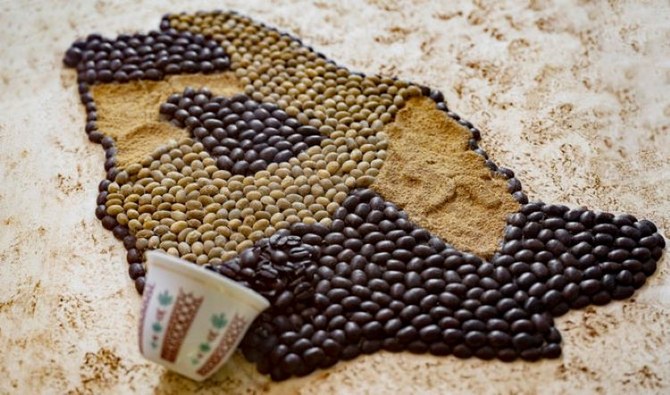
Coffee, an integral part of Saudi culture, hospitality 

Coffee and the people in Saudi Arabia are inseparable, as admiration for coffee is deeply rooted in the culture. (Supplied)
Short Url
Updated 28 September 2023
Follow

Coffee, an integral part of Saudi culture, hospitality 

  • Ministry of Culture’s Saudi Coffee Festival is open until Oct. 1
  • Gathering for an afternoon drink has deep value as it brings people together

RIYADH: Coffee is deeply rooted in Saudi culture, with families in most regions savoring the hot beverage late afternoon or early morning every day, whether at home or at the workplace.  

Almost all commercial and residential neighborhoods have cozy local coffee outlets nestled between shops. 

To introduce Saudi coffee to visitors and highlight its role as part of Saudi heritage, the Ministry of Culture is organizing the Saudi Coffee Festival for 2023 in the eastern part of King Abdullah Financial District from Thursday until Oct. 1

Targeting all age groups, the festival will offer visitors the opportunity to learn more about the history of Saudi coffee, as well as its cultivation methods, preparation and presentation.

Saudi coffee is made by roasting coffee beans until they are golden brown. The coffee is then boiled and served as a dark, unfiltered drink. Spices such as saffron, cardamom and cloves are also added to the boiled coffee for flavor and richness. Dates or desserts are served alongside Saudi coffee to balance the bitter taste of the drink. 

Saudi national Nourah Al-Harbi, who is originally from Madinah but has lived mostly in Riyadh, said: “When the sun sets, we bring our coffee and dates.” 

Sharing an anecdote from her childhood, Al-Harbi said: “I remember one of my uncles owned a farm in Madinah at the time, when I was a child …  His neighbors used to gather at his farm every evening after sunset prayer for coffee.”

Despite the popularity of the beverage, some of the Kingdom’s regions prefer other drinks during their afternoon hours, such as tea.

Hashid Adeel Mohammed, who works at a local company that specializes in warm beverages like coffee and tea, said: “Some people prefer black tea, while others like green tea, which they also have specific ways of preparing.”

Another business entrepreneur, Anas Al-Balouchi, who works as a general manager at a coffee and tea company, spoke to Arab News about some of the norms when it comes to afternoon hot drinks for people in Madinah, where he is from.

“In Madinah, tea time starts from late afternoon until sunset. But coffee is consumed from sunset to early in the evening,” he said.

“Black coffee is served in the morning.”

In a family-oriented culture, gathering for an afternoon drink has deep value as it brings people together, whether relatives sharing a house or neighbors living in the same community.


Sotheby’s to hold second Saudi Arabia auction titled ‘Origins’

Updated 23 December 2025
Follow

Sotheby’s to hold second Saudi Arabia auction titled ‘Origins’

  • 70 works by local, Mideast, international artists on Jan. 31
  • Work of late Saudi artist Safeya Binzagr will also be on sale

DUBAI: Sotheby’s will have its second auction in Saudi Arabia on Jan. 31 featuring more than 70 works by leading local, Middle East and international artists.

Titled “Origins,” the sale will be staged again in Diriyah, the birthplace of the Kingdom and a UNESCO World Heritage Site. The full selection will be available for free public viewing at Bujairi Terrace from Jan. 24.


A post shared by Sotheby's (@sothebys)

The event coincides with the opening of the Diriyah Contemporary Art Biennale and comes just ahead of the debut of Art Basel Doha in February, marking Art Basel’s first fair in the Middle East.

The sale spans a wide range of collecting categories, including Ancient Sculpture, 20th-Century Design and Prints, Middle Eastern, Modern and Contemporary, Latin American, and Modern and Contemporary South Asian.

Ashkan Baghestani, Sotheby’s head of sale and contemporary art specialist, said in a recent press release that the second auction reflects the company’s continued commitment to Saudi Arabia’s growing ecosystem.

Among the headline lots is “Coffee Shop in Madina Road” (1968) by Safeya Binzagr (1940–2024), estimated at $150,000 to $200,000. She is considered one of Saudi Arabia’s pioneering artists and the “spiritual mother” of contemporary local art.

The piece comes from the collection of Alberto Mestas Garcia, Spain’s ambassador to Saudi Arabia from 1966 to 1976, and his wife, Mercedes Suarez de Tangil Guzman.

A 1989 untitled painting by Mohammed Al-Saleem (1939–1997), estimated at $150,000 to $200,000, is from a private collection in Bahrain. The work exemplifies his Horizonism style, inspired by desert landscapes, and follows his record $1.1 million sale at Sotheby’s London in 2023.

Also included is “Demonstration” (1968) by Iraqi modernist Mahmoud Sabri (1927–2012), estimated at $400,000 to $500,000. The work reflects Sabri’s socially engaged practice and combines social realism with Christian imagery in a charged depiction of mourning and protest.

Samia Halaby’s “Copper” (1976), estimated at $120,000 to $180,000, highlights the artist’s move toward abstraction in the 1970s. Halaby, born in Jerusalem and now based in the US, has works in major international collections and participated in the 60th Venice Biennale in 2024.

A rare early work by Egyptian artist Ahmed Morsi, “Deux Pecheurs” (“Two Fishermen”) (1954), is estimated at $120,000 to $180,000. Morsi’s works have appeared only five times at auction previously and are held in major museum collections worldwide.

International highlights include Pablo Picasso’s “Paysage” (1965), estimated at $2 million to $3 million. Painted in Mougins during the final decade of his life, the work reflects Picasso’s late engagement with landscape and his dialogue with art history.

Anish Kapoor’s large-scale concave mirror sculpture “Untitled” (2005), estimated at $600,000 to $800,000, is also offered. Executed during a period of major institutional recognition for the artist, the work comes from Kapoor’s iconic mirror series.

Andy Warhol’s “Disquieting Muses (After de Chirico) (1982), estimated at $800,000 to $1.2 million, reinterprets Giorgio de Chirico’s 1917 painting through Pop Art repetition. The sale includes Warhol’s set of four Muhammad Ali screenprints from 1978, estimated at $300,000 to $500,000.

Jean Dubuffet’s “Le soleil les decolore” (1947), estimated at $800,000 to $1.2 million, appears at auction for the first time. Painted after the artist’s travels in the Sahara, the work reflects his response to desert landscapes and nomadic life.

The auction will also feature seven works by Roy Lichtenstein from the personal collection of Dorothy and Roy Lichtenstein.

Leading the group are “Interior with Ajax (Study)” (1997), estimated at $600,000 to $800,000, and “The Great Pyramid Banner (Study)” (1980), estimated at $150,000 to $200,000.