

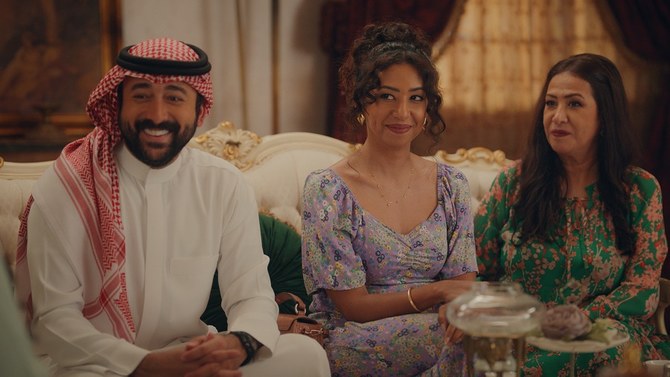
Saudi Netflix drama-comedy ‘Crashing Eid’ tackles romantic taboos with heart

“Crashing Eid” is family drama-comedy that tackles societal romantic taboos - it debuts worldwide on Oct. 19. (Supplied)
Short Url
Updated 28 September 2023
Follow

Saudi Netflix drama-comedy ‘Crashing Eid’ tackles romantic taboos with heart

DUBAI: Following hot on the heels of Netflix’s first Saudi original comedy series “Tahir’s House,” the global streamer has just announced another Jeddah-set original series that is tailor-made to get the Kingdom talking.

Created by Saudi filmmaker Nora Aboushousha (“Lucky You Are Mine”), “Crashing Eid” is family drama-comedy that tackles societal romantic taboos with both an irreverent spirit and a warm heart, set to debut worldwide on Oct. 19.

The show follows Razan (Summer Shesha), a Saudi woman living in the UK with her teenage daughter who plans to marry a British-Pakistani man under the assumption that her family will approve the pairing without question. When she returns home during Ramadan, with her fiancé following soon after as an uninvited guest, she soon finds that breaking with tradition may be harder than she had originally thought — to both hilarious and dramatic results.

Aboushousha, herself from Jeddah, is a rising star in the Kingdom, with her one-location lockdown crime series “Rahin Altaqiq” and drama comedy about rebellious young Saudi woman “Confessions” both becoming viral hits over the last few years. She is also no stranger to pushing boundaries, with her short “Lucky You Are Mine” winning a production grant by the Saudi Film Commission before debuting at the 2022 Red Sea International Film Festival in her hometown to strong acclaim.

“We started off with a concept of someone who is different from their family, and that grew into this story of a single mother who returns from abroad. We started wondering, what will inspire the clash with the rest of the family? And immediately we realized, ‘oh, she should come back ready to be married to someone from outside the culture!’ Everything fell into place from there,” Aboushousha told Arab News.

For Shesha, who steps into her first major lead role as Razan, the project inspired her not only because of the ways that the conceit allows each member of the family to flourish as they grapple with the events it sets into motion, but because the themes are so easy to relate to for so many people across the world.

“First of all, this show is awesome. I really think it is. That drew me to it to begin with. But it also mattered to me that this is on Netflix worldwide. This is a show with global themes of family, conflict and love. I really wanted a show that both felt specific and universal and this show has really captures that,” Shesha told Arab News.


Mini op-ed: Recognising a shift in how people relate to wellness, self-care

Updated 05 March 2026
Follow

Mini op-ed: Recognising a shift in how people relate to wellness, self-care

DUBAI: I have spent nearly a decade working in the beauty industry in Saudi Arabia and the UAE, and Ramadan always has a way of prompting change; in habits, in priorities, and in the routines people have been carrying without question. Speaking from my own corner of the industry, one of these habits is often hair removal.

Saudi Arabia’s beauty and personal care market was valued at about $7.56 billion in 2025 and is set to grow to an estimated $8.03 billion in 2026. Within that growth, personal care encompassing the daily (sometimes unglamorous) routines hold the largest share. But market size alone does not tell the full story. A study conducted at King Abdulaziz University Hospital, Jeddah, found that three quarters of Saudi women experienced complications from temporary hair removal methods, including skin irritation, in-grown hairs and hyperpigmentation. A separate 2025 study published in the Majmaah Journal of Health Sciences found that laser hair removal was both the most considered and most commonly undergone cosmetic procedure among Saudi respondents, yet dissatisfaction with cosmetic procedure outcomes was reported by nearly half of all participants. The numbers point to a gap not in demand, but in results. 

When I launched a specialized electrolysis practice in the UAE in 2016, it was with a clear gap in mind; safe, regulated, permanent hair removal for the region’s specific needs. The range of hair types here and the prevalence of conditions such as polycystic ovary syndrome, or PCOS, demanded a method that works across all of them.  Electrolysis is the only method recognized by the US Food and Drug Administration and American Marketing Association as achieving true permanent results, regardless of hair color or type. 

Despite this, awareness in Saudi Arabia remains limited. Part of this is familiarity, laser has dominated the conversation for years, and electrolysis, which requires more sessions and a licensed electrologist’s precision, has struggled to break through. Part of it is education. Many clients who come to us have never heard of electrolysis; they come because they have exhausted everything else. 

Right now, Saudi Arabia is in the middle of a genuine transformation in how people relate to wellness and self-care. The beauty market is maturing, consumers are asking harder questions of the brands they choose and Vision 2030 has not just shaped the economy, it has shaped how Saudis are showing up in their own lives. In that context, the idea of choosing permanence over repetition lands differently.
 
Mariela Marcantetti is a beauty industry entrepreneur based between Saudi Arabia and the UAE.