

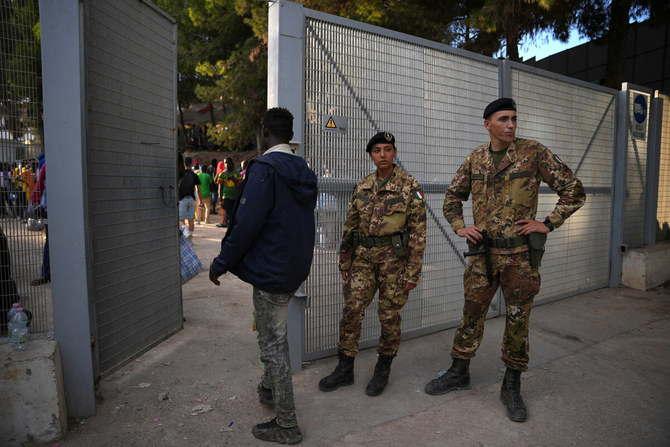

London: Italy will speed up age checks on migrants and deport those who falsely claim to be under the age of 18, amid a standoff between the EU and Tunisia over arrangements to stem the flow of people from North Africa to Europe, The Times reported on Thursday.
So far, 11,650 unaccompanied minors have arrived in Italy this year out of a total of 133,139 people — nearly double the number at the same stage last year. Under Italian law, migrants younger than 18 cannot be repatriated.
Italy currently uses psychological evaluation of migrants to determine age under a 2017 law, but it is now expected that X-rays of wrist bones will be used more frequently instead after new rules were approved on Wednesday.
Campaigners warn that the wrist X-ray approach to age verification is unreliable. “All the studies show you cannot use it to establish age with any certainty. There is a two-year margin of error,” Antonella Inverno, head of research, data and policy with Save the Children in Italy, told The Times.
Others have suggested X-raying molar teeth and collar bones as more reliable ways of ascertaining age.
“The collar bone is the best because it’s the last bone to completely form, but you would also need to consider ethnicity. Even then you still have an age range,” said Cristina Cattaneo, a professor of forensic medicine at the University of Milan.
The new decree will also see minors older than 16 placed in adult migrant holding centers, which has raised concerns across Italy as 21,000 unaccompanied minors, many of them Egyptian, have disappeared from such facilities.
Italian Sen. Sandra Zampa said: “Protecting minors immediately after they arrive is crucial. If you go to big markets in cities at 4 a.m. you will find Egyptian kids at work.”
The moves come as Italy continues to bear the brunt of an increased flow of people from North Africa, with Prime Minister Giorgia Meloni facing increased pressure from within her own party and from her coalition ally Matteo Salvini.
This week Meloni visited the island of Lampedusa, which has experienced a surge in migrant numbers in recent days, alongside European Commission President Ursula von der Leyen, who said: “The future of Europe depends on its ability to tackle epoch-making challenges of our time and the challenge of illegal immigration is for sure one of them.”
Officials in Brussels, meanwhile, are said to be displeased with Tunisia after the number of people leaving the country for Europe increased despite a deal struck in July to reduce boat crossings in exchange for millions of euros in aid.
Sources in Tunisia said the money from Europe had not been delivered, and President Kais Saied denied entry into the country to a number of European Commission representatives and members of the European Parliament earlier this month.
“I imagine the commission delegation will be welcome in Tunisia when the financial support promised is delivered,” Tarek Kahlaoui, former head of the Tunisian Institute of Strategic Studies, told The Times.


