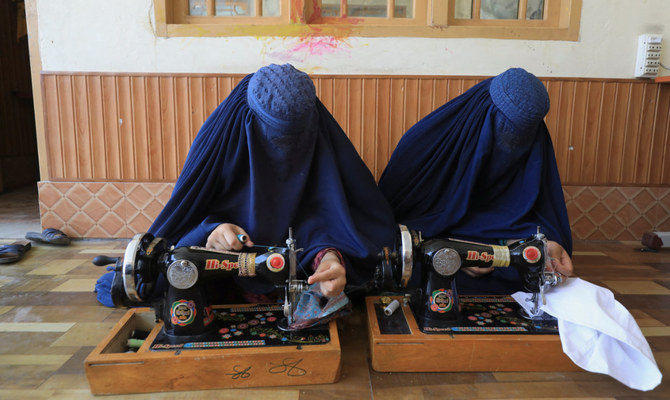
PESHAWAR, Pakistan: In a small workshop in the bustling northwestern Pakistani city of Peshawar, a dozen Afghan women sit watching a teacher show them how to make clothes on a sewing machine.
The skills center was set up last year by Peshawar resident Mahra Basheer, 37, after seeing the steady influx of people from neighboring Afghanistan where they face an economic crisis and growing restrictions on women since the Taliban took over in 2021.
Trying to create options for women to become financially independent, she opened the workshop to teach tailoring as well as digital skills and beauty treatments. Basheer quickly found hundreds of women enrolling and has a long wait list.
“If we get assistance, I think we will be able to train between 250 and 500 students at one time, empowering women who can play an important role in the community,” Basheer said.
Officials say hundreds of thousands of Afghans have traveled to Pakistan since foreign forces left and the Taliban took over in 2021. Even before then, Pakistan hosted some 1.5 million registered refugees, one of the largest such populations in the world, according to the United Nations refugee agency.
More than a million others are estimated to live there unregistered. Grappling with an economic crisis of its own, Pakistan’s government is increasingly anxious about the number of Afghans arriving, officials say. Lawyers and officials have said scores of Afghans have been arrested in recent months on allegations they don’t have the correct legal documents to live in Pakistan.
Basheer said that her main focus was expanding operations for Afghan women and she has also included some Pakistani women in the program to boost their opportunities in the conservative area. Once graduating from the three-month course, the women are focused on earning a modest but meaningful income, often starting their own businesses.
Nineteen-year-old Afghan citizen Fatima who had undertaken training at the center, said she now wanted to open a beauty parlour in Peshawar – currently banned in her home country just a few hours away.
“Right now my plan is to start a salon at home. Then to work very professionally so that I can eventually open a very big salon for myself,” she said.


![]()
![]()

Pakistani vocational school helps Afghan women refugees build businesses

Short Url
https://arab.news/2g45h
Pakistani vocational school helps Afghan women refugees build businesses
- Officials say hundreds of thousands of Afghans have traveled to Pakistan since foreign forces left and the Taliban took over in 2021


Latest updates



© 2026 SAUDI RESEARCH & PUBLISHING COMPANY, All Rights Reserved And subject to Terms of Use Agreement.