

Pakistan’s Punjab closes schools for four days amid surge in conjunctivitis cases

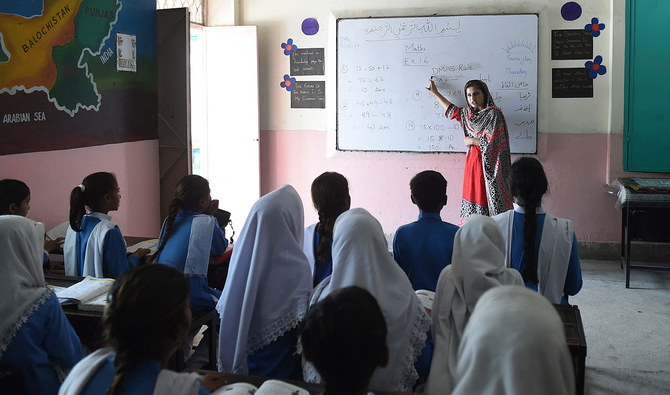
In this photograph taken on May 11, 2017, Pakistani students attend a class at a school on the outskirts of Lahore. (AFP/File)
Short Url
Updated 27 September 2023
Follow

Pakistan’s Punjab closes schools for four days amid surge in conjunctivitis cases

  • All public, private schools across Punjab to remain closed from Thursday to Sunday
  • Local media reports say state-run hospitals in Punjab treating between 500-600 patients

ISLAMABAD: Schools throughout Pakistan’s most populous Punjab province would remain closed for four days amid a surge in “pink eye” or conjunctivitis cases, the province’s School Education Department said in a notification on Wednesday.

Punjab has been grappling with a surge in conjunctivitis cases, with local media reports saying the number of patients seeking treatment in state-run hospitals across the province stand between 500-600.

Conjunctivitis, commonly known as “pink eye” condition, is an inflammation or infection of the conjunctiva, the clear, thin tissue that lines the inside of the eyelid and covers the white part of the eye. Doctors say conjunctivitis is a highly contagious disease that primarily spreads through direct contact with an infected person.

“In the wake of conjunctivitis/pink eye infection among school kids, the competent authority is pleased to announce that all public and private schools across the province shall remain closed from Thursday 28-09-2023 till Sunday 1-10-2023,” the notification read.

The School Education Department further said that schools would reopen across the province on Monday, Oct. 2 and would be required to follow all standard operating procedures to prevent the spread of the infection.

Punjab Caretaker Chief Minister Mohsin Naqvi toured the Mitha Teaching Hospital near Texali Gate in Lahore on Wednesday, saying that the situation regarding the eye infection remains “concerning.”

“ACs not working, non-operational X-ray machine, doctors with pink eye in operation theaters,” Naqvi wrote on social media platform X.

“We have set a 7-day deadline for the Health Department to address these issues.”

Pakistan’s southern port city of Karachi and other urban areas of Sindh province witnessed a surge in pink eye infections during the first week of September.

Doctors had advised patients to seek treatment for the condition and avoid self-medication.


US freezes visa processing for 75 countries, media reports Pakistan included

Updated 14 January 2026
Follow

US freezes visa processing for 75 countries, media reports Pakistan included

  • State Department announces indefinite pause on immigrant visas starting Jan 21
  • Move underscores Trump’s hard-line immigration push despite close Pakistan-US ties

ISLAMABAD: The United States will pause immigrant visa processing for applicants from 75 countries starting Jan. 21, the State Department said on Wednesday, with Fox News and other media outlets reporting that Pakistan is among the countries affected by the indefinite suspension.

The move comes as the Trump administration presses ahead with a broad immigration crackdown, with Pakistan included among the affected countries despite strong ongoing diplomatic engagement between Islamabad and Washington on economic cooperation, regional diplomacy and security matters.

Fox News, citing an internal State Department memo, said US embassies had been instructed to refuse immigrant visas under existing law while Washington reassesses screening and vetting procedures. The report said the pause would apply indefinitely and covers countries across Asia, Africa, the Middle East, Europe and Latin America.

“The State Department will pause immigrant visa processing from 75 countries whose migrants take welfare from the American people at unacceptable rates. The freeze will remain active until the US can ensure that new immigrants will not extract wealth from the American people,” the Department of State said in a post on X.

According to Fox News and Pakistan news outlets like Dawn, the list of affected countries includes Pakistan, Afghanistan, Bangladesh, Iran, Iraq, Egypt, Nigeria, Russia, Somalia, Brazil and Thailand, among others. 

“The suspension could delay travel, study, and work plans for thousands of Pakistanis who annually seek US visas. Pakistani consulates in the US are expected to provide guidance to affected applicants in the coming days,” Dawn reported.

A State Department spokesman declined comment when Arab News reached out via email to confirm if Pakistan was on the list. 

The Department has not publicly released the full list of countries or clarified which visa categories would be affected, nor has it provided a timeline for when processing could resume.

Trump has made immigration enforcement a central pillar of his agenda since returning to office last year, reviving and expanding the use of the “public charge” provision of US immigration law to restrict entry by migrants deemed likely to rely on public benefits.

During his previous term as president, Trump imposed sweeping travel restrictions on several Muslim-majority countries, a policy widely referred to as a “Muslim ban,” which was challenged in US courts before a revised version was upheld by the Supreme Court. That policy was later rescinded under the President Joe Biden administration.

The latest visa freeze marks a renewed hardening of US immigration policy, raising uncertainty for migrants from affected countries as Washington reassesses its screening and vetting procedures. 

The freeze on visas comes amid an intensifying crackdown on immigration enforcement by the Trump administration. In Minneapolis last week, a US Immigration and Customs Enforcement (ICE) agent shot and killed 37-year-old Renee Good, a US citizen, during a federal operation, an incident that has drawn nationwide protests and scrutiny of ICE tactics. Family members and local officials have challenged the federal account of the shooting, even as Department of Homeland Security officials defended the agent’s actions. The case has prompted resignations by federal prosecutors and heightened debate over the conduct of immigration enforcement under the current administration.