

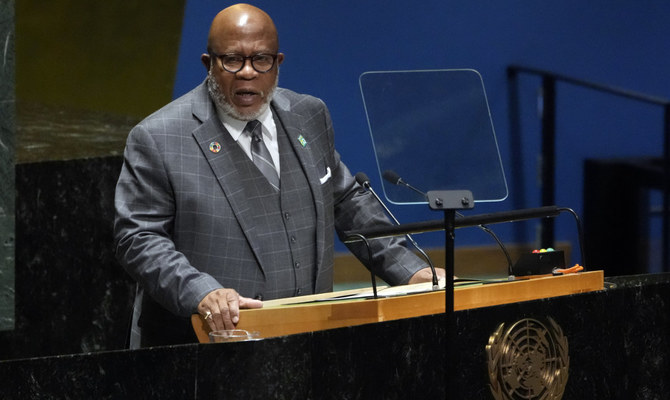

NEW YORK: The president of the UN General Assembly on Tuesday said he is “encouraged” by the progress of its 78th session, hailing the “remarkable” win of a major sustainable development declaration.
Dennis Francis spoke of the need to “unite the nations” in his opening address last week. Now addressing the UNGA as the final speaker out of 176 heads of state and ministers, he said the week’s developments are a “welcome reminder that the UN remains focused on the collective challenges of our time.”
But he warned: “Declarations in and of themselves aren’t enough. We need to maintain this momentum and to build on it with concrete, tangible actions.”
Hundreds of representatives from civil society as well as public and private organizations spoke at the UN headquarters in New York, Francis said.
The UNGA resulted in four major political declarations, covering “universal healthcare; work to end tuberculosis; pandemic prevention, preparedness and response; and the need to urgently … scale up sustainable development progress.”
The final declaration was described as a “particularly remarkable win” by Francis, who said it serves as a commitment to “push harder and close the gaps.”
He lauded member states for taking part in the high-level dialogue on development financing, highlighting the prevalence of discussions on the need to reform global finance for the benefit of the developing world. “We can’t rest until there’s accessibility, equity and justice in development finance,” he said.
Few topics raised during the week were as “frequent, consistent or as charged” as the war in Ukraine, he added.
The conflict being perpetrated by a permanent member of the UN Security Council is “unconscionable,” and has rekindled “unthinkable” decades-old fears of nuclear weapons, Francis said.
He recommitted to “shining a spotlight on the urgent need to resolve these situations of deep concern.”
Climate change requires each member state to “look closely at our own carbon footprints” and move beyond gross domestic product to a “metric that captures a country’s true vulnerability to shocks.”
Francis urged member states to take part in the UAE-hosted UN Climate Change Conference later this year with a spirit of “unity and solidarity,” and deliver a bold plan of action.
“Whether on climate or conflict, poverty or justice, or peace or strong institutions, these aren’t just global calls, they’re existential calls,” he said.
Francis ended his address by reminding member states: “We hear so often that the clock is ticking. We have it within us today to heal our divisions, find integrated solutions that reflect our universal values and commitments, and usher in a brighter tomorrow.”


