

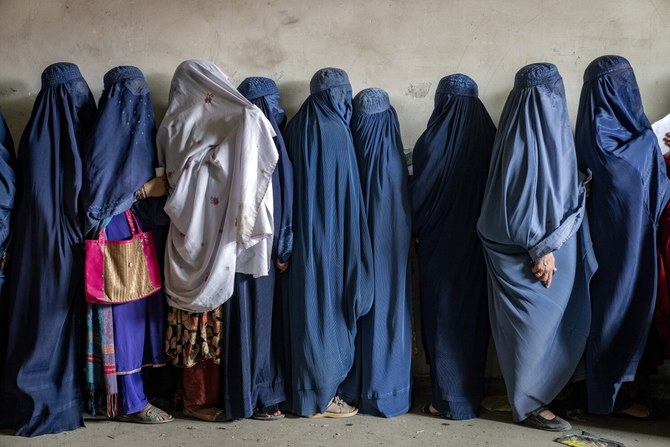

NEW YORK CITY: Experts on Tuesday urged the international community to officially recognize the “gender apartheid” in Afghanistan amid the escalating restrictions imposed on women and girls by the Taliban regime in the country.
During a media event on the sidelines of the 78th session of the UN General Assembly, shortly before a special meeting of the UN Security Council to discuss the situation in Afghanistan, international lawyer and civil society representative Karima Bennoune said the “drastic restrictions” on 50 percent of the population were “unparalleled” in the world.
“I believe the ‘gender apartheid’ approach is the most promising way forward as the Taliban are not simply failing to uphold women’s rights, this oppression of women is central to their system of governance,” she added.
“Deeming the situation to be gender apartheid not only implicates the perpetrators of the apartheid but, as was the case with racial apartheid in South Africa, it means that no member state can be complicit in or normalize the Taliban’s illegal actions.”
The International Criminal Court defines the crime of apartheid perpetrated by a regime as the systematic oppression and domination by one racial group of one or more other racial groups with the aim of maintaining that regime.
During the Security Council meeting, Bennoune noted that UN Secretary-General Antonio Guterres and a number of governments have already labeled the Taliban’s actions against women and girls as a form of apartheid, and called on the UN to officially codify this approach under international law by adding the word “gender” to the existing definition.
“The apartheid framework recognizes that the ordinary human rights approach, centering the state as the actor to implement human rights, cannot work here,” she said.
“Positive change will only be possible with a consistent, principled international response led by this council, mandated by its 10 Women, Peace and Security resolutions, and supported by states from all regions.”
Sima Sami Bahous, the executive director of UN Women, echoed Bennoune’s views during her comments at the meeting.
The members of the council unanimously condemned the treatment of women and girls in Afghanistan but stopped short of using the word “apartheid” to describe it.
Albania’s permanent representative to the UN, Ferit Hoxha, whose country holds the presidency of the council this month, said of the Taliban: “This regime and its rules are medieval and retrograde, with extrajudicial killings and arbitrary arrests simply unacceptable.
“Two years on from the Western withdrawal from Afghanistan, the situation remains dire, with the international community struggling to balance its support for the Afghan people without rewarding the de facto authorities.”
Representatives from several states, including China, Japan, Mozambique, the UK and the US, all called for a reversal of the Taliban restrictions on women and girls.
Speaking on behalf of Gabon, Ghana and Mozambique, the three current African non-permanent members of the Security Council, Mozambique’s representative to the UN, Pedro Comissario Afonso, said: “The lack of representation of the diversity of the Afghan people at the ethnic and social level in the political sphere is both apparent and deplorable.”
With winter approaching, council members expressed concern that the continued failure to reintegrate women into the positions they held before the Taliban takeover will serve only to exacerbate people’s
suffering amid a shortfall in funding for international aid, and the reluctance of many countries to engage with the regime.
Citing a recent UN Development Program report that said gross domestic product in Afghanistan fell by 3.6 percent in 2022, following a 20.7 percent contraction in 2021, China’s representative, Zhang Jun, attributed the decline to a “sharp drop” in humanitarian funding.
“The report claims two thirds of Afghanistan will need humanitarian assistance next year, with 41 million Afghans in a state of food insecurity, and yet the humanitarian assistance program is just 27 percent funded at present,” he said.
“This is a clear demonstration that the cutback in funding is of an ideological and political nature that only stands in the way of the Afghan people; winter is coming.”
Both India and Iran, who share borders with Afghanistan, expressed concern about the “potential consequences for regional insecurity” caused by the situation in the country. However, the Chinese envoy suggested that “on the whole,” the security situation had improved since the Taliban took control.
The Taliban’s choice of representative to the UN is not recognized by the international organization. Naseer Faiq, the representative of the former Afghan government that was toppled by the Taliban, strongly rejected the Chinese representative’s suggestion.
“Taliban assertions of counterterrorism and counternarcotics efforts ring hollow as they are leaders, are deeply involved in narcotics production and smuggling within the Taliban centers of power and resources distribution,” he told the council.
“Tragically, two years since the Taliban seized control, the situation of Afghanistan has not improved … the Afghan people continue to suffer.”
Describing Afghanistan under the Taliban as a “hub for terrorism,” Faiq said that despite the challenges, the Afghan people are nonetheless “resolute” in their diversity and would continue to “work tirelessly” to defend their rights.
Echoing calls by Afghan community organizations, he urged the council and international partners to maintain the pressure on the Taliban and demand the reversal of policies that deny women their rights.
“We also call on the UN to recognize and classify the plight of woman and girls as gender apartheid, and emphasize the necessity of ongoing humanitarian assistance for the people of Afghanistan, subject to rigorous monitoring and supervision of aid delivery,” Faiq said.
“We can help shape a better future for the Afghan people and prevent the country from once again becoming a breeding ground for extremism.”


