


RIYADH: Saudi Arabia’s sustainable transport plans are a vital part of the Kingdom’s drive to reduce global carbon emissions by 4 percent, said a government official on Tuesday.
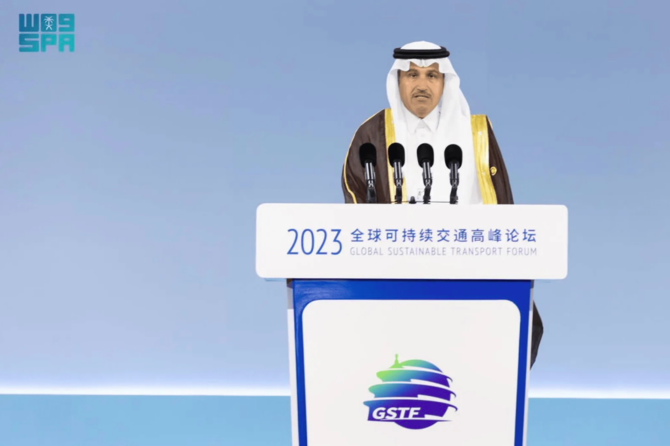
Speaking at the Global Sustainable Transport Forum held in Beijing from Sept. 25-26, the Saudi Transport and Logistics Services Minister, Saleh bin Nasser Al-Jasser, stressed that sustainability is a fundamental element of the Kingdom’s Vision 2030.
Al-Jasser underscored that the Kingdom’s strong commitment to sustainability has been smoothly incorporated into the transport and logistics sector through the National Strategy for Transport and Logistics.
The strategy includes reducing carbon emissions per person by 2 percent in a year, increasing sustainable mobility, electrifying transport and implementing them across the logistics value chain.
It also includes developing the necessary infrastructure to meet future demand, with the primary goal of minimizing traffic fatalities.
According to Al-Ekhbariya, the minister also pointed out that cooperation, innovation and the exchange of best practices create the foundation for achieving common goals.
He also revealed that there has been significant progress over the years, with the number of fatalities falling from 28 per 100,000 people in 2016 to 13.5 in 2020.
Through the implementation of a national safety program that emphasizes infrastructure development, road safety awareness and governance improvements, the goal is to lower the fatalities to less than five by 2030.
Al-Jasser also emphasized how the COVID-19 pandemic hugely affected the global logistics and transportation industry, causing supply chains to break down and some transport sectors to collapse.
This fact underlines how crucial it is to balance the social, economic, and environmental pillars of sustainable development to create green transportation networks.
Furthermore, the minister said in August that Saudi Arabia’s master plan to develop logistics centers in the Kingdom will help improve transport services and contribute to infrastructure development.
He noted that the new master plan will also strengthen Saudi Arabia’s connection with global markets, as the Kingdom is strategically placed in the middle of three continents.
Saudi Arabia’s NSTL aims to position the Kingdom as one of the top 10 countries globally in the logistics performance index by the end of this decade, aligned with the goals outlined in Vision 2030.


