

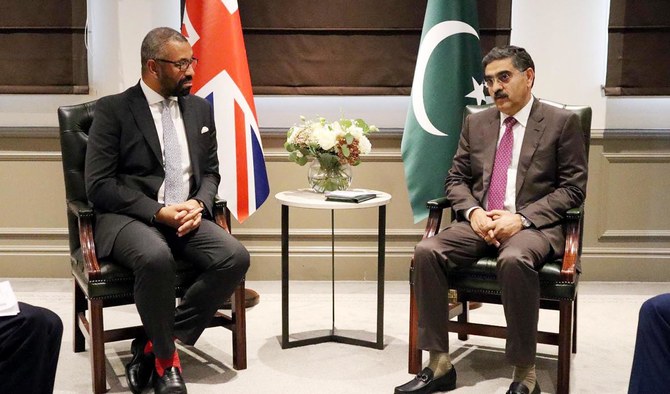

ISLAMABAD: Caretaker Prime Minister Anwaar-ul-Haq Kakar on Monday met the UK’s foreign secretary as well as financial and capital market leaders and top British-Pakistani and other business groups on a stopover visit to London on his way back from New York to attend the UN General Assembly.
Pakistan in June set up a Special Investment Facilitation Council (SIFC) — a civil-military hybrid forum — to fast-track decision making and promote investment from foreign nations. The council has identified five sectors as priority for seeking investment, namely agriculture, mining, information technology, defense production and energy, as the South Asian country deals with a balance of payments crisis and requires billions of dollars in foreign exchange to finance its trade deficit and repay its international debts in the current financial year.
Last week, Kakar used his visit to New York for the UN General Assembly as an opportunity to meet business and thought leaders and stakeholders and make the case for improved business climate in Pakistan and its potential for foreign direct investment in a range of sectors.
On Monday, senior leaders of London’s capital and financial markets called on Kakar in London and expressed “keen interest in exploring promising investment opportunities in the financial and capital market of Pakistan, reflecting a growing mutual interest in expanding economic collaboration,” the PM’s Office said in a statement released after his meeting with notable investment firms, including Fidelity International Limited (FIL), Wellington Management, Ashmore, Jefferies International, Redwheel Capital, Switex Industrial SA, Oxford Frontier Capital, GuarantCo, JP Morgan, Kalrock Capital, and UBL UK.
“Prime Minister Kakar informed the delegation about Pakistan’s current economic landscape, highlighting government measures for external account improvement,” the PM office said.
“He said that recent administrative actions strengthened the Pakistani rupee against the US dollar, fostering optimism for stability. He said positive indicators, including inflows from the World Bank, Asian Development Bank, and friendly nations, contributed to reduced inflation, stabilized reserves, and revival of industrial growth.”
Kakar also spoke about the potential for foreign direct investment in Pakistan’s key sectors and the positive impact of a Stand-By Arrangement (SBA) with the IMF, agreed in June. He highlighted economic improvements such as reduced inflation and improved trade after the removal of restrictions on imports and fiscal measures for monetary support and medium-term inflation targets.
“Furthermore, the Prime Minister highlighted Pakistan’s pro-investment efforts, introducing the Special Investment Facilitation Council,” the PMO said. “This initiative, led by the Prime Minister himself, streamlines investment processes, attracts investments in key sectors, and fosters long-term growth by simplifying the business landscape.”
Kakar separately met prominent British-Pakistani businessmen in London and highlighted positive economic indicators resulting from reforms pursued by his government, including a strengthening of the rupee, reduced inflation, and expected economic growth.
“The Prime Minister spoke about Pakistan’s investment-friendly approach, mentioning incentives and ease-of-business reforms,” the PMO said. “He introduced the Special Investment Facilitation Council, chaired by himself, to streamline investment in key sectors through a single-window platform. This initiative aims to enhance ease of doing business, remove bureaucratic hurdles, and create a long-term investment roadmap.”
Kakar also shared the government’s resolve and commitment to privatize loss-making state-owned enterprises and urged overseas Pakistanis to take advantage of the opportunities for investment in Pakistan. He invited diaspora business leaders “to invest, especially in Special Economic Zones, to contribute to Pakistan’s economic recovery.”
The PMO said the business leaders “conveyed their strong interest in expanding their business operations in Pakistan while actively seeking to increase their investments in the country.”
Abdullah Kamani, a leading British businessman and the co-founder and executive chairman of Boohoo Group, separately called on Kakar. Boohoo Group plc is a British online fashion retailer, aimed at 16–30-year-olds. The business was founded in 2006, and had sales in 2019 of £856.9 million. It specializes in own brand fashion clothing.
“Kamani expressed keen interest in establishing long-term buying linkages with Pakistan and the ambition to create a comprehensive supply chain in the country, encompassing organic cotton to apparel production,” the PM’s office said. “They also hoped for improved Pakistan-UK air connectivity to facilitate increased imports from Pakistan.”
Kakar conveyed Pakistan’s commitment to facilitating investment and offered support in establishing manufacturing facilities within the country, particularly within Special Economic Zones (SEZs). He urged Boohoo Group to consider opening buying houses in Pakistan and invited the company to send a buying delegation to Pakistan.
Kakar also met UK’s Foreign Secretary James Cleverly on Monday and discussed “all areas of mutual interest, including multifaceted bilateral relations, and resumption of PIA flights.”


