

Australian government faces legal action for failing to rescue women, children detained in Syrian detention camp 

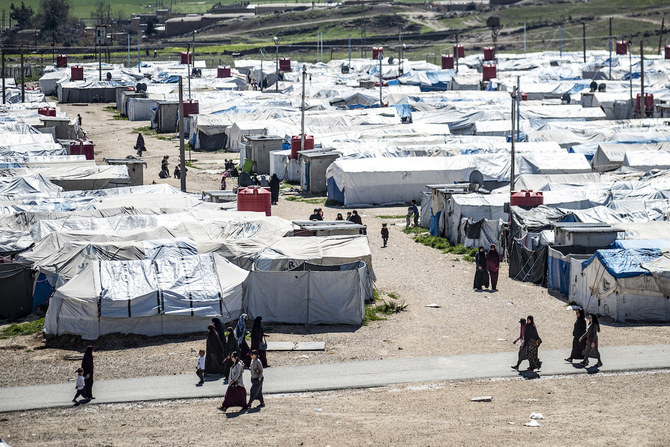
Women and children walk at Camp Roj, where relatives of people suspected of belonging to Daesh are held. (File/AFP)
Short Url
Updated 25 September 2023
Follow

Australian government faces legal action for failing to rescue women, children detained in Syrian detention camp 

  • Australia has effective control over the detention of Australians, Save the Children claims

LONDON: More than 30 Australian women and children detained in a Syrian detention camp are taking legal action against their government, arguing that it has the authority and obligation to repatriate them to Australia, The Guardian reported on Monday. 

The Australians, who are wives, widows and children of dead or jailed Daesh fighters, remain detained inside the Roj camp in northeast Syria. Most have been in the camp for more than four years and some of the children born at the location have never left. 

Many of the women claim their husbands coerced or manipulated them into traveling to Syria. None has been charged with a crime or received a warrant for arrest, The Guardian reported.

The Australians are being forcibly held by the Autonomous Administration of North and East Syria and its military wing, the Syrian Democratic Forces.

Save the Children Australia, which represents 12 Australian women and their 21 children, argues in federal court filings that Australia is a part of the coalition that “specifically supports the AANES to maintain the detention of persons, including women and children.”

According to the court documents, AANES has openly urged coalition countries, including Australia, to repatriate citizens.

There is no safety issue with traveling to camps, the organization added, as journalists, family members, and nongovernmental organization employees often travel in and out.

Save the Children claims that Australia has effective control over the detention of Australians and that the government must prove that the women and children are lawfully detained, or that Australia cannot repatriate them, “or bring their bodies to the court.”

Michael Newton, a Vanderbilt University law school professor, has argued in an affidavit that Australia “enjoys the practical ability, by virtue of exercising de facto authority, to make arrangements for ending the extended detention of Australian women and children in northeastern Syria.”

He added: “As a logical corollary, Australian officials have the means, in my expert opinion, of securing the release and subsequent return of the Australian women and children in northeastern Syria.”

The Australian government has said in court documents that it “does not have control of the remaining Australian women and children” and cannot be forced to return them, The Guardian reported.

It claims it is not responsible for Australians traveling to Syria or being detained, and that camp detention is at the “absolute discretion” of the AANES, over which the government has no power.

Even if repatriation was agreed by Syrian forces, “the commonwealth would need to arrange for their safe repatriation having regard to the security and geopolitical situation that exists at the relevant time.”

Save the Children Australia CEO Mat Tinkler said the legal challenge was necessary because “these innocent Australian children … have been abandoned by their own government.”

He added: “Despite countless opportunities to repatriate these families, the Australian government has ultimately failed in its duty to bring all of its citizens home to safety.”

Eight orphaned children, including a pregnant teenager, were returned to New South Wales in 2019. Four women and 13 children were also rescued from Roj in October last year.

The government has said that it is committed to repatriating all Australians who may be safely evacuated, but has not stated when another operation may be carried out.


Top UN court to hear Rohingya genocide case against Myanmar

Updated 6 sec ago
Follow

Top UN court to hear Rohingya genocide case against Myanmar

THE HAGUE: Did Myanmar commit genocide against its Rohingya Muslim minority? That’s what judges at the International Court of Justice will weigh during three weeks of hearings starting Monday.
The Gambia brought the case accusing Myanmar of breaching the 1948 Genocide Convention during a crackdown in 2017.
Legal experts are watching closely as it could give clues for how the court will handle similar accusations against Israel over its military campaign in Gaza, a case brought to the ICJ by South Africa.
Hundreds of thousands of Rohingya Muslims fled violence by the Myanmar army and Buddhist militias, escaping to neighboring Bangladesh and bringing harrowing accounts of mass rape, arson and murder.
Today, 1.17 million Rohingya live crammed into dilapidated camps spread over 8,000 acres in Cox’s Bazar in Bangladesh.
From there, mother-of-two Janifa Begum told AFP: “I want to see whether the suffering we endured is reflected during the hearing.”
“We want justice and peace,” said the 37-year-old.

’Senseless killings’

The Gambia, a Muslim-majority country in West Africa, brought the case in 2019 to the ICJ, which rules in disputes between states.
Under the Genocide Convention, any country can file a case at the ICJ against any other it believes is in breach of the treaty.
In December 2019, lawyers for the African nation presented evidence of what they said were “senseless killings... acts of barbarity that continue to shock our collective conscience.”
In a landmark moment at the Peace Palace courthouse in The Hague, Nobel Peace laureate Aung San Suu Kyi appeared herself to defend her country.
She dismissed Banjul’s argument as a “misleading and incomplete factual picture” of what she said was an “internal armed conflict.”
The former democracy icon warned that the genocide case at the ICJ risked reigniting the crisis, which she said was a response to attacks by Rohingya militants.
Myanmar has always maintained the crackdown by its armed forces, known as the Tatmadaw, was justified to root out Rohingya insurgents after a series of attacks left a dozen security personnel dead.

‘Physical destruction’

The ICJ initially sided with The Gambia, which had asked judges for “provisional measures” to halt the violence while the case was being considered.
The court in 2020 said Myanmar must take “all measures within its power” to halt any acts prohibited in the 1948 UN Genocide Convention.
These acts included “killing members of the group” and “deliberately inflicting on the group conditions of life calculated to bring about its physical destruction in whole or in part.”
The United States officially declared that the violence amounted to genocide in 2022, three years after a UN team said Myanmar harbored “genocidal intent” toward the Rohingya.
The hearings, which wrap up on January 30, represent the heart of the case.
The court had already thrown out a 2022 Myanmar challenge to its jurisdiction, so judges believe they have the power to rule on the genocide issue.
A final decision could take months or even years and while the ICJ has no means of enforcing its decisions, a ruling in favor of The Gambia would heap more political pressure on Myanmar.
Suu Kyi will not be revisiting the Peace Palace. She has been detained since a 2021 coup, on charges rights groups say were politically motivated.
The ICJ is not the only court looking into possible genocide against the Rohingya.
The International Criminal Court, also based in The Hague, is investigating military chief Min Aung Hlaing for suspected crimes against humanity.
Another case is being heard in Argentina under the principle of universal jurisdiction, the idea that some crimes are so heinous they can be heard in any court.