

Brushstrokes behind bars: Karachi’s art exhibition spotlights creative expression of prison inmates

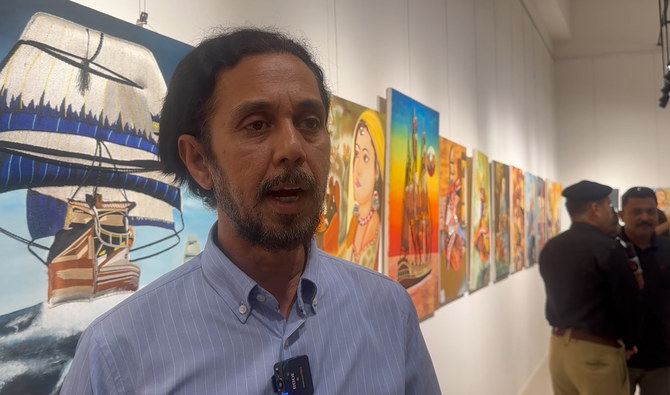
Husnain Raza, an art teacher at the Karachi central jail's school of fine arts and music, speaks with Arab News during an art exhibition in Karachi, Pakistan, on September 23, 2023. (AN Photo)
Short Url
Updated 24 September 2023
Follow

Brushstrokes behind bars: Karachi’s art exhibition spotlights creative expression of prison inmates

  • The Pakistan Arts Council has displayed the work of students of the School of Fine Arts and Music at the central jail
  • The initiative can bring out the untapped creative potential behind prison walls and strengthen the justice system

KARACHI: A leading Pakistani art gallery unveiled a unique exhibition by prison inmates on Saturday, featuring meticulously crafted models of revered Islamic sites in the holy cities of Makkah and Madinah, as well as intricately designed bracelets and handbags for women adorned with exquisite beadwork.
The event was organized by the Arts Council of Pakistan in Karachi that aims to foster a sense of community through artistic expression and enrich the cultural landscape of the country.
The council received assistance for this endeavor from authorities at the city’s central jail, which launched the School of Fine Arts and Music in 2008.
The school offers painting, jewelry-making, and language-training classes, among other things, to its inmates.
“In these paintings, there is abstract art, impressionism, portraiture, landscapes, seascapes, and a fusion of embroidery and painting in a mixed-medium style,” said Husnain Raza, an art teacher and former inmate, in an interview with Arab News. “In this form, artworks are crafted through full embroidery and then embossed, resulting in what is called 2-D paintings.”
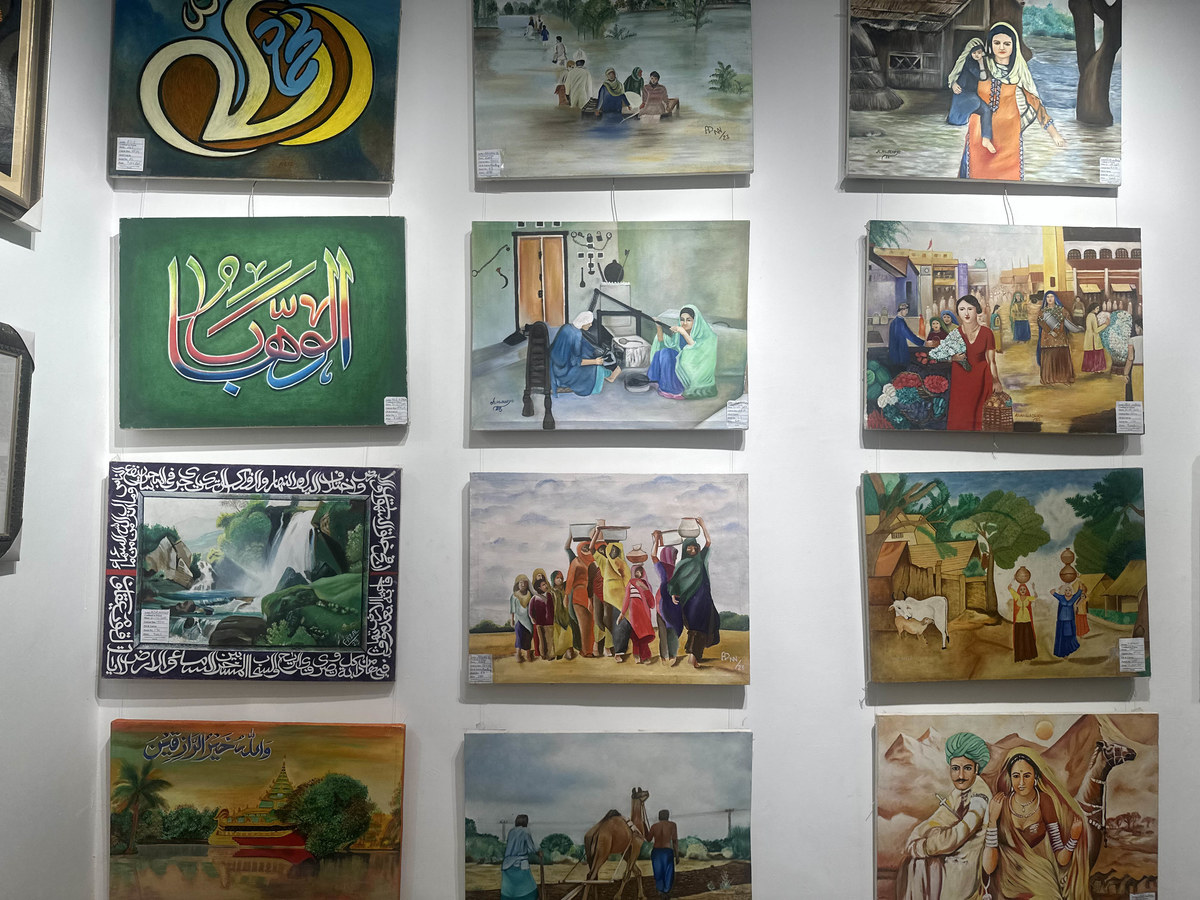


Artwork of prison inmates of Karachi central jail displayed at an art gallery in Karachi, Pakistan, on September 23, 2023.

Raza emphasized that beneath the visual allure of these artworks lie profound narratives built around the country’s cultural heritage and the personal stories of the artists.
Muhammad Yousuf, deputy jail superintendent, informed this was the first time an exclusive exhibition was held to display prisoners’ artwork.
“Our aim is to show people that jails are often viewed merely as places where crimes are punished, but we need to change it,” he continued. “Our motto is to change behavior. These [inmates] are members of our society, and we intend to send them back as changed individuals.”
The exhibition featured nearly 35 participating students, Raza added, noting that the artwork of three prisoners — Ejaz, Allah Wadayu, and Abdul Aziz — particularly stood out.
“Ejaz’s paintings were viewed as exceptional since they illustrated both cultural and abstract landscapes with his depiction of horses,” he said, adding that Allah Wadayu had also laid emphasis on the cultural dimension in his work.
“Abdul Aziz’s focus centered on the people left behind when someone is incarcerated: the women of the household, such as mothers, sisters, and wives, who anxiously await the return of their loved ones,” he elaborated.
Prisons across Pakistan are usually overcrowded and known for their less-than-ideal conditions.
Initiatives such as the one promoted by the central prison in Karachi along with the arts council can not only bring out the untapped creative potential within prison walls but also offer a more nuanced view of incarceration and justice in Pakistan.


Pakistan grants commercial license to Kuwait-backed Shariah-compliant digital bank

Updated 7 sec ago
Follow

Pakistan grants commercial license to Kuwait-backed Shariah-compliant digital bank

  • Pakistan has announced that Raqqami Islamic Digital Bank aims to launch operations this month with $100 million investment
  • Prime Minister Shehbaz Sharif calls for Kuwait and Pakistan to translate cordial political relations into strong economic ties

ISLAMABAD: Prime Minister Shehbaz Sharif granted the Kuwait Investment Authority-backed Raqqami Islamic Digital Bank (RIDB) the commercial license to operate in Pakistan on Tuesday, stressing the need to convert cordial political ties between the two countries into a strong economic relationship. 

Pakistan’s finance adviser Khurram Schehzad announced last month that RIDB intends to launch operations in the South Asian country from February with a $100 million investment. 

The RIDB describes itself as Pakistan’s first fully Shariah-compliant digital bank. The retail bank offers online financing, savings and payment services to individuals and small and medium-sized enterprises, also focusing on financial inclusion for underserved segments.

Prime Minister Sharif participated in a ceremony to grant the license to RIDB in Islamabad. The event was attended by top RIDB officials including its Chairman Abdullah Al-Mutairi and Chief Executive Officer Umair Aijaz. 

“This would go a long way in further strengthening our brotherly and our bilateral economic relations,” Sharif told participants. “You said very aptly that economic and brotherly relations go hand in hand. It cannot be that your political relations flourish but economic relations remain stagnant.”

He said the Shariah-compliant digital bank will also have features that will support and augment banking in Pakistan. 

Sharif called on both nations to join hands to promote their bilateral economic, investment and trade relations “like never before.” He vowed that Pakistan’s government was committed to enhancing bilateral trade and economic ties by working closely with the Kuwaiti government.

Pakistan’s banking sector is dominated by a handful of large lenders with strong capital buffers and profits driven largely by holdings of government securities.

Pakistan has intensified its efforts in recent years to secure foreign investment, particularly from Gulf nations, as it seeks to ensure sustained economic progress. Schehzad has said that the RIDB’s entry into Pakistan reflects strengthening investment ties between Islamabad and Kuwait, particularly in the financial and digital economy sectors.