Ethiopia, Egypt, Sudan resume Nile dam talks

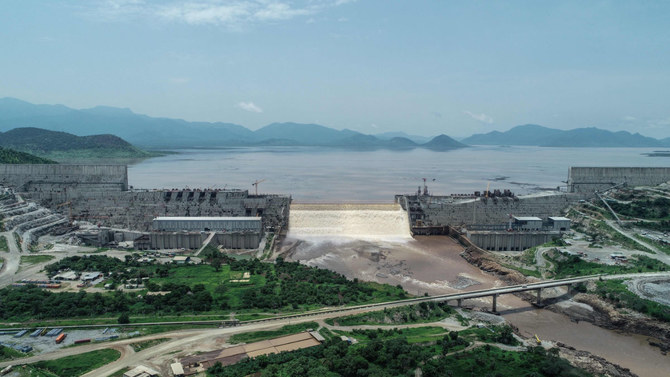
An aerial view Grand Ethiopian Renaissance Dam on the Blue Nile River in Guba, northwest Ethiopia. (AFP file photo)
Short Url
Updated 24 September 2023
Follow

Ethiopia, Egypt, Sudan resume Nile dam talks

  • For years at loggerheads over the issue, Egyptian President Abdel Fattah El-Sisi and Ethiopian Prime Minister Abiy Ahmed agreed in July to finalize a deal within four months, resuming talks in August

NAIROBI: Ethiopia said Saturday it had begun a second round of talks with Egypt and Sudan over a controversial mega-dam built by Addis Ababa on the Nile, long a source of tensions among the three nations.
Ethiopia this month announced the completion of the fourth and final filling of the Grand Ethiopian Renaissance Dam, prompting immediate condemnation from Cairo, which denounced the move as illegal.
Egypt and Sudan fear the massive $4.2-billion dam will severely reduce the share of Nile water they receive and had repeatedly asked Addis Ababa to stop filling it until an agreement was reached.
For years at loggerheads over the issue, Egyptian President Abdel Fattah El-Sisi and Ethiopian Prime Minister Abiy Ahmed agreed in July to finalize a deal within four months, resuming talks in August.
Ethiopia’s foreign ministry wrote on X, formerly known as Twitter, that the three countries had opened a second round of negotiations in Addis Ababa.
“Ethiopia is committed to reaching a negotiated and amicable solution through the ongoing trilateral process,” it said.

Protracted negotiations over the dam since 2011 have thus far failed to bring about an agreement between Ethiopia and its downstream neighbors.
Egypt has long viewed the dam as an existential threat, as it relies on the Nile for 97 percent of its water needs.
Egyptian Foreign Minister Sameh Shoukry, in an address to the UN General Assembly, said that Cairo wanted a “binding agreement” on the filling and operation of the dam.
“We remain in anticipation of our goodwill being reciprocated with a commitment from Ethiopia to arrive at an agreement that will safeguard the interests of Egypt, Sudan, and Ethiopia,” Shoukry said.
“It would be a mistake to assume we can accept a fait accompli when it comes to the very lives of more than 100 million Egyptian citizens.”
The dam is central to Ethiopia’s development plans, and in February 2022 Addis Ababa announced that it had begun generating electricity for the first time.
At full capacity, the huge hydroelectric dam — 1.8 kilometers long and 145 meters high — could generate more than 5,000 megawatts.
That would double Ethiopia’s production of electricity, to which only half the country’s population of 120 million currently has access.
The position of Sudan, which is currently mired in a civil war, has fluctuated in recent years.
The United Nations says Egypt could “run out of water by 2025” and parts of Sudan, where the Darfur conflict was essentially a war over access to water, are increasingly vulnerable to drought as a result of climate change.


Village in southern Lebanon buries a child and father killed in Israeli drone strike

Updated 7 sec ago
Follow

Village in southern Lebanon buries a child and father killed in Israeli drone strike

  • Hassan Jaber, a police officer, and his 3-year-old son, Ali, were on foot when the strike hit a passing car in Yanouh on Monday
  • The car’s driver, Ahmad Salami, was also killed. The Israeli military said Salami was an artillery official with Hezbollah
YANOUH: Mourners in southern Lebanon on Tuesday buried a father and his young son killed in an Israeli drone strike that targeted a Hezbollah member.
Hassan Jaber, a police officer, and his child, Ali, were on foot when the strike on Monday hit a passing car in the center of their town, Yanouh, relatives said. Lebanon’s health ministry said the boy was 3 years old. Both were killed at the scene along with the car driver, Ahmad Salami, who the Israeli military said in a statement was an artillery official with the Lebanese militant group.
It said it was aware of a “claim that uninvolved civilians were killed” and that the case is under review, adding it “makes every effort to reduce the likelihood of harm” to civilians.
Salami, also from Yanouh, was buried in the village Tuesday along with the father and son.
“There are always people here, it’s a crowded area,” with coffee shops and corner stores, a Shiite religious gathering hall, the municipality building and a civil defense center, a cousin of the boy’s father, also named Hassan Jaber, told The Associated Press.
When the boy and his father were struck, he said, they were going to a bakery making Lebanese breakfast flatbread known as manakish to see how it was made. They were standing only about 5 meters (5.5 yards) from the car when it was struck, the cousin said.
“It is not new for the Israeli enemy to carry out such actions,” he said. “There was a car they wanted to hit and they struck it in the middle of this crowded place.”
Jaber said the little boy, Ali, had not yet entered school but “showed signs of unusual intelligence.”
“What did this innocent child do wrong, this angel?” asked Ghazaleh Haider, the wife of the boy’s uncle. “Was he a fighter or a jihadi?”
Attendees at the funeral carried photos of Ali, a striking child with large green eyes and blond hair. Some also carried flags of Hezbollah or Amal, a Shiite party that is allied with but also sometimes a rival of Hezbollah.
Lebanon’s Internal Security Forces, of which the child’s father was a member, said in a statement that the 37-year-old father of three had joined in 2013 and reached the rank of first sergeant.
The strike came as Israel has stepped up its campaign against Hezbollah and its allies in Lebanon.
The night before the strike in Yanouh, Israeli forces launched a rare ground raid in the Lebanese village of Hebbarieh, several kilometers (miles) from the border, in which they seized a local official with the Sunni Islamist group Al-Jamaa Al-Islamiya, or the Islamic Group in English. The group is allied with Hezbollah and the Palestinian militant group Hamas.
The low-level conflict between Lebanon and Israel escalated into full-scale war in September 2024, later reined in but not fully stopped by a US-brokered ceasefire two months later.
Since then, Israel has accused Hezbollah of trying to rebuild and has carried out near-daily strikes in Lebanon that it says target Hezbollah militants and facilities.
Israeli forces also continue to occupy five hilltop points on the Lebanese side of the border. Hezbollah has claimed one strike against Israel since the ceasefire.