

Pakistan’s EDUCAST to launch telemedicine services in Sudan with support from Islamic Development Bank

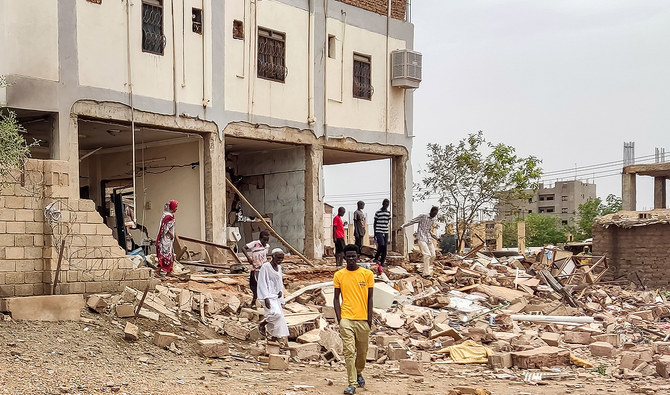
In this file photo, taken on June 6, 2023, people inspect the rubble at a house that was hit by an artillery shell in the Azhari district in the south of Khartoum. (AFP/File)
Short Url
Updated 23 September 2023
Follow

Pakistan’s EDUCAST to launch telemedicine services in Sudan with support from Islamic Development Bank

  • EDUCAST CEO says testing of equipment, identification of sites completed, operations to launch within four weeks
  • Karachi-based EDUCAST will jointly launch Sudan program with Yemen’s Building Foundation for Development

KARACHI: Pakistani digital health service provider EDUCAST will launch ‘first of its kind’ mobile telemedicine operations in Sudan within a month to offer medical support and assist local health care providers, the CEO of the company said this week.

Karachi-based EDUCAST, a digital health services and online medical education providing platform, signed an agreement in July with the Building Foundation for Development (BFD), a humanitarian organization headquartered in Yemen to work together in Sudan. The Science and Technology Innovation Department of the Jeddah-based Islamic Development Bank is supporting the project.

More than five months into a conflict between Sudan’s army and paramilitary group, Rapid Support Forces, the country’s health care sector is on its knees due to direct attacks from the warring parties as well as shortages of staff and medicines, they said. A World Health Organization (WHO) official said this week there have been 56 verified attacks so far on health care in Sudan since the war began in April and about 70 percent to 80 percent of hospitals in conflict states are now out of service.

“We have completed our initial work, including testing of equipment, identification of the operational sites in Sudan and will hopefully be in a position to launch operations within the next four weeks,” EDUCAST founder and CEO Abdullah Butt told Arab News on Thursday.

“Right now, about 80 percent of health facilities have been destroyed in Sudan due to the war and the country is in dire need of medical facilities,” he added, saying his organization was approached by Sudanese authorities and its humanitarian commission seeking telemedicine services.

“This will be the first of its kind telehealth service to be provided by any Pakistani company in an active war region,” Butt said.

Under the agreement between EDUCAST and BFD, a network of mobile telehealth units will be set up in Sudan to provide universal coverage and access to safe and effective mother and child health and other emergency related services.

The telehealth education and clinical support facilities will be provided at five medical teaching hospitals in Sudan.

The project seeks to develop the medical capacity of up to 1,000 Sudanese doctors by delivering online training and certification programs. It will also facilitate them with in-person training courses at Pakistan’s teaching hospitals in key health areas, including maternal and neonatal child health, infectious and non-communicable diseases.

Through its eDoctor program, EDUCAST will support local medical practitioners through its network of over 1,200 eDoctors, with presence in Pakistan, Saudi Arabia, Oman, Qatar and the United Arab Emirates.

The project will focus on areas of Sudan devastated by war and where there is a large number of internally displaced persons and insufficient health capacity, Butt said.

Meer Behrose Regi, Pakistan’s envoy to Sudan, called for increased humanitarian efforts in Sudan.

“Everything is needed over there,” he told Arab News, “but the risk of security remains substantially high, though many companies are still operating there.”


UN torture expert decries Pakistan ex-PM Khan’s detention

Updated 12 December 2025
Follow

UN torture expert decries Pakistan ex-PM Khan’s detention

  • Khan’s party alleges government is holding him in solitary confinement, barring prison visits
  • Pakistan’s government rejects allegations former premier is being denied basic rights in prison

GENEVA: Pakistan’s former prime minister Imran Khan is being held in conditions that could amount to torture and other inhuman or degrading treatment, the United Nations’ special rapporteur on torture warned Friday.

Alice Jill Edwards urged Pakistan to take immediate and effective action to address reports of the 73-year-old’s inhumane and undignified detention conditions.

“I call on Pakistani authorities to ensure that Khan’s conditions of detention fully comply with international norms and standards,” Edwards said in a statement.

“Since his transfer to Adiala Jail in Rawalpindi on September 26, 2023, Imran Khan has reportedly been held for excessive periods in solitary confinement, confined for 23 hours a day in his cell, and with highly restricted access to the outside world,” she said.

“His cell is reportedly under constant camera surveillance.”

Khan an all-rounder who captained Pakistan to victory in the 1992 Cricket World Cup, upended Pakistani politics by becoming the prime minister in 2018.

Edwards said prolonged or indefinite solitary confinement is prohibited under international human rights law and constitutes a form of psychological torture when it lasts longer than 15 days.

“Khan’s solitary confinement should be lifted without delay. Not only is it an unlawful measure, extended isolation can bring about very harmful consequences for his physical and mental health,” she said.

UN special rapporteurs are independent experts mandated by the Human Rights Council. They do not, therefore, speak for the United Nations itself.

Initially a strong backer of the country’s powerful military leadership, Khan was ousted in a no-confidence vote in 2022, and has since been jailed on a slew of corruption charges that he denies.

He has accused the military of orchestrating his downfall and pursuing his Tehreek-e-Insaf (PTI) party and its allies.

Khan’s supporters say he is being denied prison visits from lawyers and family after a fiery social media post this month accusing army leader Field Marshal Asim Munir of persecuting him.

According to information Edwards has received, visits from Khan’s lawyers and relatives are frequently interrupted or ended prematurely, while he is held in a small cell lacking natural light and adequate ventilation.

“Anyone deprived of liberty must be treated with humanity and dignity,” the UN expert said.

“Detention conditions must reflect the individual’s age and health situation, including appropriate sleeping arrangements, climatic protection, adequate space, lighting, heating, and ventilation.”

Edwards has raised Khan’s situation with the Pakistani government.