

Imran Khan’s woes set to rule him out of Pakistan election race

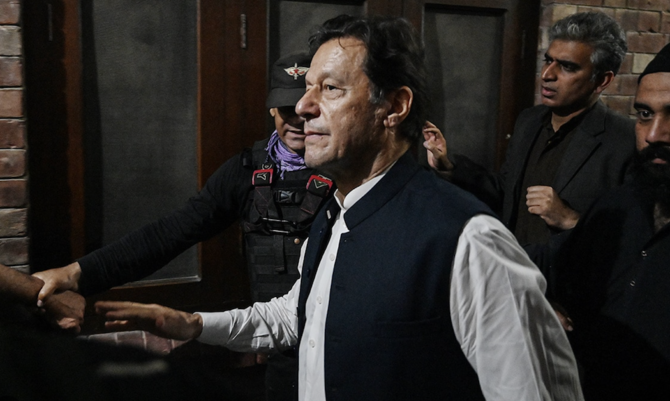
Former Pakistan's Prime Minister Imran Khan (C) leaves after appearing at the high court in Lahore on March 17, 2023. (AFP/File)
Short Url
Updated 22 September 2023
Follow

Imran Khan’s woes set to rule him out of Pakistan election race

  • Participation of Imran Khan, the main opposition leader and former prime minister, in January’s general election is doubtful
  • Khan remains in jail after being convicted in a graft case in August despite his three-year sentence being suspended by a court

ISLAMABAD: The participation of main opposition leader and former Prime Minister Imran Khan in Pakistan’s general election set for January next year remains doubtful. Khan, winner of the last election in 2018, remains in jail after being convicted in a graft case in August despite his three-year sentence being suspended by a court.

Here are some facts about the options for Khan, 70, who is the country’s most popular party leader according to independent opinion polls:

BARRED FROM PUBLIC OFFICE

Khan, 70, remains barred from holding public office for five years due to his conviction, despite the suspension of his jail sentence. The bar will remain in place until his conviction is overturned by the high court, where he has appealed, a situation that currently rules him out of the January elections.

It remains unclear if his appeal will be decided in time for the next election, but aside from this graft case, the former cricket star faces dozens of other serious cases, too, which carry sentences from five years up to a death penalty.

STATE SECRETS CASE

Khan remains in judicial custody for a case related to leaking state secrets, which is at a pre-trial stage being heard by a special court that holds proceedings at a prison where he’s detained on security grounds. This week, another court allowed police to add sedition charges against him in two cases related to abetting attacks against military installations on May 9 by his supporters to protest against his brief arrest.

KHAN’S PTI WEAKENED

Khan’s Pakistan Tehreek-e-Insaf (PTI) party can still contest the elections and will seek to tap into a sympathy vote, but it has been severely hobbled by the departure of key leaders in the aftermath of the May violence and the crackdown that ensued.

In Khan’s absence, the PTI was being led by former Foreign Minister Shah Mahmood Qureshi, but he too has been arrested in the state secrets case.

ROLE OF THE MILITARY

Analysts say the military-backed caretaker government, which has been questioned by the election commission over its credibility, wouldn’t let Khan bounce back, especially as independent polls show him to be the most popular party leader, a standing that could earn the PTI a good showing in January’s election.

Khan and his party continue to accuse the military of being behind his ousting and the crackdown.

The military, which according to analysts brought Khan to power in 2018, denies being behind his removal. His criticism of the armed forces and its top brass has not eased, and his appeals to the military to open talks with him haven’t yielded a response.

The military’s support remains key to anyone looking to attain power in Pakistan.


Pakistan president meets UAE counterpart, explores trade, investment opportunities

Updated 27 January 2026
Follow

Pakistan president meets UAE counterpart, explores trade, investment opportunities

  • Asif Ali Zardari is in UAE on four-day visit to strengthen bilateral ties, review bilateral cooperation
  • Both sides discuss regional, international developments, reaffirm commitment to promote peace

ISLAMABAD: President Asif Ali Zardari met his UAE counterpart Sheikh Mohammed bin Zayed Al-Nahyan in Abu Dhabi on Tuesday during which both sides explored new opportunities in trade, investment, energy and other sectors, Zardari's office said. 

Zardari arrived in Abu Dhabi on Monday evening with a high-level delegation on a four-day official visit to the UAE to review trade, economic and security cooperation. 

"The leaders discussed ways to further deepen the longstanding and brotherly relations between Pakistan and the UAE," a statement from Zardari's office said about his meeting with the UAE president. 

"They reviewed the full spectrum of bilateral cooperation and explored new opportunities in trade, investment, energy, infrastructure, technology, and people-to-people exchanges, highlighting the significant potential for expanding economic and strategic partnership.

Zardari highlighted the significance of Al-Nayhan's visit to Pakistan last month, the statement said, expressing appreciation for the UAE's continued support for strengthening bilateral ties.

It said both sides also exchanged views on a range of regional and international developments, reaffirming their commitment to promoting peace, stability and sustainable development.

The meeting was also attended by Pakistan's First Lady Aseefa Bhutto-Zardari, the Pakistani president's son Bilawal Bhutto-Zardari, who is also the chairman of the Pakistan Peoples Party, Interior Minister Mohsin Naqvi and Pakistan's ambassador to the UAE. 

ZARDARI MEETS AD PORTS CEO

Zardari earlier met AD Ports Group CEO Captain Mohamed Juma Al-Shamisi to discuss the group's investment initiatives in Karachi. 

"Both sides agreed that the expansion and modernization of port infrastructure would strengthen trade flows and support Pakistan’s broader economic development and country’s seaborne trade," the President's Secretariat said in a statement.

It added that Zardari described the AD Ports Group's long-term investment and expanding role in Pakistan's maritime and logistics sector as a key pillar of Pakistan–UAE economic cooperation.

Pakistan and the UAE maintain close political and economic relations, with Abu Dhabi playing a pivotal role in supporting Islamabad during periods of financial stress through deposits, oil facilities and investment commitments. 

The UAE is Pakistan's third-largest trading partner, after China and the United States, and a key destination for Pakistani exports, particularly food, textiles and construction services.

The Gulf state is also home to more than 1.5 million Pakistani expatriates, one of the largest overseas Pakistani communities in the world, who contribute billions of dollars annually in remittances, a crucial source of foreign exchange for Pakistan’s economy.

Beyond trade and labor ties, Pakistan and the UAE have steadily expanded defense and security cooperation over the years, including military training, joint exercises and collaboration in counter-terrorism and regional security matters.