

Pakistan PM says pushing for $10 billion disbursement of pledged flood-relief funds

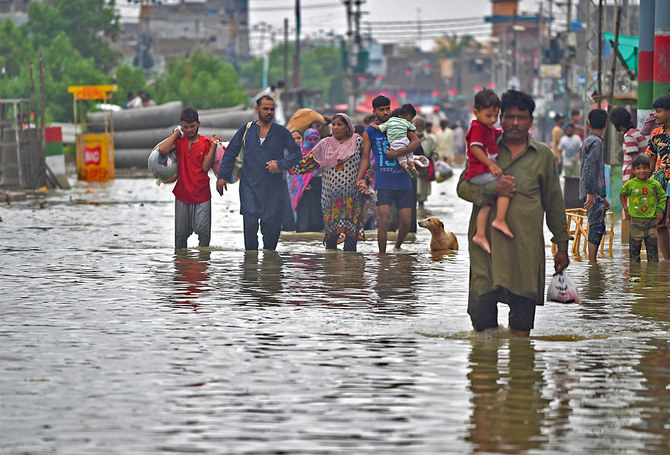
In this file photo, taken on July 25, 2022, people wade across a flooded street after heavy monsoon rainfall in Karachi, Pakistan. (AFP/File)
Short Url
Updated 22 September 2023
Follow

Pakistan PM says pushing for $10 billion disbursement of pledged flood-relief funds

  • Anwaar-ul-Haq Kakar points out Pakistan’s flood recovery plan was built around the international pledges
  • The climate-induced floods affected million people and killed over 1,700 during last year’s monsoon season

KARACHI: Pakistan is striving to get donors to release $10 billion in pledges to help it recover from devastating floods by launching rebuilding projects that hinge on the funding, caretaker Prime Minister Anwaar-ul-haq Kakar said on Friday.

Donors from around the world stepped up after Pakistan was hammered by floods last year and the $10 billion amounts to more than half of what Islamabad estimated it needed to rebound from the disaster.

“In all our interactions, one point has been that the projects are designed in accordance with the pledges, and that we ensure that they convert to tangible financial assistance,” Kakar told the national broadcaster.

“We’re trying to ensure that the amounts promised and pledged to us are dispersed to Pakistan and are spent on those affected by the floods,” he said.

Such funding is crucial for cash-strapped Pakistan but the government says it has not arrived, amid growing concerns about its future debt obligations. An IMF bailout was delayed until July this year over concerns about a lack of fiscal reform.

Among the donors were the Islamic Development Bank with $4.2 billion, the World Bank with $2 billion, Saudi Arabia with $1 billion, as well as the European Union and China. France and the United States also made contributions.

The floods, which scientists said were aggravated by global warming, affected at least 33 million people and killed more than 1,700 from the beginning of the monsoon season in mid-June 2022 until mid-November that year.


Pakistan, UK sign £35 million Green Compact to strengthen climate resilience

Updated 21 December 2025
Follow

Pakistan, UK sign £35 million Green Compact to strengthen climate resilience

  • Pakistan ranks among nations most vulnerable to climate change and has seen erratic changes in its weather patterns
  • UK will help Pakistan mobilize climate finance, strengthen regulatory frameworks and develop bankable climate projects

ISLAMABAD: Pakistan and the United Kingdom (UK) have formalized a comprehensive climate partnership with the launch of a Green Compact that aims to enhance climate resilience, accelerate clean energy transition and scale up nature-based solutions, including mangrove conservation, Pakistani state media reported on Sunday.

The agreement, signed in Islamabad by Federal Minister for Climate Change and Environmental Coordination Dr. Musadik Malik and UK Minister for International Development Jennifer Chapman, unlocks £35 million in targeted support for green development and long-term climate action, according to Radio Pakistan broadcaster.

Pakistan ranks among nations most vulnerable to climate change and has seen erratic changes in its weather patterns that have led to frequent heatwaves, untimely rains, storms, cyclones, floods and droughts in recent years. In 2022, monsoon floods killed over 1,700 people, displaced another 33 million and caused over $30 billion losses, while another 1,037 people were killed in floods this year.

Mohammad Saleem Shaikh, a spokesperson for Pakistan’s Ministry of Climate Change, described the compact as a “decisive move toward action-oriented climate cooperation,” noting that its implementation over the next decade will be critical for Pakistan which regularly faces floods, heatwaves and water stress.

“The Compact is structured around five core pillars: climate finance and investment, clean energy transition, nature-based solutions, innovation and youth empowerment, and adaptation and resilience,” the report read.

“Under the agreement, the UK will work with Pakistan to mobilize public and private climate finance, strengthen regulatory frameworks for green investment, and develop bankable climate projects.”

Clean energy forms a central component of Pakistan’s transition, with Islamabad planning to expand solar and wind generation to reduce fossil fuel dependence, improve energy security and stabilize power costs, according to Shaikh.

“Renewable energy is now economically competitive, making the transition both environmentally and financially viable,” he was quoted as saying.

“Nature-based solutions, particularly large-scale mangrove restoration, will protect coastal communities from storm surges and erosion while enhancing biodiversity and carbon sequestration.”

Under the Compact, technical support, mentoring and access to investors will be provided to climate-smart startups and young innovators, reflecting Pakistan’s recognition of youth-led initiatives as central to future climate solutions.

On the occasion, Chapman, on her first official visit to Pakistan, underscored the urgency of climate action, highlighting the UK’s support for renewable energy, mangrove and ecosystem restoration, early-warning systems, climate budgeting and international investment flows into Pakistan.

Shaikh described the Green Compact as “a strategic turning point” in Pakistan–UK relations on climate change, saying its effective implementation is essential for Pakistan to meet its national climate targets.