

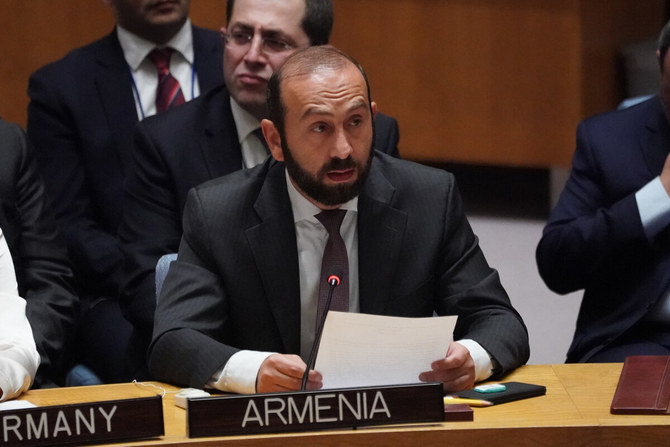
Armenia slams UN Security Council for failure to prevent Azerbaijan ‘invasion’ of Nagorno-Karabakh

Azerbaijan and Armenian separatists from the disputed territory of Nagorno-Karabakh held their first direct peace talks on September 21, after Baku claimed to have regained control over the breakaway region in a lightning military operation (AFP)
Short Url
Updated 22 September 2023
Follow

Armenia slams UN Security Council for failure to prevent Azerbaijan ‘invasion’ of Nagorno-Karabakh

  • Foreign Minister Ararat Mirzoyan addresses a special council session two days after Azerbaijan launched a military offensive in the region
  • Baku describes the deployment as an “antiterrorist” operation after 2 civilians and 4 police officers were killed by landmines allegedly placed by Armenian armed forces

NEW YORK: Armenia’s foreign minister has condemned the UN Security Council for failing to prevent what he described as the beginning of ethnic cleansing of Armenian populations by Azerbaijani forces in the mountainous Nagorno-Karabakh region.

Ararat Mirzoyan’s comments came on Thursday as he addressed a special session of the Security Council, on the sidelines of the 78th session of the UN General Assembly, two days after Azerbaijan launched a military offensive in the region that its Defense Ministry described as an “antiterrorist” operation. It followed the deaths of two civilians and four police officers in incidents involving landmines allegedly placed by Armenian armed forces.

Challenging the assertion by Azerbaijani authorities that the aim of the operation is to combat terrorism, Mirzoyan said it was a “large-scale invasion … in blatant violation of international law” that has left hundreds of ethnic Armenians dead, injured or missing.

He added: “The intensity and cruelty of the offensive makes it clear that the intention is to finalize ethnic cleansing of the Armenian population of Nagorno-Karabakh. Outcomes of this large-scale military operation clearly revealed the atrocious nature.

“There were clear signs this was coming and we have been raising the alarm about it for a long time now, but the international community refused to take it seriously.”

Internationally recognized as part of Azerbaijan, Nagorno-Karabakh is an ethnic Armenian enclave that has long sought independence from its parent state, sparking two wars between Armenia and Azerbaijan since the 1990s.

Azerbaijan seemingly scored a decisive victory in the second of those conflicts, in 2020, when it regained control of the region, before a Russian-brokered ceasefire paused hostilities. In May this year, Armenia’s Prime Minister Nikol Pashinyan conceded that Nagorno-Karabakh was part of Azerbaijan and recognized its sovereignty there.

In December last year, government-backed Azerbaijani protesters blocked the only road connecting the enclave with Armenia, preventing food and other essentials items from reaching the region and causing causing what the UN described as a humanitarian crisis.

In response to this, the International Court of Justice issued a preliminary ruling ordering the government to “ensure unimpeded movement” on the roads.

Mirzoyan told the Security Council: “This council, as an august body meant to ensure the implementation of court orders, failed to react adequately when the International Court of Justice adopted legally binding orders and they were disrespected by Azerbaijan.

“When in April, Azerbaijan installed illegal checkpoints and later started to kidnap people, the international community again failed to undertake adequate measures. When Armenia raised the alarm, the international community reacted to our warnings with skepticism.”

Azerbaijan’s foreign minister, Jeyhun Bayramov, told council members that the Armenian perspective on events was in defiance of the UN’s own principles of respect of sovereignty and territorial integrity.

The UK’s minister of state for the Middle East, North Africa, South Asia and the UN at the Foreign, Commonwealth and Development Office, Tariq Ahmad, called for a halt to all military action and a return to the negotiating table, and urged the UN to support efforts to address the immediate humanitarian needs in the region.

“While we fully recognize issues of sovereignty and territorial integrity, military might cannot be used to resolve tensions between communities,” he said. “Direct dialogue is the only way to find genuine, sustainable peace, genuine sustainable solutions.

“It is therefore now vital that talks resume with representatives of the Armenians on the basis of a credible plan to ensure the rights and security of everyone in the region, and to allow them to live in peace.”

UN Secretary-General Antonio Guterres called for strict observation of the 2020 ceasefire agreement. Miroslav Jenca, the assistant secretary-general for Europe, Central Asia and Americas at the UN Department of Political Affairs, highlighted the need to protect the civilian population of the region and said that ensuring their essential needs are met, including the preservation of their human rights, is the overriding priority.

“A genuine dialogue between the government of Azerbaijan and representatives of the region, together with full engagement in the normalization process by Armenia and Azerbaijan, are the only sustainable way forward,” Jenca said.


Venezuela’s furious street forces ready to ‘fight’ after US raid

Updated 59 min 30 sec ago
Follow

Venezuela’s furious street forces ready to ‘fight’ after US raid

  • As proud defenders of the Venezuelan leadership’s socialist “Bolivarian revolution,” the ousting of Maduro has left them furious and bewildered, convinced that he was betrayed by close allies

CARACAS: When explosions boomed in the night and US warplanes roared in the sky over Caracas, Jorge Suarez and his companions rushed fearfully for their guns.
For these members of the “colectivos” — armed loyalists of the leftist leadership — the US raid that ousted Nicolas Maduro as their president was the most dramatic challenge yet.
“We’re not used to it — it was like a best-seller, like something out of a movie,” said Suarez, in black sunglasses and a cap bearing the slogan: “Doubt is treason.”
“We took to the streets, waiting for instructions from our leaders.”
As proud defenders of the Venezuelan leadership’s socialist “Bolivarian revolution,” the ousting of Maduro has left them furious and bewildered, convinced that he was betrayed by close allies.
“There is frustration, anger and a will to fight,” said a 43-year-old member of one collective the Boina Roja — which translates to Red Beret — who identified himself only as Willians, in a black cap and hooded jacket.
“It’s still not really clear what happened...What is clear is that there were many betrayals,” he added — pointing to implausible failures in Maduro’s defenses.
“We don’t understand how the anti-aircraft system failed. We don’t know what happened with the rocket-launch system.”

- Policing the transition -

Established in their current form under Maduro’s predecessor Hugo Chavez, the colectivos are tasked with keeping social order on the streets — but accused by opponents of beating and intimidating rivals.
They have closed ranks behind Delcy Rodriguez, Maduro’s former deputy who took over as interim president.
She has pledged to cooperate with US President Donald Trump over his demand for access to Venezuela’s huge oil reserves — but has insisted the country is not “subordinate” to Washington.
Willians said the colectivos were resisting certain post-Maduro narratives, which he dismissed as mind games — such as “that Trump might bomb again, or that Delcy Rodriguez is with the United States.”
They respect her ideological pedigree — Rodriguez is the daughter of a far-left militant who died in the custody of the intelligence services in 1976.
“I don’t think anyone would betray her father,” said Alfredo Canchica, leader of another collective, the Fundacion 3 Raíces.
“You can betray the people, but not your father.”
Colectivo members declined to be drawn out on how the post-Maduro phase might play out under Trump and Rodriguez, however.
“We don’t believe the threats that the Americans are going to come, dig in and take us out,” said Canchica.
“They’ll have to kill us first.”

- Maduro ‘betrayed’ -

Feared by opponents as a rifle-wielding, motorbike-mounted shock force, the colectivos are welcomed in some neighborhoods where they are credited with preventing crime — and where authorities hand out subsidized food parcels.
Speaking at the Chato Candela baseball stadium in the working-class 23 de Enero district, Canchica rejected the negative image they have gained.
When opposition demonstrators and some world powers were accusing Maduro of stealing an election in July 2014, “we stopped the shantytowns from rising up,” he said.
The colectivos also claim to run sports programs, coordinate with hospitals and transport networks, and visit traders to keep price speculation in check.
Fiercely committed to the “Chavista” cause, they felt the sting of betrayal in Maduro’s capture.
“The betrayal must have come from someone very close to our commander” Maduro, said Canchica.
“It was so perfect we didn’t notice, and we still don’t know who betrayed us, how they betrayed us — it happened so fast.”
In his office with images of independence hero Simon Bolivar, Chavez and Maduro on the wall, and books, bullets and a sound-wave bomb on the table, Suarez bitterly recalled watching animated reconstructions of Maduro’s capture published online.
“It makes you angry,” he said.
“Despite all the support Commander (Vladimir) Putin, China and North Korea have given us militarily, how can we react in real time when (the US) has more advanced technology than we do?“