International community must help stop Houthi militias: Yemeni president

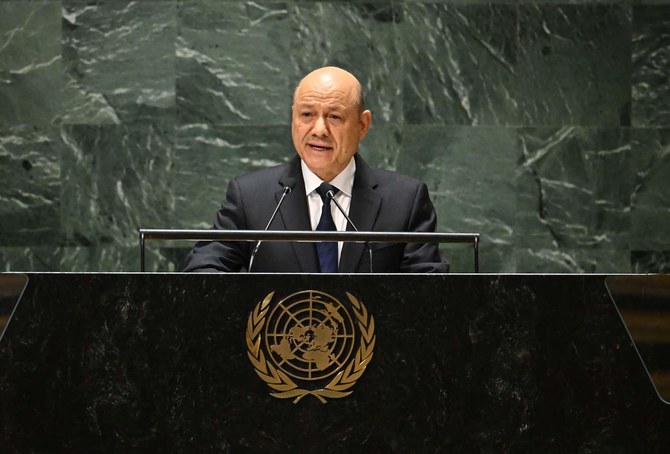
Chairman of Yemen’s Presidential Leadership Council, Rashad Al-Alimi, addresses 78th UNGA in New York City on September 21, 2023. (AFP)
Short Url
Updated 21 September 2023
Follow

International community must help stop Houthi militias: Yemeni president

  • Rashid Al-Alimi, chairman of the Presidential Leadership Council of Yemen, spoke at the UN General Assembly in New York
  • Al-Alimi condemned Houthi militia activity in his country and called for international support to end the decade-long conflict

NEW YORK: The world must do more to stop the flow of arms and resources to Iran-backed Houthi militias, Rashid Al-Alimi, the chairman of Yemen’s Presidential Leadership Council, said on Thursday.

Al-Alimi, the opening speaker at the 8th plenary meeting of the 78th UN General Assembly’s general debate in New York, strongly condemned human rights violations committed by the Houthis since the conflict erupted in Yemen almost a decade ago.

He first called for “an end to the suffering of the Yemeni people,” and commended the international community for supporting “the constitutional legitimacy, sovereignty, independence and territorial integrity of Yemen and noninterference in its international affairs.”

Al-Alimi said that despite attempted compromises and efforts by the government, “peace remains elusive” in Yemen.

“We do hope that the militias will recognize the truth — that only a state that is based on the rule of law and equal citizenship will help to make sure that our country is stable and safe. These are the demands of the legitimate government,” he said.

Al-Alimi warned that if Houthi militias are allowed to continue their insurgency unchecked, “our country may become a hotspot for exporting terrorism.”

He added: “If we deal with the militias as a de facto authority, this means that oppression, the violation of freedoms — we will not be able to eradicate this behavior easily.”

Houthi militias are using peace agreements to prolong the conflict and gain time to gather more resources, he said.

Sustaining peace and ending the war is the only way to guarantee rights, freedom and equality for the Yemeni people, and build good relations with other Gulf Cooperation Council countries, Al-Alimi said.

He called for the strengthening of the Yemeni economy via the country’s central bank in order to improve service conditions in Yemen and prevent funds from falling into the hands of the Houthis.

“The institutions of Yemen will remain underfunded and will not have the necessary resources to deal with these cross-border challenges” if funds are not directed to recognized governmental financial institutions, Al-Alimi said.

He ended his speech with a call for the international community to intervene in Yemen to end Houthi activity in the region.

“Every delay from the international community to be firmer when it comes to the Yemeni dossier will increase losses, and Houthi militias will continue with their cross-border threats. They will continue to commit grave violations of human rights,” he said.

Al-Alimi said that although the Yemeni budget and economy was strong enough to allow for the provision of adequate services for the Yemeni people at the beginning of the war, Houthi attacks on oil facilities had halted the pre-war economic momentum.

“Houthi militias recently escalated their threats, targeting navigation routes in the Red Sea and the Gulf of Aden. They’ve used these as military areas. They’ve tested new weapons. They’ve targeted commercial ships and tankers. These militias, supported by the Iranian regime, continue to destabilize the region,” he said.

Al-Alimi said that his speech took place on the ninth anniversary of the Houthi takeover in Yemen. He called on UN member states to commit to an arms embargo to stop Houthi access to weaponry such as ballistic missiles and drones.

He also thanked Saudi Arabia for a “generous donation of $1.2 billion to support our public budget,” saying that without the grant, “we would have been unable to honor our obligations, including the disbursement of salaries.”


Israel’s ‘deliberate intention of preventing births among Palestinians’ meets ‘legal criteria of Genocide Convention’: Reports

Updated 10 sec ago
Follow

Israel’s ‘deliberate intention of preventing births among Palestinians’ meets ‘legal criteria of Genocide Convention’: Reports

  • Births in Gaza fell by 41% during conflict as maternal deaths, miscarriages surged
  • ‘The destruction of maternal care in Gaza reflects the deliberate infliction of conditions of life calculated to bring about the destruction of the Palestinian people, in whole or in part’

LONDON: Births in Gaza fell by 41 percent due to Israel’s war on the territory, with the conflict resulting in catastrophic numbers of maternal deaths, miscarriages and birth complications, two reports have found.

The data on pregnant women, babies and maternity care in the war-torn Palestinian enclave also revealed a surge in newborn mortality and premature births, The Guardian reported on Wednesday.

Dangerous wartime conditions and Israel’s systematic destruction of Gaza’s health systems were blamed for the alarming statistics.

The two reports were conducted by Physicians for Human Rights, in collaboration with the University of Chicago Law School’s Global Human Rights Clinic and Physicians for Human Rights — Israel.

Researchers highlighted Israel’s “deliberate intention of preventing births among Palestinians, meeting the legal criteria of the Genocide Convention.”

The reports build on earlier findings by PHR’s Israel branch. They place the testimonies of pregnant women and new mothers within the context of health data and field reports, which recorded “2,600 miscarriages, 220 pregnancy-related deaths, 1,460 premature births, over 1,700 underweight newborns, and over 2,500 infants requiring neonatal intensive care” between January and June 2025.

PHRI’s Lama Bakri, a psychologist and project manager, said: “These figures represent a shocking deterioration from pre-war ‘normalcy,’ and are the direct result of war trauma, starvation, displacement and the collapse of maternal healthcare.

“These conditions endanger both mothers and their unborn babies, newborns, and breastfed infants, and will have consequences for generations, permanently altering families.”

She added: “Beyond the numbers, what emerges in this report are the women themselves, their voices, choices and lived realities, confronting impossible dilemmas that statistics alone cannot fully capture.”

Maternal and newborn care in Gaza has been damaged by Israel’s destruction of health infrastructure, as well as fuel shortages, blocked medical supplies, mass displacement and relentless bombardment.

As a result, survival in Gaza’s overcrowded tent encampments has become the sole option for pregnant women and new mothers.

During the first six months of Israel’s war on the territory, more than 6,000 mothers were killed, at an average of two every hour, according to UN Women estimates.

It is also believed that about 150,000 pregnant women and new mothers have been forcibly displaced by the conflict.

In the first months of last year, just 17,000 births were recorded in Gaza, a 41 percent fall compared to the same period in 2022.

The researchers examined Israel’s apparent strategy to undermine Palestinian births, highlighting a targeted strike in December 2023 on the Al-Basma IVF clinic.

The attack on Gaza’s largest fertility center destroyed about 5,000 reproductive specimens and ended a pattern of 70-100 IVF procedures each month.

The strike was deliberately designed to target the reproductive potential of Palestinians, the Independent International Commission of Inquiry later found.

“Reproductive violence constitutes a violation under international law; when carried out systematically and with them intent to destroy, it falls within the definition of genocide of the Genocide Convention,” the reports said.

“The destruction of maternal care in Gaza reflects the deliberate infliction of conditions of life calculated to bring about the destruction of the Palestinian people, in whole or in part.”