Naseem Shah is ruled out of the Cricket World Cup in a big injury blow for Pakistan

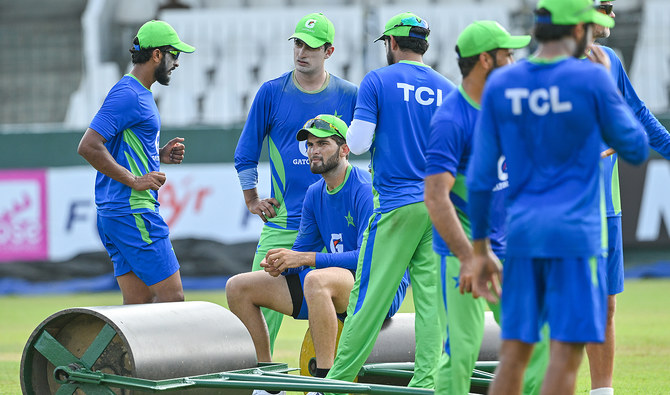
In this file photo, taken on July 23, 2023, Pakistan's Shaheen Shah Afridi (C), Naseem Shah (2L) and Hasan Ali (L) attend a practice session at the Sinhalese Sports Club (SSC) Ground in Colombo on the eve of their second Test cricket match against Sri Lanka. (AFP/File)
Short Url
Updated 22 September 2023
Follow

Naseem Shah is ruled out of the Cricket World Cup in a big injury blow for Pakistan

  • Naseem sustained shoulder injury during Asia Cup in Sri Lanka
  • Shah was replaced by Hasan Ali in a 15-member squad

ISLAMABAD: Pakistan sustained a big blow after its ace pace bowler Naseem Shah was ruled out of the Cricket World Cup on Friday due to a right shoulder injury.
Naseem sustained the injury during the Asia Cup in Sri Lanka. He was replaced by Hasan Ali in a 15-member squad announced on Friday. The World Cup starts on Oct. 5 in India.
Hasan played his last ODI in June last year against the West Indies but was dropped due to his indifferent form in 50-overs cricket.
“Hasan is an experienced bowler and has performed well in mega events in the past,” chief selector Inzamam-ul-Haq said in Lahore while announcing the squad.
“We were forced to make one change because of an unfortunate injury to Naseem Shah. We needed someone who could bowl with the new ball. He (Hasan) bowls well with both old and new ball, and is a team man. His presence lends energy to the team.”
The Pakistan Cricket Board said Naseem has been advised to undergo surgery, following a thorough medical examination and consultations with leading medical experts and is expected to recover in three to four months. It means the mercurial fast bowler is certain to miss a test series against Australia after the World Cup.
There were doubts over the fitness of fast bowler Haris Rauf, who missed out the last Super 4 game against Sri Lanka after sustaining an injury during the game against India.
“We had a few injury scares in the recent Asia Cup, but I am glad to share that all the players are fully fit and are eager to perform for their country in the all-important tournament,” Inzamam said.
“I have received encouraging reports from our medical panel about Haris Rauf. He has started to (shadow) bowl at the National Cricket Academy and will be available for selection.”
The core of the Pakistan team is the same which competed in the recent Asia Cup under captain Babar Azam, but couldn’t qualify for the final after losing to archrival India and Sri Lanka in the Super 4 portion of the tournament.
Spin all-rounders Shadab Khan and Mohammad Nawaz both retained their places in the side with leg-spinner Usama Mir as the other spin option for Pakistan. Pakistan didn’t tinker with its batting lineup with left-hander test specialist Saud Shakeel as the only surprise inclusion in the 15-member side.
Pakistan is scheduled to play two warm-up games against New Zealand and Australia before it takes on the Netherlands in its opening World Cup game on Oct. 6 at Hyderabad.
___
Pakistan squad: Babar Azam (captain), Imam-ul-Haq, Fakhar Zaman, Abdullah Shafique, Saud Shakeel, Salman Ali Agha, Iftikhar Ahmed, Mohammad Rizwan, Shadab Khan, Mohammad Nawaz, Hasan Ali, Mohammad Wasim, Shaheen Shah Afridi, Haris Rauf, Usama Mir. Reserves: Zaman Khan, Abrar Ahmed, Mohammad Haris.


Pakistan launches first skills impact bond to fund training with private capital

Updated 8 sec ago
Follow

Pakistan launches first skills impact bond to fund training with private capital

  • New $3.57 million pilot ties investor returns to job placement and retention outcomes
  • The program aims to upskill youth at scale, with 40 percent of trainees targeted to be women

KARACHI: Pakistan on Tuesday launched its first-ever Pakistan Skills Impact Bond (PSIB), a private-capital-funded instrument aimed at financing technical training by linking investor repayments to measurable employment outcomes, as the government seeks new ways to upskill its rapidly growing workforce without relying solely on public spending.

The Rs 1 billion ($3.57 million) pilot tranche, backed by a government guarantee, is part of a three-year program designed to fund skills training through an outcome-based model, under which investors are repaid only if trainees achieve results such as certification, job placement and at least six months of employment retention.

Social impact bonds are a form of results-based financing in which private investors provide upfront capital for social programs, while governments or donors repay them only if agreed performance targets are met. Pakistan’s skills bond is intended to shift training finance away from traditional input-based budgets toward a market-oriented approach that rewards verified outcomes and crowds in private investment.

“Speaking at the event, Senator Muhammad Aurangzeb, Federal Minister for Finance and Revenue, underscored the transformational importance of the PSIB in Pakistan’s broader economic reform agenda and human capital strategy,” the finance division said in a statement. “He described the day as ‘an important moment focused on education and training,’ reiterating that Pakistan’s demographic dividend can only be realized if the country succeeds in upskilling and reskilling its youth at scale.”

The program is anchored in collaboration with the National Vocational and Technical Training Commission (NAVTTC) and is expected to evolve over time, with later tranches potentially linking repayments to a small share of trainees’ future earnings, a move officials say could help make the model financially self-sustaining.

The bond forms part of a broader government push to adopt social impact financing across priority areas including education, gender equality, health, climate resilience and poverty reduction, the statement said.

“Highlighting gender inclusion as central to the program design, the Finance Minister welcomed the recommendation led by the British Asian Trust that 40 percent of trainees under the PSIB be women, acknowledging that women’s participation and leadership in the workforce will play a decisive role in shaping Pakistan’s economic trajectory,” it added.

The Ministry of Finance has provided the initial guarantee to help establish credibility and attract investors, but has stressed the support is limited to the pilot phase.

The government has noted the model is intended to support Pakistan’s large youth population by aligning training with labor market demand, including high-value digital skills, while reducing long-term pressure on public finances.

The launch ceremony was attended by senior government officials, development partners, private sector representatives and international organizations involved in structuring and financing the bond.