

Pakistan’s anti-graft body to reopen corruption cases against former public office holders

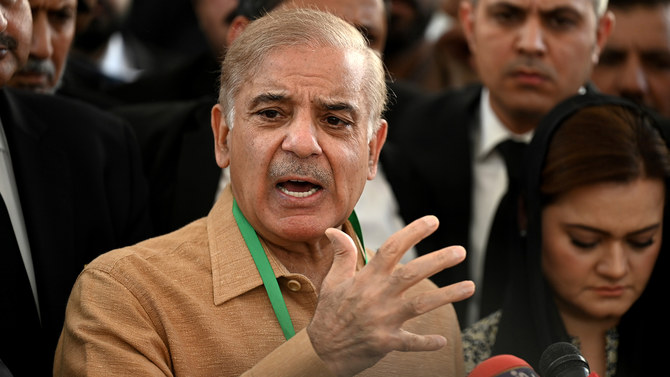
In this file photo, taken on April 5, 2022, Pakistan's former prime minister Shehbaz Sharif (C) addresses the members of the media before attending a hearing outside the Supreme Court building in Islamabad. (AFP/File)
Short Url
Updated 21 September 2023
Follow

Pakistan’s anti-graft body to reopen corruption cases against former public office holders

  • The country’s top court ordered the reinstatement of cases against suspects who embezzled less than Rs500 million
  • Corruption cases against public officials were dismissed following amendments to the legal accountability framework

ISLAMABAD: Pakistan’s anti-graft body is seeking to reopen cases involving former government officials accused of embezzling less than Rs500 million, said the local media on Thursday, as the South Asian nation gears up for general elections in January next year.

The Supreme Court of Pakistan gave a verdict last week to reinstate corruption references against public office holders that were dismissed after the administration of former prime minister Shehbaz Sharif made amendments to the country’s accountability laws. These amendments specified that the National Accountability Bureau (NAB) would not investigate corruption cases that involved less than Rs500 million.

According to local media reports, NAB has asked various authorities, including the Federal Investigation Agency (FIA), provincial anti-corruption units, banking courts, and the police, to return the corruption references that had been transferred to them as a result of the amendments.

Some of these cases involve high-profile individuals, such as former prime ministers Nawaz Sharif, Imran Khan, Shehbaz Sharif, Yousuf Raza Gilani, Raja Pervez Ashraf, Shahid Khaqan Abbasi, and Shaukat Aziz.

“The NAB headquarters has submitted an application before the registrar [of] accountability court Islamabad for [the] reopening of closed cases,” Pakistan’s Dawn newspaper said, citing a NAB source.

The exact count of the cases that are expected to be reopened following the top court’s verdict is still not clear, though an estimate suggests they are likely to be between 1,600 to 1,800 cases.

Aside from the former premiers, other prominent politicians whose cases are expected to be reopened include former president Asif Ali Zardari, former federal ministers Khawaja Saad Rafiq, Khawaja Asif, and Rana Sanaullah, among others.

The development comes at a time when Pakistan is gearing up for the next general elections which will be held in January amid heightened political, economic, and security crises in the country.


Pakistan, Iran resolve to strengthen trade cooperation, work for regional peace

Updated 4 sec ago
Follow

Pakistan, Iran resolve to strengthen trade cooperation, work for regional peace

  • Pakistan Foreign Minister Ishaq Dar speaks to Iranian counterpart Seyyed Abbas Araghchi
  • Pakistan, Iran have attempted to enhance bilateral trade to $10 billion in recent years

ISLAMABAD: The foreign ministers of Iran and Pakistan vowed on Sunday to strengthen bilateral cooperation in trade, connectivity, various other sectors and work for regional peace, the Pakistani foreign ministry said in a statement.

Pakistan and Iran have attempted to enhance bilateral trade and commerce in recent years. The two neighbors have set up border markets and discussed barter trade to get around banking and currency restrictions.

Sanctions and foreign exchange shortages remain key hurdles for Iran, making barter systems and cross-border markets central to its trade strategy with Pakistan.

Deputy Prime Minister Ishaq Dar, who also serves as Pakistan’s foreign minister, spoke to Iran’s Foreign Minister Seyyed Abbas Araghchi over the phone on Sunday during which the two discussed regional developments. 

“Both leaders reaffirmed their commitment to further strengthening cooperation in trade, connectivity and people-to-people ties, and reiterated their resolve to work closely together for regional peace and development,” the Pakistani foreign office said in a statement. 

Pakistan and Iran have attempted to enhance bilateral trade to $10 billion. However, apart from sanctions and foreign exchange shortages, ties between the two countries remain complicated due to security issues. 

Pakistan and Iran have remained at odds over instability along their shared, porous border that even led to a missile exchange between them in 2024. Both countries, however, were quick to move to ease tensions.

Iranian President Dr. Masoud Pezeshkian visited Pakistan in August this year, during which the two countries signed agreements to enhance bilateral trade to $10 billion by 2028. 

Both countries have also consistently criticized Israel for its war on Gaza and repeated violations of a fragile ceasefire brokered by world powers, including the US.