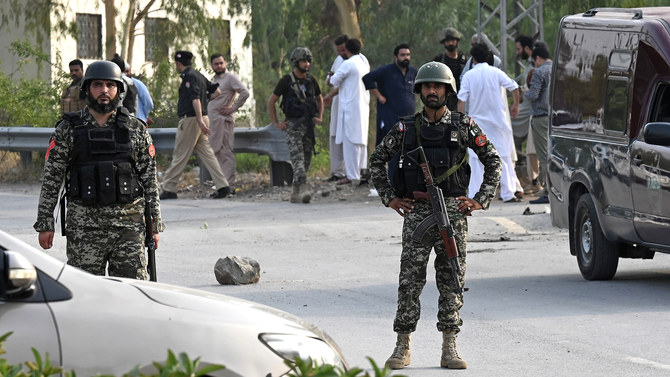
ISLAMABAD: Pakistani security forces on Thursday killed eight militants and arrested five others in two separate intelligence-based operations in the northwestern Khyber Pakhtunkhwa province, the army’s media wing said in a statement.
According to the Inter-Services Public Relations (ISPR), the first operation was conducted in the Jani Khel area of the Bannu district in which six militants were killed and five were taken into custody.
The second operation was carried out in the Datta Khel area of North Waziristan district, killing two militants after an intense exchange of fire.
Datta Khel was part of the erstwhile Federally Administered Tribal Areas (FATA) of the country which were later merged with the province of Khyber Pakhtunkhwa in 2018. The area used to be a stronghold of Tehreek-e-Taliban Pakistan (TTP) militants who carried out some of the deadliest attacks against Pakistani security forces.
The TTP is distinct from the Afghan Taliban, though its leaders have taken oath of allegiance to the administration in Kabul.
“On 21 September 2023, security forces conducted intelligence-based operations in two districts of Khyber Pakhtunkhwa, which resulted in the killing of eight terrorists and the apprehension of five terrorists and their facilitators,” the ISPR said.
It added the slain militants from Bannu were involved in numerous “terrorist” activities against the security forces, including the facilitation of a motorcycle-borne suicide attack on a military convoy in Jani Khel on August 23, in which nine soldiers were killed.
“Weapons and ammunition were also recovered from killed terrorists, [while] the sanitization of the surrounding areas is being carried out to neutralize any other terrorist found in the area,” the ISPR statement added. “Security forces of Pakistan remain determined to eliminate the menace of terrorism.”
Militancy in Pakistan witnessed a significant decline due to the army’s operations conducted in these areas in the past.
Following the return of Afghan Taliban to power in 2021, however, there has been a significant increase in attacks in regions along the Pakistan-Afghanistan border.
This surge was primarily witnessed after a fragile truce between the TTP and the government in Islamabad collapsed in November last year.


Security forces kill eight militants, detain five in northwest Pakistan — army
https://arab.news/9rmnx
Security forces kill eight militants, detain five in northwest Pakistan — army

- Pakistan army says militants were killed in two separate operations in Bannu and North Waziristan districts
- It maintains these militants were involved in numerous ‘terrorist’ activities against the country’s security forces

Afghanistan fires at Pakistani jets over Kabul as conflict intensifies
- Violence follows air strikes inside Afghanistan this week Pakistan says targeted militant infrastructure
- Pakistan says operation against Afghan forces ongoing, security forces destroyed Afghan posts, camps
KABUL: Afghanistan said it was firing at Pakistani jets in Kabul after blasts and gunfire rocked the capital on Sunday, compounding instability in a region rattled by US–Israeli strikes on Iran and retaliatory attacks on US targets in Gulf states.
The Taliban-ruled state has suffered Pakistani strikes against government installations over the past week following accusations, which it denies, that it harbors militants.
The heaviest fighting in years between the neighbors has raised fears of a protracted conflict along their 2,600-km (1,615-mile) border, with several countries including Qatar and Saudi Arabia calling for restraint and offering to help mediate a ceasefire.
Explosions echoed across parts of Kabul before sunrise, followed by bursts of gunfire, a Reuters witness said. It was not clear what had been targeted or whether there were casualties.
Taliban administration spokesperson Zabihullah Mujahid said the sounds were the result of Afghan forces targeting Pakistani aircraft over the capital.
“Air defense attacks were carried out in Kabul against Pakistani aircraft. Kabul residents should not be concerned,” Mujahid said.
Pakistan’s prime minister’s office, information ministry and military did not respond to requests for comment.
The violence follows air strikes inside Afghanistan this week that Pakistan said targeted militant infrastructure. Afghanistan described the strikes as a violation of sovereignty and announced retaliatory operations along their shared border.
Iran, which shares borders with both Afghanistan and Pakistan, had offered to help facilitate dialogue before itself coming under attack on Saturday from Israel and the US bent on diminishing Iran’s military capability.
ACCUSATION AND ESCALATION
Pakistan has said Afghanistan harbors Tehreek-e-Taliban Pakistan (TTP) militants, which it said are waging an insurgency inside Pakistan.
Afghanistan has denied the accusation, saying it does not allow Afghan territory to be used against other countries and that Pakistan’s security challenges are an internal matter.
Pakistani security sources have said operation “Ghazab Lil Haq,” meaning “Wrath for the Truth,” was ongoing and that Pakistani forces had destroyed Afghan posts and camps.
Both sides have reported heavy losses, issuing differing casualty figures for each other.
Reuters could not independently verify the claims.
Diplomatic efforts have intensified, with Saudi Arabia, Russia, China, the European Union and United Nations urging restraint and calling for talks.
The US said it supports Pakistan’s right to defend itself.
Pakistan Defense Minister Khawaja Muhammad Asif described the fighting as “open war.”
Afghanistan Interior Minister Sirajuddin Haqqani said the conflict would be “very costly.” He said only front-line forces were engaged in fighting that the country has yet to fully deploy its military.


