

Pakistani PM briefs UN chief on economic recovery plans, new investment council

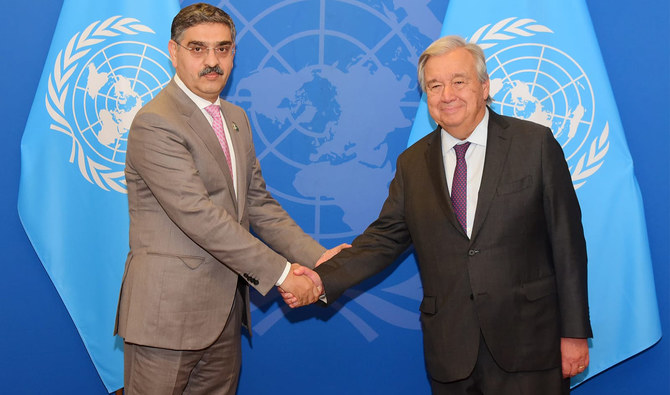
Pakistan’s caretaker Prime Minister Anwaar-ul-Haq Kakar (left) meets United Nations Secretary-General Antonio Guterres in New York, US, on September 20, 2023. (@PakPMO/Twitter)
Short Url
Updated 21 September 2023
Follow

Pakistani PM briefs UN chief on economic recovery plans, new investment council

  •  Kakar is in New York where he will address the UNGA session on Friday
  • Expressing gratitude to Guterres for his support during last year’s floods

ISLAMABAD: Pakistan’s caretaker Prime Minister Anwaar-ul-Haq Kakar met United Nations Secretary-General Antonio Guterres in New York and discussed the challenge of economic recovery and a new Special Investment Facilitation Council (SIFC) set up in June to attract funding from foreign countries, the PM Office said on Thursday.

Kakar arrived in the United States on September 19 to participate in the 78th United Nations General Assembly (UNGA) session. He will address the session on Friday, September 22.

In his meeting with Guterres on Wednesday, Kakar discussed Pakistan’s economic recovery and initiatives to attract both domestic and international investments.

“The Prime Minister updated the UNSG on the newly established Special Investment Facilitation Council (SIFC), which has the objective of promoting investments into Pakistan for the robust economic recovery of the country,” the statement said.

Pakistan set up the SIFC — a civil-military hybrid forum — to attract foreign funding, particularly from GCC nations, in agriculture, mining, information technology, defense production and energy.

Expressing gratitude to Guterres for his support during last year’s devastating floods and for his co-hosting of the Geneva Conference on Pakistan’s Resilient Recovery, Rehabilitation, and Reconstruction Framework (4RF), the prime minister emphasized the need for developed nations to fulfill their climate finance commitments.

Kakar also participated in a high-level dialogue on “Financing for Development,” convened by the General Assembly, on Wednesday in which he called upon the UN to formulate a strategy for global equitable development and to give debt relief and financial support to developing nations.

“We must fulfill the commitments made at the SDGs Summit, and to achieve the SDGs, we must engage the private sector,” Kakar was quoted as saying by the state-owned Associated Press of Pakistan.

He expressed concern about the disproportionate concentration of private-sector investment in developed economies over developing nations.

“An institution focused on public-private partnerships could be established under the auspices of the United Nations,” he said.


Pakistan army chief assumes role as first Chief of Defense Forces, signaling unified command

Updated 5 sec ago
Follow

Pakistan army chief assumes role as first Chief of Defense Forces, signaling unified command

  • New role is held simultaneously with Gen Asim Munir’s existing position as Chief of Army Staff
  • It is designed to centralize operational planning, war-fighting doctrine, modernization across services

ISLAMABAD: Pakistan’s most senior military officer, Field Marshal Syed Asim Munir, formally took charge as the country’s first Chief of Defense Forces (CDF) on Monday, marking a structural change in Pakistan’s defense command and placing the army, navy and air force under a single integrated leadership for the first time.

The new role, held simultaneously with Munir’s existing position as Chief of Army Staff, is designed to centralize operational planning, war-fighting doctrine and modernization across the services. It reflects a trend seen in several advanced militaries where a unified command oversees land, air, maritime, cyber and space domains, rather than service-level silos.

Pakistan has also established a Chief of Defense Forces Headquarters, which Munir described as a “historic” step toward joint command integration.

In remarks to officers from all three forces after receiving a tri-services Guard of Honor at the General Headquarters (GHQ) in Rawalpindi, Munir said the military must adapt to new theaters of conflict that extend far beyond traditional ground warfare.

He stressed the need for “a formalized arrangement for tri-services integration and synergy,” adding that future war will involve emerging technologies including cyber operations, the electromagnetic spectrum, outer-space platforms, information warfare, artificial intelligence and quantum computing.

“He termed the newly instituted CDF Headquarters as historic, which will afford requisite integration, coherence and coordination to meet the dynamics of future threat spectrum under a tri-services umbrella,” the military quoted Munir as saying in a statement. 

The ceremony also included gallantry awards for Pakistan Navy and Air Force personnel who fought in Marka-e-Haq, the brief May 2025 conflict between Pakistan and India, which Pakistan’s military calls a model for integrated land, air, maritime, cyber and electronic combat. During his speech, Munir paid tribute to the personnel who served in the conflict, calling their sacrifice central to Pakistan’s defense narrative.

The restructuring places Pakistan closer to command models used by the United States, United Kingdom and other nuclear-armed states where a unified chief directs inter-service readiness and long-range war planning. It also comes at a time when militaries worldwide are re-engineering doctrine to counter threats spanning satellites, data networks, information space and unmanned strike capabilities.