

Canada gathers allies as tensions rise with India over Sikh leader’s murder

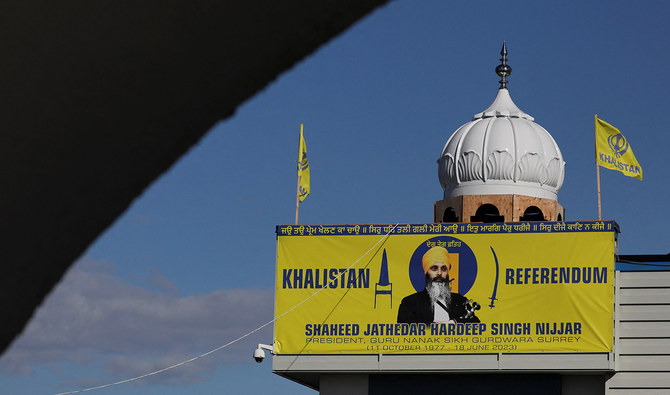
A banner with the image of Sikh leader Hardeep Singh Nijjar is seen at the Guru Nanak Sikh Gurdwara temple, site of his June 2023 killing, in Surrey, British Columbia, Canada September 20, 2023. (REUTERS)
Short Url
Updated 21 September 2023
Follow

Canada gathers allies as tensions rise with India over Sikh leader’s murder

  • Trudeau’s rare attack just days after Delhi hosted G20 Summit is putting Western nations in awkward position
  • Britain has refused to publicly criticize India, White House encourages India to cooperate with investigation

OTTAWA: Canada this week divulged it had intelligence possibly linking Indian government agents to the murder of a separatist Sikh leader, the kind of news that usually sparks uproar among democratic allies. Not this time.

India is being courted by the United States and others as a counterweight to China, and Prime Minister Justin Trudeau’s rare attack just days after New Delhi hosted a G20 Summit is putting Western nations in an awkward position.

“India is important in Western calculations for balancing China, and Canada is not,” said Stephanie Carvin, a professor of international relations at Ottawa’s Carleton University.

“This really does put Canada offside among all other Western countries,” she said.

Trudeau announced on Monday that Canada was “actively pursuing credible allegations” that Indian agents had potentially been involved in the murder of Canadian citizen Hardeep Singh Nijjar in June.

At that point Ottawa had already been discussing the matter with key allies such as the Five Eyes intelligence sharing alliance, which also includes the United States, Britain, Australia and New Zealand.

The results so far have been muted. Britain refused to publicly criticize India and said bilateral trade talks will continue as planned. Indeed, a statement from Foreign Secretary James Cleverly about the affair did not mention India by name.

Britain is in a difficult position, caught between supporting Canada and antagonizing India, a country it wants as a trading partner and ally to help confront China, said Chietigj Bajpaee, India expert at the Chatham House think tank in London.

“Short of there being any definitive evidence of India’s involvement, I think the UK response is likely to remain muted,” he said. A free trade deal would be a “major political win” for both India and Britain, Bajpaee said.

'WAITING GAME'

White House national security adviser John Kirby said the United States was “deeply concerned” and encouraged Indian officials to cooperate in any investigation. India rejects the idea it was involved in the murder.

The Washington Post reported Trudeau had pushed for a joint statement condemning India at last week’s Group of 20 summit in New Delhi and was turned down by the United States and others.

Kirby said “any reports that we rebuffed Canada in any way whatsoever are false, and we will continue to coordinate and consult with them on this.”

The muted response to Trudeau’s allegations is stark when compared to the uproar after Russian double agent Sergei Skripal and his daughter Yulia were poisoned by nerve agent in England in 2018. Britain, the United States, Canada and others threw out more than 100 Russian diplomats to punish Moscow for an attack it has always denied carrying out.

“Our Five Eyes partners are understandably reluctant to really wade into this, given everybody’s interest in advancing ties with India, in the context of the ongoing tension with China,” said Wesley Wark of the Center for International Governance Innovation think tank in Waterloo, Ontario.

“It’s a bit of a waiting game. If the Canadians come up with very solid evidence about egregious Indian state involvement in an assassination attempt, I think we’ll hear more from our allies in support,” he said.

With allies unwilling to contemplate any kind of joint condemnation of India, the Canadian options now look limited, at least until it can provide incontrovertible evidence.

“If we don’t get our allies to support this, either publicly or privately, Canada’s not going to be able to do a great deal to move India,” said Richard Fadden, former head of the Canadian Security Intelligence Service.

“And I think the greatest thing we can aspire to in the short term or the medium term is to get India not to do this again,” he told CTV.

Canadian government sources indicated they would have preferred to wait longer before making a statement but felt they had to act, given some domestic media outlets were about to break the story.

Trudeau would have never spoken “out loud if we didn’t have the information lining up into a fact base,” said one source, adding that they hoped more information would come soon.

Canada has not made public the intelligence it has because there is an active murder investigation, the senior source said.

“On the cusp of the global opportunity for India, they absolutely need to handle this responsibly — for their own interests,” the source said.


Power outages hit Ukraine and Moldova as Kyiv struggles against the winter cold

Updated 10 sec ago
Follow

Power outages hit Ukraine and Moldova as Kyiv struggles against the winter cold

  • Outages had been caused by a technical malfunction affecting power lines linking Ukraine and Moldova
  • Blackouts were reported in Kyiv, as well as Zhytomyr and Kharkiv regions

KYIV: Emergency power cuts swept across several Ukrainian cities as well as neighboring Moldova on Saturday, officials said, amid a commitment from the Kremlin to US President Donald Trump to pause strikes on Kyiv as Ukraine battles one of its bleakest winters in years.
Ukraine’s Energy Minister Denys Shmyhal said that the outages had been caused by a technical malfunction affecting power lines linking Ukraine and Moldova.
The failure “caused a cascading outage in Ukraine’s power grid,” triggering automatic protection systems, he said.
Blackouts were reported in Kyiv, as well as Zhytomyr and Kharkiv regions, in the center and northeast of the country respectively. The outage cut water supplies to the Ukrainian capital, officials said, while the city’s subway system was temporarily suspended because of low voltage on the network.
Moldova also experienced major power outages, including in the capital Chisinau, officials said.
“Due to the loss of power lines on the territory of Ukraine, the automatic protection system was triggered, which disconnected the electricity supply,” Moldova’s Energy Minister Dorin Junghietu said in a post on Facebook. “I encourage the population to stay calm until electricity is restored.”
Weaponizing winter
The large-scale outage followed weeks of Russian strikes against Ukraine’s already struggling energy grid, which have triggered long stretches of severe power shortages.
Moscow has sought to deny Ukrainian civilians heat, light and running water over the course of the war, in a strategy that Ukrainian officials describe as “weaponizing winter.”
While Russia has used similar tactics throughout the course of its almost four-year invasion of Ukraine, temperatures throughout this winter have fallen further than usual, bringing widespread hardship to civilians.
Forecasters say Ukraine will experience a brutally cold period stretching into next week. Temperatures in some areas will drop to minus 30 degrees Celsius (minus 22 Fahrenheit), Ukraine’s State Emergency Service said.
Trump said late Thursday that President Vladimir Putin had agreed to a temporary pause in targeting Kyiv and other Ukrainian towns amid the extreme weather.
“I personally asked President Putin not to fire on Kyiv and the cities and towns for a week during this ... extraordinary cold,” Trump said during a Cabinet meeting at the White House. Putin has “agreed to that,” he said, without elaborating on when the request to the Russian leader was made.
The White House didn’t immediately respond to a query seeking clarity about the scope and timing of any limited pause.
Kremlin spokesperson Dmitry Peskov confirmed Friday that Trump “made a personal request” to Putin to stop targeting Kyiv until Sunday “in order to create favorable conditions for negotiations.”
Talks are expected to take place between US, Russian and Ukrainian officials on Feb. 1 in Abu Dhabi. The teams previously met in late January in the first known time that officials from the Trump administration simultaneously met with negotiators from both Ukraine and Russia. However, it’s unclear many obstacles to peace remain. Disagreement over what happens to occupied Ukrainian territory, and Moscow’s demand for possession of territory it hasn’t captured, are a key issue holding up a peace deal, Zelensky said Thursday.
Russian presidential envoy Kirill Dmitriev said on social media Saturday that he was in Miami, where talks between Russian and US negotiators have previously taken place.
Russia struck Ukrainian energy assets in several regions on Thursday but there were no strikes on those facilities overnight, Ukraine’s President Volodymyr Zelensky said Friday.
In a post on social media, Zelensky also noted that Russia has turned its attention to targeting Ukrainian logistics networks, and that Russian drones and missiles hit residential areas of Ukraine overnight, as they have most nights during the war.
Trump has framed Putin’s acceptance of the pause in strikes as a concession. But Zelensky was skeptical as Russia’s invasion approaches its fourth anniversary on Feb. 24 with no sign that Moscow is willing to reach a peace settlement despite a US-led push to end the fighting.
“I do not believe that Russia wants to end the war. There is a great deal of evidence to the contrary,” Zelensky said Thursday.